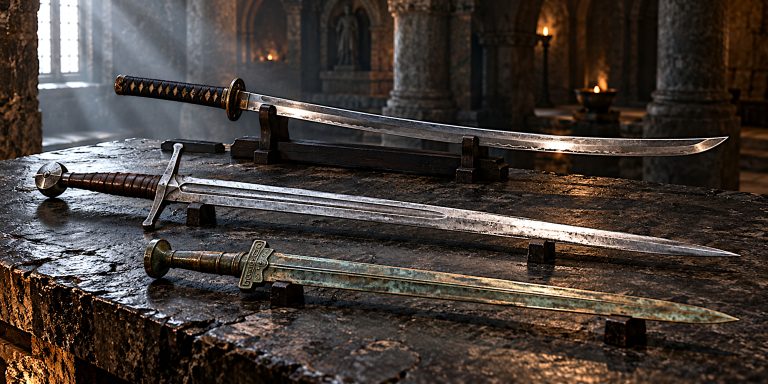
The medieval arms race was not a neat contest in which every new weapon immediately produced a better suit of armour. It was a long, uneven process shaped by wealth, materials, tactics and the people who had to use the equipment. A sword that worked well against an unarmoured opponent might struggle against mail. A crossbow could threaten at range, while a well-made breastplate could blunt many missile strikes. The battlefield kept changing, and armourers and weapon-makers had to keep up.
The story runs from the mail-clad warriors of the early Middle Ages to the plate-armoured men-at-arms and gunpowder weapons of the fifteenth century. It is a history of practical adaptation, not a simple march towards ever-heavier armour and ever-deadlier weapons.
What do we mean by a medieval arms race?
The phrase “arms race” is useful, provided we do not take it too literally. Medieval Europe had no single military system, central research programme or steady stream of standardised equipment. Weapons and armour varied by region, period, wealth and military role. A mounted noble, a town militia archer and a professional crossbowman did not face the same problems or carry the same kit.
Still, changes in one area could put pressure on another. Stronger bows and crossbows encouraged better body protection. More complete armour shifted attention towards weapons that could strike with force or reach vulnerable openings. Siege engines prompted stronger walls, while gunpowder artillery eventually made old fortifications increasingly costly to defend.
The changes also reflected tactics, training and supply. A weapon’s value depended on who could afford it, who knew how to use it and how it fitted into a larger force. Medieval warfare was not a catalogue of clever objects. It was a system of people, money, craft and violence, with the occasional very expensive horse.
Mail, shields and the early medieval battlefield
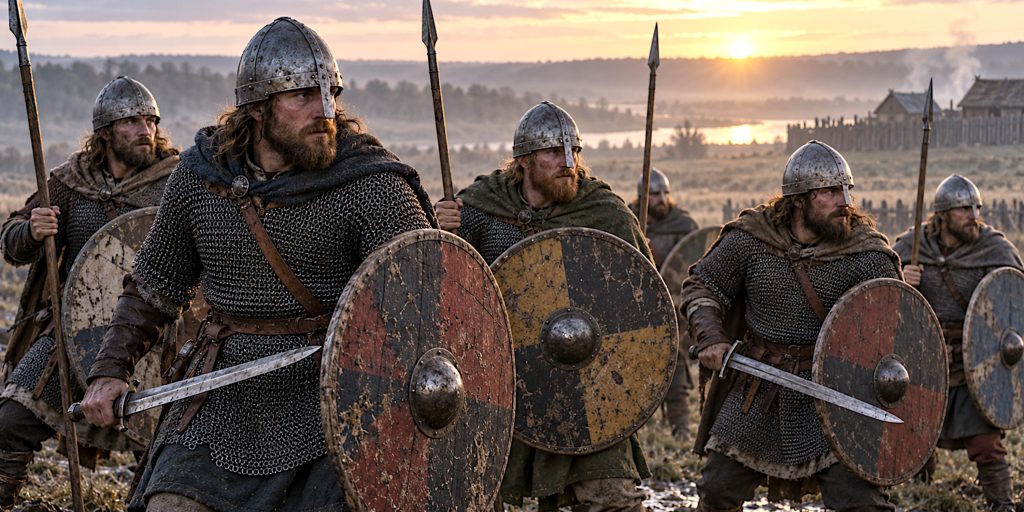
For much of the early Middle Ages, mail offered wealthy warriors flexible protection against cuts. Helmets, shields and padded clothing added further defence. Mail did not make its wearer invulnerable: it could be pierced in some circumstances, and even a blow that failed to break the links could still injure the person beneath. Protection depended on the quality of the mail, what lay underneath it and where the strike landed.
Swords remained valued sidearms, but they were not universal answers to every opponent. Spears were widely useful and relatively economical to equip and maintain. Axes could deliver powerful blows, while bows gave armies a way to threaten from a distance. A warrior’s equipment worked as a combination, rather than as a personal collection of dramatic finishing moves.
Shields were central to many styles of fighting. They protected a large area, helped form defensive lines and could be used actively in close combat. The relationship between sword and shield is easy to miss when popular images focus on the sword alone. In practice, the shield often did as much to keep its owner alive.
Better missiles, better protection
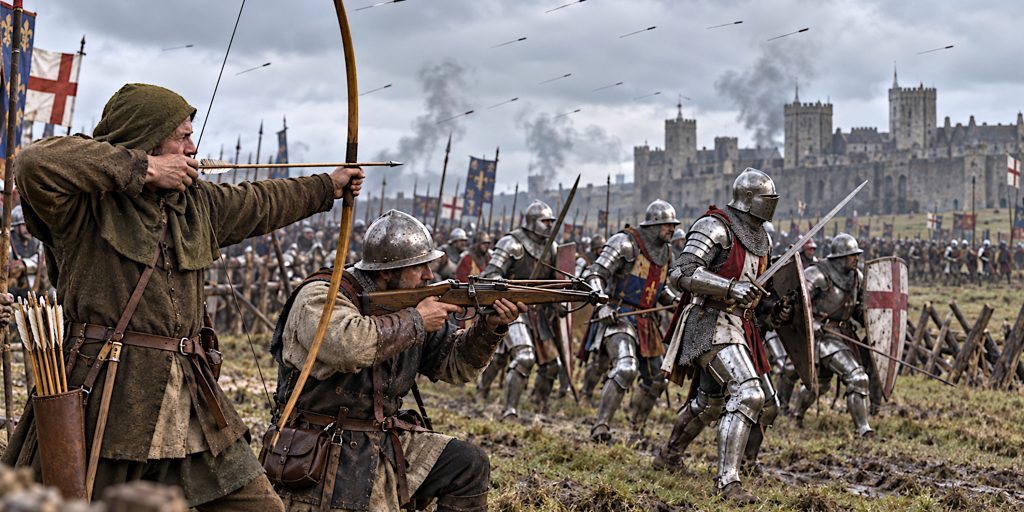
Bows and crossbows placed growing demands on armourers, especially as crossbows developed stronger mechanisms. In the fourteenth and fifteenth centuries, steel crossbow prods and devices such as windlasses made it possible to draw more powerful weapons. The trade-off was time: stronger crossbows generally took longer to span than a bow, and their use depended on the mechanisms and training available.
The longbow had different strengths. It could be fired more rapidly by a trained archer, but that skill took years to develop. At Crécy in 1346, Froissart’s account describes English arrows striking men-at-arms and their horses. He wrote that “the sharp arrows ran into the men of arms and into their horses.” The passage captures the danger of concentrated missile fire, but it should not be read as proof that arrows routinely pierced the best plate armour. Armour could protect effectively; volleys could still disrupt formations, injure horses and find less protected targets.
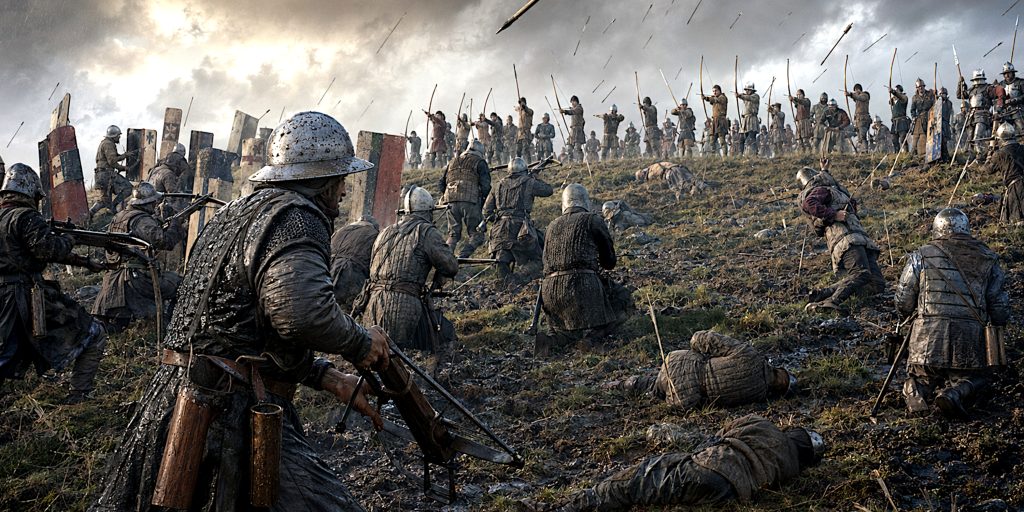
As ranged weapons improved, armour developed from mail reinforced with small plates towards more extensive plate protection. By the early fifteenth century, wealthy men-at-arms could wear articulated plate over much of the body. This was not a sudden replacement of mail. Mail remained useful, particularly at joints and under plate, where flexible protection was still needed.
The shift was gradual and varied across Europe. Research on medieval shooting and defensive arms describes a marked acceleration in their development from the late thirteenth through the fifteenth century, while also stressing that tactics and broader technological change mattered alongside weapons themselves.
Plate armour and the changing role of the sword
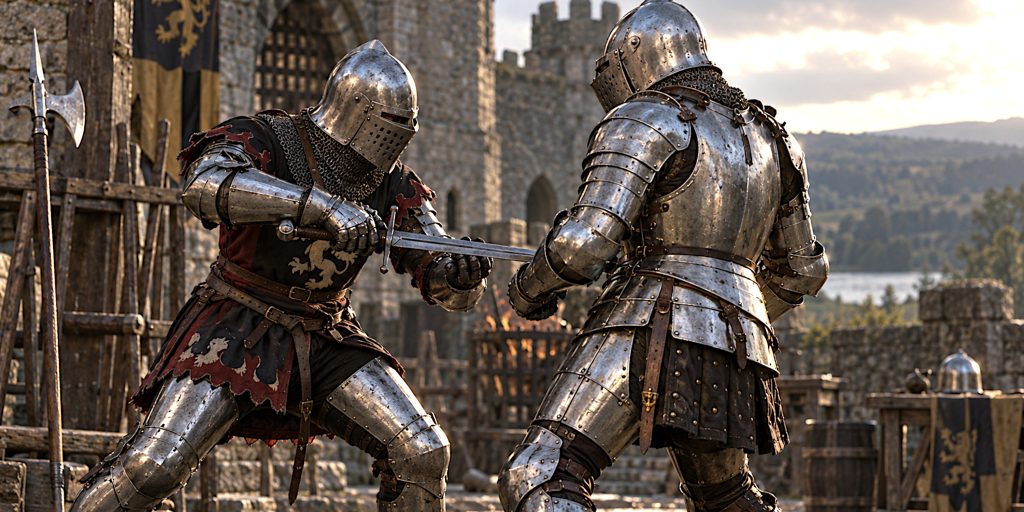
Well-made plate armour made ordinary cutting attacks less reliable. That did not make swords obsolete. It changed how they were used.
Later medieval swords included forms with narrower, more tapered blades suited to thrusting, but the idea that the longsword was invented simply to punch through plate is too tidy. Against a fully armoured opponent, fighters could use the sword in close combat, grip it with both hands on the blade for control, and target openings around the joints, visor and other vulnerable areas. The sword remained versatile, but it was one part of a larger toolkit.
Polearms were especially useful against armoured opponents. The poleaxe combined striking surfaces and points in a weapon that could deliver powerful blows or thrusts. Hammers and axes could concentrate force, while hooks and spikes offered ways to unbalance or control an opponent. Daggers, including the rondel dagger, were carried as close-range weapons and could be used against gaps in armour.
This was not a clean change from “swords” to “anti-armour weapons”. Soldiers carried what suited their status and role, and battlefield choices depended on circumstance. Armour itself also remained mobile enough for skilled men-at-arms to fight on foot or horseback. Its weight was spread across the body and its joints were designed to move. It was restrictive compared with ordinary clothing, certainly, but not the immovable metal shell of popular imagination.
Castles, siege engines and the arms race beyond the battlefield
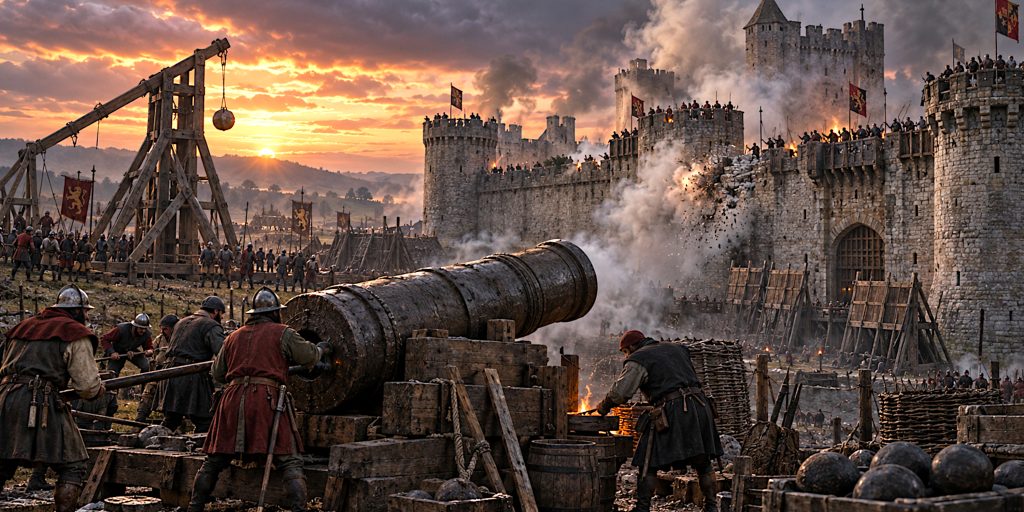
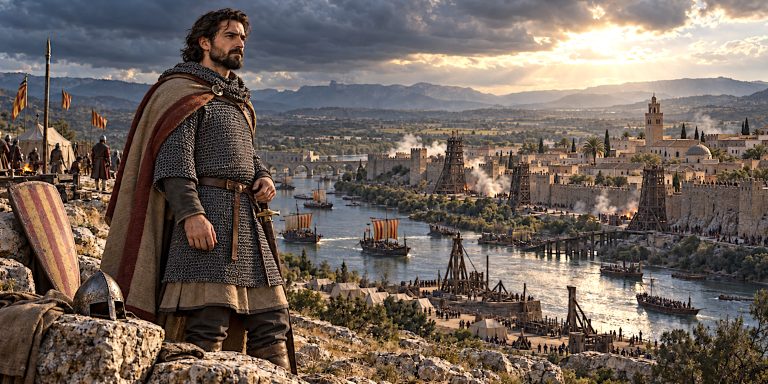
The arms race played out around fortifications as well as on open ground. Before gunpowder artillery became influential, attackers used trebuchets, rams, mining and blockade. Defenders strengthened walls, built towers and used archers and crossbowmen to make an assault costly.
A siege was often a contest of time, supplies and money. A large engine could damage walls, but building, transporting and operating it required labour and resources. If an assault failed, an army might try to starve a garrison into surrender instead. English Heritage notes that sieges demanded substantial manpower and planning, and could end in assault, negotiated surrender or withdrawal.
Gunpowder artillery gradually changed this balance. Early bombards were cumbersome and unreliable by later standards, but they added a new threat to walls that had been designed to resist older siege methods. Fortifications adapted in turn. The relationship was not instant: castles and guns coexisted for centuries, and the result depended on the size of the artillery, the strength of the walls and the resources available to both sides.
The Royal Armouries’ overview of the Hundred Years’ War covers the changing use of longbows, crossbows and siege engines, including the gradual move towards artillery.
Gunpowder and the late medieval balance
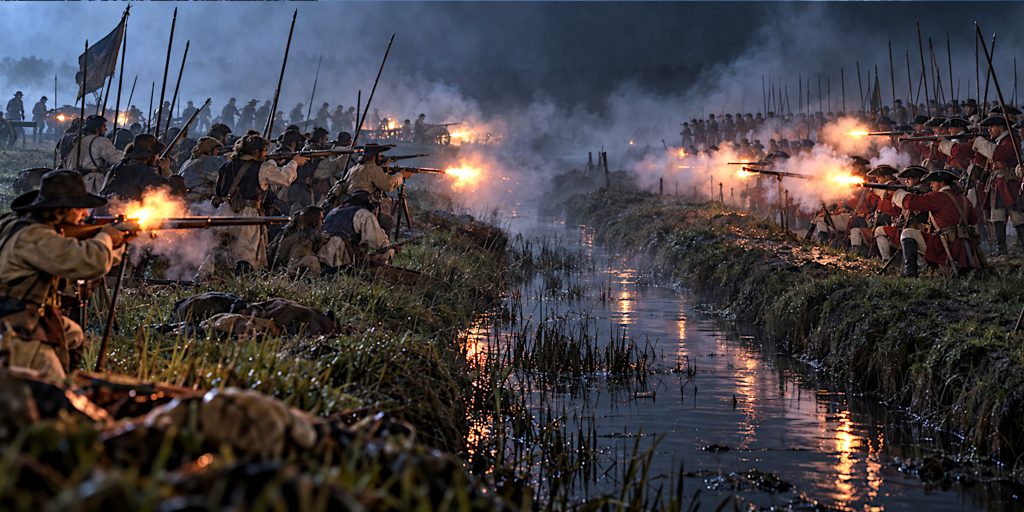
Hand-held firearms appeared in Europe during the fourteenth century. Early handguns were slow to prepare and difficult to use, but their role expanded over time. The change was not a single moment when firearms suddenly made armour pointless. Plate continued to be worn, and armourers adapted it, including by making some sections thicker to resist projectiles.
Gunpowder weapons also changed the economics of warfare. Firearms and artillery required metalworking, powder, shot, transport and trained crews. Their influence therefore depended on the ability of rulers and cities to pay for the equipment and organise its use. As firearms became more common, the balance between protection, mobility and cost shifted. Armour did not vanish overnight, but its role on the battlefield changed.
The Royal Armouries presents this transition alongside the continued importance of bows, crossbows and armour. The study of medieval shooting and defensive arms on Persée also places firearms within a wider pattern of technical and tactical change.
What the medieval arms race tells us
Medieval weapons and armour developed through overlapping responses, not a single chain of cause and effect. Mail remained useful after plate appeared. Swords remained useful after polearms became prominent. Longbows and crossbows had different strengths, and neither made armour irrelevant. Early firearms introduced new pressures, but they did not instantly settle every question on the battlefield.
The more revealing story is how medieval societies organised violence. Armour required skilled labour and considerable wealth. Bows depended on long training; crossbows offered different demands and advantages. Siege engines and artillery required supply networks and specialist knowledge. What a warrior carried reflected not only what worked, but also what could be made, bought, transported and used well.
That is why the medieval arms race is more interesting than a simple contest between blade and breastplate. It shows people repeatedly adapting to danger, with ingenuity, expense and, occasionally, spectacular miscalculation.