The Border Reivers make considerably more sense once you put them on a map. A surname in a chronicle can seem remote. Place it beside a river crossing, a neighbouring family and a defensible stone tower, and the practical business of frontier life becomes rather clearer. So does the difficulty of keeping your cattle.
The SevenSwords interactive Border Reiver surname map brings those connections together. Explore the families associated with the Anglo-Scottish frontier, find their regional centres and follow links to castles, towers and other historic sites.
With 109 family profiles and 28 strongholds currently included, it offers several ways into the subject. Start with a familiar surname, investigate a particular valley or simply pick a tower and see whose history gathers around it.
Explore the interactive Border Reiver map
Why geography matters to Border Reiver history
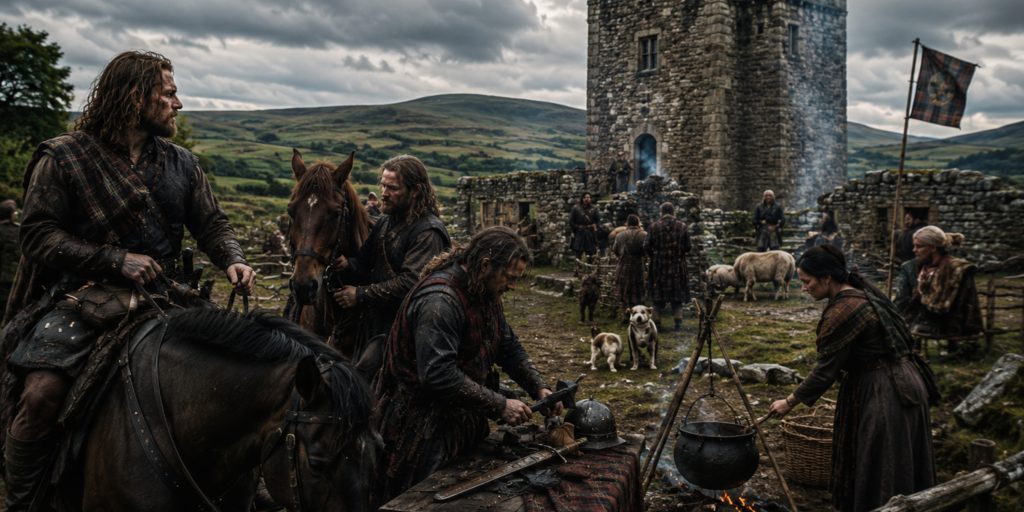
Reiving was the raiding and theft associated with a frontier repeatedly unsettled by war, competing jurisdictions and local rivalries. Livestock was movable wealth. Kinship offered protection, influence and people who might turn up when needed. Whether their arrival improved matters depended rather heavily on which side you were standing.
The map focuses on the frontier around 1500–1603, placing names within the landscapes of the later reiving period. Liddesdale, Eskdale, Annandale, Teviotdale, Redesdale and Tynedale were connected places, rather than isolated entries in a family history.
It is tempting to imagine a straightforward contest between Scots and English. Border society was less obliging. Families fought neighbours on their own side of the boundary, cooperated across it and pursued interests that did not always suit either crown. A royal office and an appetite for private advantage could coexist quite comfortably.
A map helps the reader hold that complexity in view. National allegiance mattered, but so did the next valley.
Search Border Reiver surnames and their regional connections
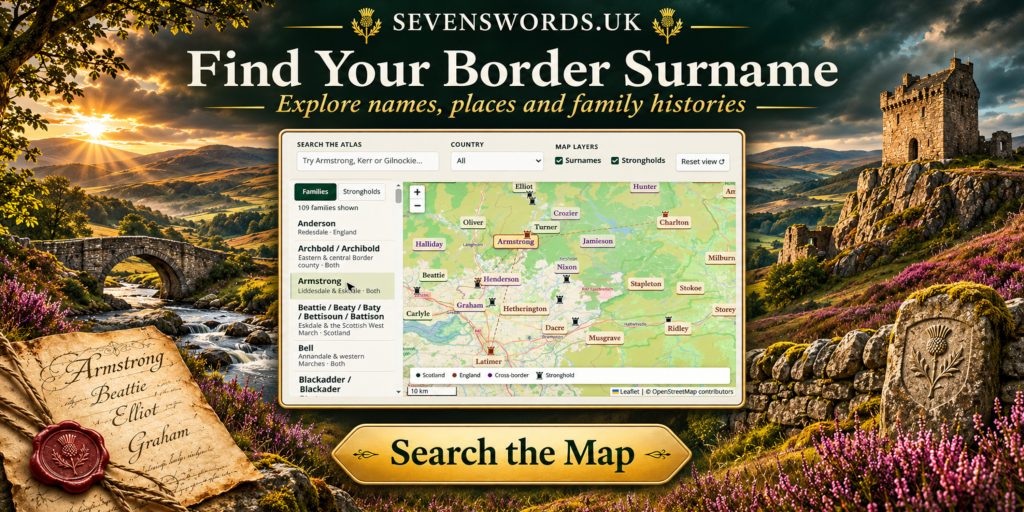
The atlas combines a searchable directory with a map that you can drag and zoom. Search for a name, select an entry and open its profile. Country filters let you narrow the display, while separate layers control surname labels and strongholds.
The selection includes famous riding surnames alongside landed families, frontier magnates and other Border-associated names. Their inclusion does not mean they all played the same role.
| Name in the atlas | Regional association shown |
|---|---|
| Armstrong | Liddesdale and Eskdale |
| Elliot and spelling variants | Liddesdale |
| Scott / Scot | Teviotdale and Ettrick |
| Kerr / Carr | Jedburgh and Cessford |
| Graham | Esk and the Debatable Land |
| Johnstone / Johnston | Annandale |
| Charlton / Charleton | North Tynedale |
| Robson | Redesdale and North Tynedale |
These are broad associations, not exclusive territories. Families had branches, people moved and neighbours did not arrange themselves into tidy coloured parcels for the convenience of future historians.
Spelling variants appear together in the directory. This is useful when exploring a historical name, although grouped spellings do not themselves establish a shared pedigree.
Search the Border surname directory and map
Open a family profile and follow the evidence
Selecting a surname takes you beyond a label. Profiles bring together origin notes, notable bearers, reported feuds, traditional allies and associated strongholds where a connection has been assigned.
The Armstrong entry is a useful place to begin. It introduces the surname’s western Border associations, discusses the distinction between an origin explanation and family tradition, and leads into the story of Kinmont Willie and his rescue from Carlisle Castle in 1596.
Its legal-record section also shows why the wording of a historical claim matters. An official describing a disputed imprisonment was a participant with a position to defend. His account is evidence, but it is not an impartial verdict simply because it reached an archive.
Where legal-record entries are provided, the atlas separates what a source records from what it can establish. That distinction gives readers a more useful starting point than an impressive anecdote left to fend for itself.
Feuds and alliances need similar care. A relationship might concern one branch, one raid or one particular episode. It need not describe every bearer of the surname for the next three centuries.
Discover the castles, towers and bastles
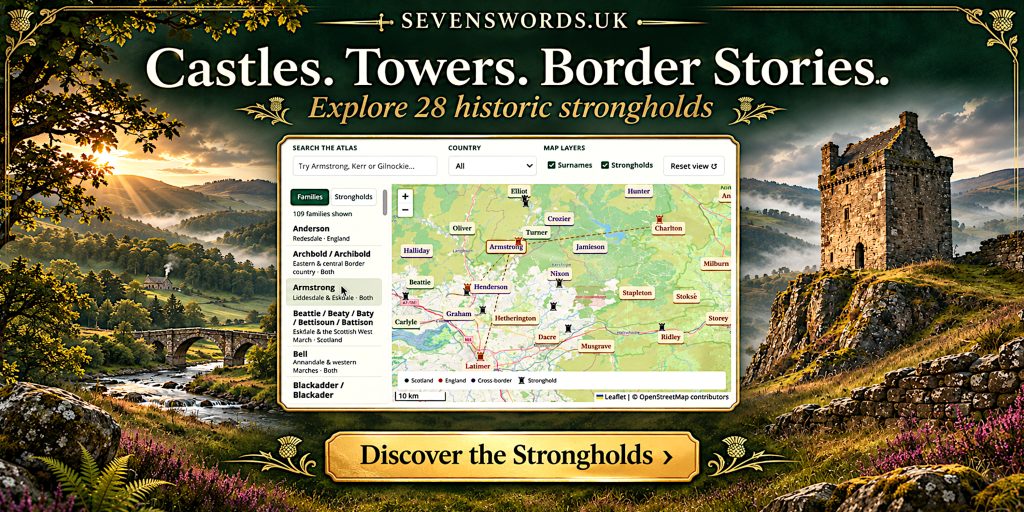
The stronghold layer adds the built landscape to the family names. The current selection includes Hermitage Castle, Gilnockie Tower, Carlisle Castle, Cessford Castle, Ferniehirst Castle and Black Middens Bastle, among other sites.
These buildings served different purposes. Great castles expressed royal and aristocratic power. Smaller tower houses offered defensible accommodation. Bastles combined domestic space with protection for livestock, a sensible arrangement when the household’s assets were capable of being driven away overnight.
The links between a family and a building also vary. Ownership is one possibility; imprisonment, rescue or attack may explain another. Read the individual entry before assuming that a connected castle was the family home.
For a reader planning a Border history trip, the map provides geographical orientation and ideas for further research. Check current opening arrangements with the relevant owner or heritage organisation before travelling. Some entries concern ruins, approximate sites or private property, and a marker does not establish public access.
Explore the castles and towers on the map
How to use the interactive map
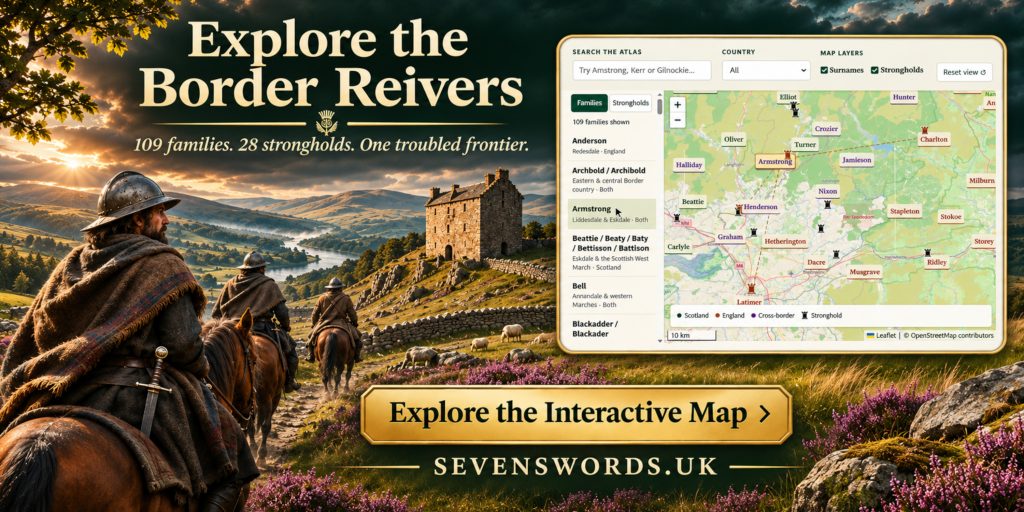
Start with the search box if you have a particular surname or stronghold in mind. Alternatively, browse the Families and Strongholds tabs, then select an entry to open its details.
Use the zoom controls to reveal more surname labels and separate nearby markers. Drag the map to follow the frontier, switch layers to simplify the view, or reset it to begin again. Matching families remain available in the directory even when their labels are not visible at the current zoom level.
On mobile, the profile appears below the map and directory. After selecting a name, continue down the page to read its history and explore its connections.
One rewarding approach is to begin with Armstrong, inspect the linked strongholds and then follow a named ally or opponent. Another is to compare an English Border surname with a Scottish neighbour. Both approaches turn a directory into a route through the history.
Can the map help with family history?
Yes, as a starting point for places, names and further reading. It can suggest regional associations to investigate and highlight spelling variants that may be worth considering in records.
It cannot prove that your ancestor was a reiver. Nor does a shared surname establish descent from a famous rider, a tower-owning branch or a later notable bearer of the name.
I find the map most useful when it prompts a better question: which branch, in which place, at which date? Parish records, wills, deeds and other surviving documents are then needed to test the connection. The family legend may survive the exercise. It should at least be asked to produce its paperwork.
Start exploring the Border frontier
The strength of the SevenSwords Border Reiver map is the opportunity to move between scales: from a familiar surname to a valley, from a family profile to a stronghold, and from an entertaining story to the evidence behind it.
You do not need a Border surname to enjoy it. An interest in castles, local history or the awkward relationship between royal authority and armed neighbours is quite sufficient.
Open the interactive Border Reiver surname map and choose your starting point.
Sources and further reading
- SevenSwords: Border Reiver Surname Map, Families, Castles and Towers. Live interface, directory, Armstrong profile and editorial notes inspected on 14 November 2026. Feature counts reflect that inspection.
- The atlas provides further references within individual profiles, including links for reported relationships and legal-record entries. Consult these alongside its Sources and editorial notes when following a particular claim.