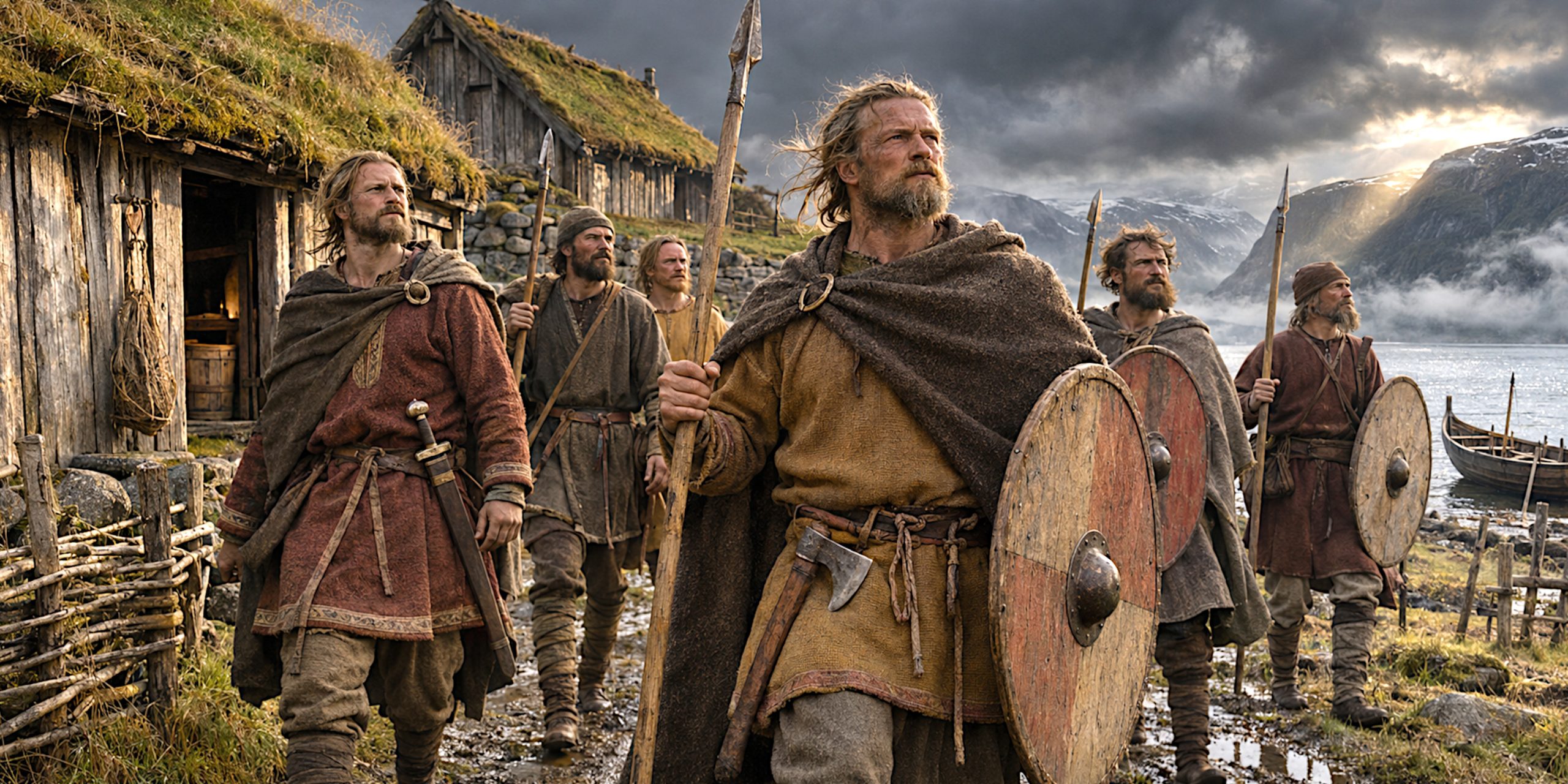
The popular Viking is permanently dressed for battle. His axe is enormous, his temper unreliable, and apparently nobody has asked who is bringing in the hay.
The Norse bóndi offers a more useful way of understanding Scandinavian society. A farmer and householder, he belonged to a world in which land, family, legal standing and the ability to defend oneself were closely connected. Some householders fought, sailed on expeditions or supported powerful leaders. Others spent most of their lives managing farms.
“Bondi warriors” is therefore a convenient modern description, but it needs care. Bóndi was a social designation, not a military rank or a standard troop type. Understanding that distinction brings us much closer to the people behind the shields.
Who Were the Bondi?
The Old Norse singular is bóndi, with bændr as a common plural. English-language histories and wargames often use the simplified spelling “bondi”.
The word described a farmer or householder, particularly someone established with a household, land and livestock. Its meaning varied across time and place. It could encompass people of quite different means, rather than one neatly defined economic class.
A modest farmer and a substantial rural landholder might both be described as bændr. “Free farmer” is a useful translation, provided we do not assume that every person concerned owned an independent farm outright or enjoyed identical rights. Medieval usage was less obliging than a modern character sheet. Old Norse Dictionary
| Feature | What it tells us |
|---|---|
| Social position | An established free householder, with circumstances varying by region |
| Economic foundation | Farming, livestock and household production |
| Military identity | Potential participant in armed service, rather than automatically a professional warrior |
The Swedish History Museum makes a valuable distinction: although saga ideals celebrated warfare, hunting and riding, most free men were farmers. The literary ideal and the daily occupation were not necessarily the same thing.
Their Place in Norse Society
A household was an economic concern, a family institution and a source of public standing. Its head represented interests that extended beyond his own person.
Established free householders could participate in legal and political life through assemblies, usually called the thing. Precisely who could speak, judge or exercise influence depended on the community and its laws. Wealth, connections and reputation mattered considerably.
The bondi should not be imagined as either a powerless serf or a comfortably independent modern smallholder. A man might possess recognised rights while still depending on a stronger neighbour, a chieftain or a network of relatives.
Freedom also existed alongside enslavement. Norse rural society included enslaved people whose labour supported households and estates. Any pleasing picture of universally independent Viking farmers leaves a substantial part of the population out of the frame.
What interests me most is the overlap between household responsibility and public authority. These men mattered because they maintained farms and represented families. Their military usefulness grew from that position, rather than replacing it.
How Farmers Became Fighters
There was no single route from farmstead to battlefield.
A householder might become involved in local defence, accompany a leader, support a feud or participate in an expedition. His household could also contribute provisions, equipment or labour without his personally joining every campaign.
Scandinavian naval mobilisation is often discussed through the leiðangr, also written leidang or leding. In its developed medieval form, this organised communities to provide ships, crews and resources.
The caution concerns chronology. Detailed surviving laws generally belong to the medieval period after the Viking Age. They cannot simply be treated as an unchanged instruction manual for ninth-century Scandinavia. The origins, extent and development of these obligations remain subjects of historical discussion.
Museum accounts nevertheless show how closely ships, rural communities and military service could be connected. The Viking Ship Museum describes crew selection under a ship commander and circumstances in which farmers themselves had to serve when sufficient farm workers were unavailable. vikingeskibsmuseet.dk
For a farming household, service carried costs beyond weapons. Someone had to feed the animals and maintain production during an absence. A successful expedition might bring wealth; an ill-timed one could leave a household badly exposed.
Organisation and Leadership
“Bondi” does not identify a regiment with a fixed commander, strength or battlefield role.
Householders serving in an armed force might operate within a ship’s crew, a local contingent or the following of a powerful man. Personal relationships and local obligations helped turn individuals into a functioning group.
Useful distinctions include:
- Householders and rural recruits, whose experience and equipment varied.
- Experienced expedition members, who might also maintain farms.
- Retainers attached to a ruler or magnate, whose service could be more sustained.
These categories could overlap. Farming did not prevent a man from becoming an experienced fighter, just as owning an impressive sword did not prove that he was one.
The surviving evidence does not justify assigning all bændr the same training, morale or competence. A household’s resources tell us something about its capacity to equip a fighter. They tell us rather less about how he behaved when the opposing line advanced.
Arms and Armour
There was no universal bondi equipment set. Wealth, date, location and circumstances shaped what an individual could carry.
Spears, axes, shields, swords and bows all belonged to the wider Scandinavian military world. Their presence in that world does not establish that every farmer possessed all of them.
Spears and Axes
A spear provided reach and could be used with a shield. Different spearheads suited different purposes, and the archaeological range warns against treating every example as interchangeable.
Axes likewise ranged from practical tools to specialised weapons. A farmer’s familiarity with an axe is plausible; universal mastery of battlefield axe fighting is another matter.
The broad-bladed, often two-handed weapon commonly called the Dane axe belongs especially to the later Viking Age and subsequent centuries. It should not be handed to every Scandinavian farmer in every period. The Museum of Cultural History identifies the late Viking Age broadaxe as a specialised fighting weapon and a prestigious object in its own right.
Specific Sword Types
The characteristic Viking Age sword was a one-handed weapon, commonly with a straight, double-edged blade. Single-edged examples also existed.
Archaeologists often classify these swords through Jan Petersen’s hilt typology. Its letters describe archaeological forms, principally hilt features. They do not identify military ranks or weapons reserved for particular social groups.
| Sword type | Historical relevance | Caution |
|---|---|---|
| Petersen Type C | An early Viking Age hilt form, represented in the reused guard of the Lesja sword | Older fittings could remain in circulation |
| Petersen Type M | A comparatively plain iron hilt form associated with the ninth and tenth centuries | Simplicity does not prove ownership by a farmer |
| Petersen Type K | A Viking Age form represented by surviving swords with elaborate decoration | Rich examples cannot stand for ordinary equipment |
The Lesja sword, found in the Norwegian mountains, is particularly instructive. Its undecorated iron fittings combine an older Type C guard with a later Type M upper hilt component. The Museum of Cultural History interprets it as a practical weapon outside the most exalted levels of society.
It demonstrates that Viking Age swords could be plain, repaired or assembled using older components. It does not reveal its owner’s occupation. That final step would require evidence we do not possess.
Swords were valuable possessions, and richly decorated examples conveyed considerable status. A prosperous householder might own one, but the familiar image of every farmer wearing an ornate sword is difficult to sustain.
Shields
A round wooden shield with a central handgrip and iron boss is a sound starting point for reconstruction.
An unusually well-preserved example from Trelleborg in Denmark, discovered in 2008, was made from pine and measured approximately 80 centimetres across. Such finds help correct the impression that Viking shields were uniformly thick, heavy objects.
The shield was active protection. Its usefulness depended on handling, positioning and cooperation with others, rather than simply carrying a large wooden disc into danger.
Helmets and Body Armour
Mail and iron helmets existed, but equipping every rural fighter with both would misrepresent the evidence.
The Gjermundbu burial in Norway contained a helmet, mail, weapons and riding equipment. Its wealth makes it valuable evidence for an exceptionally well-equipped individual, rather than a typical farmer.
Ordinary wool clothing is a more cautious starting point for many householders. Precisely how widespread additional textile protection was remains uncertain. Familiar modern reconstructions of quilted armour should not be presented as a proven universal Viking uniform.
How Did Bondi Warriors Fight?
There is no surviving “bondi fighting manual”.
When householders joined Scandinavian forces, their roles depended on their equipment, experience and the needs of the force. Possible tasks included fighting with spear and shield, using missile weapons, defending a position and serving aboard ships.
Close cooperation mattered. A man standing beside relatives, neighbours or shipmates belonged to a social group as well as a tactical one.
The shield wall remains a useful term for some forms of close infantry fighting, but it should not become a complete explanation of Norse warfare. Terrain, missiles, movement, broken formations and fighting at sea all complicate the picture.
For less heavily protected men, maintaining cohesion was particularly important. Once a group lost its ability to support one another, individual courage could do only so much.
I would be wary of both familiar extremes: the helpless agricultural labourer pushed into battle and the born warrior who required no training. Neither gives us a convincing account of people whose experience must have varied enormously.
Archaeology: What Can We Actually Identify?
Archaeology supplies weapons, buildings, burials and human remains. It rarely supplies a convenient label reading “free farmer, occasional military service”.
That limitation matters.
Weapon Graves
A grave containing an axe, spear or sword demonstrates a deliberate burial choice. It may express status, identity, family ambition or martial associations.
It does not automatically establish the deceased’s occupation or prove that every object was used in combat.
Research on Scandinavian and overseas weapon burials has challenged the assumption that they represent an ordinary cross-section of free farmers. Furnished graves could favour people of substantial standing, while burial practices differed sharply between regions.
Farms and Settlements
Settlement archaeology restores the wider setting: buildings, agricultural work, food production and household manufacture.
Weapons become more meaningful when considered alongside that evidence. Farming and military activity could belong to the same life, but finding a weapon does not establish how frequently its owner fought.
Fortresses and Military Sites
Trelleborg provides evidence of organised military activity, including weapons and signs of violence. It helps us understand the demands of royal power and warfare.
It does not allow every person associated with the fortress to be classified as a bondi. The distinction between identifying military activity and identifying someone’s social status is essential.
Contemporary Accounts and Norse Voices
There is no substantial surviving collection of contemporary testimony written by ordinary bændr about their military service. We must work with observers, material evidence and texts preserved later.
Ibn Fadlan: An Eyewitness in 922
The traveller Ahmad ibn Fadlan, describing the Rus he encountered on the Volga, wrote:
“Each man has an axe, a sword, and a knife and keeps each by him at all times.”
This is valuable contemporary evidence for the armed appearance of the people he observed. They were travellers and traders in a particular setting, however, rather than a representative sample of Scandinavian farmers. His account cannot establish a universal bondi equipment list.
Hávamál: Advice Preserved Later
Hávamál offers a memorable warning:
“Away from his arms in the open field
A man should fare not a foot”
These lines come from stanza 38, in Henry Adams Bellows’s translation. The poem survives in medieval manuscripts and contains material whose dating is debated, so it should be distinguished from a securely dated eyewitness account.
It expresses an ideal of preparedness. It does not prove that every farmer spent the working day fully armed. Advice literature has always found room for circumstances more alarming than the average Tuesday.
Common Misconceptions About Bondi Warriors
| Claim | A more accurate reading |
|---|---|
| Bondi were a standard Viking infantry unit | The word described social standing, with varied military participation |
| Every bondi was poor | Householders could differ considerably in wealth and influence |
| All farmers owned swords | Ownership varied; ornate swords are particularly unsuitable as universal equipment |
| Farmers were necessarily untrained | Some could have substantial military experience, but we cannot quantify it |
| Medieval levy laws describe the entire Viking Age | Later regulations require careful handling when reconstructing earlier conditions |
| A weapon burial identifies a bondi | Grave goods alone cannot securely establish that status |
Why the Bondi Matter
The bondi brings Scandinavian history back to the household.
Armies depended on people who produced food, maintained equipment, supplied crews and supported those who travelled. Some of those people also fought. Their importance lay in the connection between economic resources, public standing and military capacity.
The danger is turning that connection into another stereotype. The farming warrior can become as misleading as the permanently marauding Viking if we assume that every free householder followed the same life.
I find the more varied picture considerably more convincing. These were people with property to protect, relatives to support, obligations to negotiate and differing appetites for danger. Some acquired experience and wealth through warfare. Others had good reasons to remain close to home.
The crops, after all, were unlikely to wait for anyone’s heroic reputation.