Gilles de Rais occupies one of the darkest and most uncomfortable corners of medieval history. He was a wealthy Breton lord, a successful military captain, a companion of Joan of Arc and a Marshal of France. He was also convicted of abducting, sexually assaulting and murdering children.
Those two lives belong to the same man.
Later writers turned him into a monster of almost supernatural proportions, frequently connecting him with the folktale of Bluebeard. Attempts have also been made to present him as the victim of a political conspiracy. Neither approach is particularly helpful. The first replaces history with horror, while the second must explain away an extensive body of witness testimony and confessions.
The real Gilles de Rais is disturbing enough without decoration. He was a capable soldier whose wealth, rank and reputation protected him for years. His story exposes the violence of fifteenth-century warfare, the weakness of medieval institutions and the alarming freedom available to a powerful aristocrat.
Gilles de Rais at a Glance
| Detail | Information |
|---|---|
| Full name | Gilles de Montmorency-Laval, commonly called Gilles de Rais or Retz |
| Born | Probably around 1404 or 1405 |
| Birthplace | Usually identified as Champtocé-sur-Loire, Anjou |
| Parents | Guy II de Laval-Rais and Marie de Craon |
| Wife | Catherine de Thouars |
| Principal titles | Baron de Rais, Lord of several estates, Marshal of France |
| Allegiance | Charles VII of France |
| Main conflict | Hundred Years’ War |
| Famous associate | Joan of Arc |
| Arrested | 15 September 1440 |
| Tried | Nantes, 1440 |
| Executed | 26 October 1440 |
| Place of execution | Nantes |
| Historical reputation | Soldier, nobleman and convicted murderer |
The spelling of his territorial name varies. “Rais” and “Retz” both appear in modern writing, although Gilles de Rais has become the standard form in English.
Family, Childhood and Inheritance
Gilles was born into the upper ranks of the French aristocracy. His father belonged to the Laval family, while his mother connected him to the powerful Craon dynasty. He had a younger brother, René de La Suze.
Both parents died while the boys were still young. Their maternal grandfather, Jean de Craon, became their guardian. Jean was politically ambitious, financially aggressive and quite prepared to use marriage as a way of expanding the family’s influence.
In 1420, Gilles married Catherine de Thouars. The marriage gave him access to further estates, including Tiffauges and Pouzauges. It also helped make him one of the wealthiest noblemen in western France.
His possessions extended through Brittany, Anjou, Maine and Poitou. They included castles, lands, tolls and feudal rights. Such wealth did not mean an unlimited supply of ready money, but it gave him the ability to raise troops and operate among the leading men of Charles VII’s court.
There is little reliable evidence about his personality as a child. Stories portraying him as naturally cruel tend to come from much later interpretations. Medieval biography often searches childhood for warning signs after the ending is already known. It is a satisfying narrative habit, though not a sound historical method.
France During the Early Life of Gilles de Rais
Gilles grew up during one of the most dangerous periods of the Hundred Years’ War.
Following the disastrous French defeat at Agincourt in 1415, English power expanded across northern France. The Treaty of Troyes in 1420 recognised Henry V of England as heir to Charles VI of France, displacing the future Charles VII. When Henry V and Charles VI both died in 1422, the infant Henry VI was proclaimed king of England and France by the Anglo-Burgundian alliance.
Charles VII retained support in central and southern France, but his position was fragile. France was divided between rival courts, armed factions and regional interests. Castles changed hands, private feuds overlapped with royal warfare, and military service could be a route to influence as well as survival.
This was the world in which Gilles began his career. It rewarded aggression, expensive displays of loyalty and the ability to bring armed men into the field.
The Beginning of His Military Career
Gilles appears in military activity during the 1420s, although the details of his earliest service are not always clear. He became associated with the circle of Georges de La Trémoille, one of the dominant figures at Charles VII’s court.
His operations were concentrated largely in territories contested by the French, English and their Burgundian allies. He served alongside experienced commanders including Ambroise de Loré and Jean de Bueil.
One of the actions most closely associated with his early reputation was the capture of Le Lude in 1427. The fortress was held by an English-aligned garrison and presented a serious obstacle in the region. Its recovery helped establish Gilles as more than a richly equipped aristocrat playing at war.
By 1429, he had sufficient military and political standing to be entrusted with significant responsibilities during the campaign to relieve Orléans.
Gilles de Rais and Joan of Arc
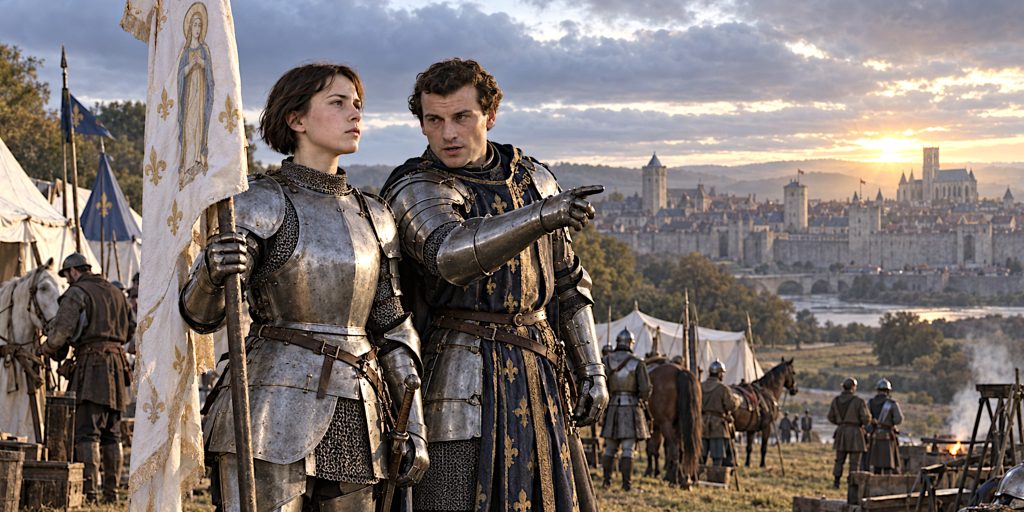
The relationship between Gilles de Rais and Joan of Arc has been heavily romanticised. They fought in the same royal army and participated in several of the same campaigns, but there is no secure evidence that they were intimate friends or that Gilles served as Joan’s personal protector.
Their association was nevertheless real and important.
When the army gathered for the relief of Orléans in 1429, Gilles was among the captains entrusted with accompanying the force. He had money, troops, local experience and useful court connections. Joan supplied something far less conventional: religious confidence and an extraordinary ability to transform morale.
Gilles participated in operations around Orléans during the French attacks on English positions in May 1429. The lifting of the siege was a decisive psychological victory. English forces were not destroyed, but the belief that they could advance without serious resistance had been badly shaken.
He then joined the Loire campaign, which cleared several English-held positions and opened the road towards Reims.
Battles and Campaigns
| Date | Battle or campaign | Role and significance |
|---|---|---|
| 1427 | Capture of Le Lude | Helped recover an important stronghold from an English-aligned garrison |
| May 1429 | Relief of Orléans | Served among the French commanders during the operations that broke the English siege |
| June 1429 | Battle of Jargeau | Participated in the attack on an English-held Loire town |
| June 1429 | Operations at Meung-sur-Loire | Supported the campaign against English positions along the Loire |
| June 1429 | Battle of Beaugency | Took part in the French recovery of another key Loire stronghold |
| 18 June 1429 | Battle of Patay | Present during the campaign that ended in a major English field defeat |
| July 1429 | Reims campaign | Helped escort Charles VII through hostile and uncertain territory for his coronation |
| September 1429 | Attack on Paris | Participated in the unsuccessful French attempt to capture the city |
| 1430s | Regional campaigning | Continued to serve the crown intermittently, particularly in western and central France |
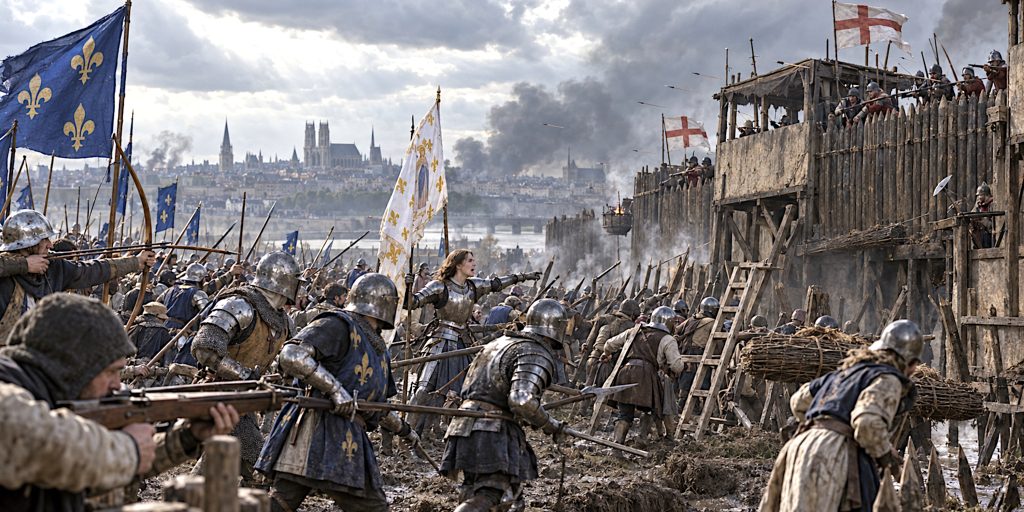
Some older accounts place Gilles at nearly every important event in Joan’s career. The documentation does not always justify that confidence. His presence is well supported during the central campaigns of 1429, but his precise tactical role in each engagement is harder to reconstruct.
The Loire Campaign
After Orléans, the French moved rapidly against English strongholds along the Loire.
At Jargeau, the French assaulted a defended town rather than waiting through a long blockade. Artillery helped batter the fortifications before the final attack. At Meung-sur-Loire and Beaugency, the French continued to pressure English garrisons and lines of communication.
The campaign culminated at Patay on 18 June 1429. English forces attempted to establish a defensive position using archers and sharpened stakes, the same combination that had proved devastating in earlier battles. This time, the French found them before the position was properly organised.
French cavalry struck quickly. The English army suffered a serious defeat, and several senior commanders were captured.
There is no reason to credit Gilles personally with the victory at Patay. He was part of a command structure containing several experienced soldiers. His importance lay in contributing men, resources and noble authority to an unusually energetic French campaign.
Marshal of France
Gilles was made a Marshal of France around the time of Charles VII’s coronation at Reims in July 1429.
The title was a major honour. A marshal was expected to assist with military organisation, discipline, command and the management of royal forces. It placed Gilles among the most prestigious soldiers in the kingdom.
His appointment probably reflected several factors:
- His service during the victories of 1429
- His wealth and ability to maintain troops
- His relationship with La Trémoille
- His aristocratic status
- The crown’s need to reward visible loyalty
It should not automatically be read as proof that he was a military genius. Medieval appointments were rarely awarded on merit alone. Yet neither should the title be dismissed as purely decorative. Gilles had participated in successful operations and was treated by contemporaries as a serious military figure.
Military Acumen
Gilles de Rais appears to have been a brave and competent field commander. He understood the practical importance of fortresses, aggressive assaults and concentrated force. He was also able to finance a substantial military household, which made him useful in a war where kings regularly expected nobles to carry part of the financial burden.
His strengths included:
- Experience in siege warfare
- A willingness to participate directly in assaults
- The ability to raise and equip retainers
- Knowledge of the western French borderlands
- Strong political connections at court
- Familiarity with cavalry operations and combined forces
His limitations are equally important.
There is little evidence that he independently designed a major campaign or commanded an army on the scale of the leading French captains. His greatest successes came as part of a broader royal effort led by men such as the Duke of Alençon, Jean de Dunois, La Hire, Jean Poton de Xaintrailles and Arthur de Richemont.
His later career also reveals catastrophic failures in administration and judgement. A commander who cannot control his expenditure or preserve his political position has a very particular sort of strategic weakness. Gilles could command men in battle, but he proved unable to command himself.
My own assessment is that he was a formidable aristocratic captain rather than a great general. That is still significant. France in 1429 needed capable captains with money and nerve, and Gilles possessed both.
Arms and Armour
No complete suit of armour or authenticated sword belonging to Gilles de Rais is known to survive. Reconstructions therefore rely on French armour, military inventories, artistic evidence and surviving weapons from the first half of the fifteenth century.
As a wealthy nobleman, Gilles could have obtained equipment of extremely high quality.
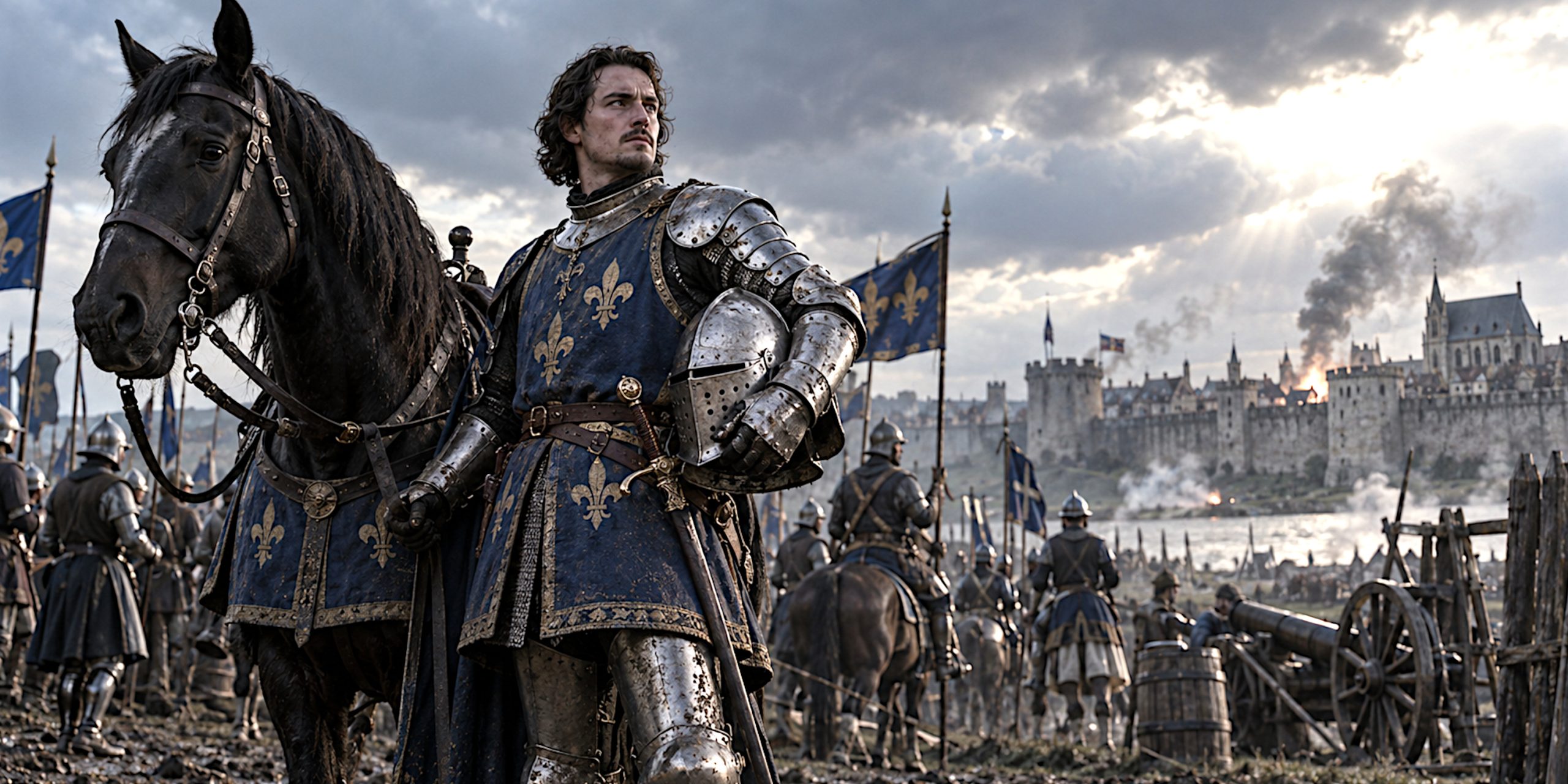
Probable Personal Armour
| Equipment | Likely form |
|---|---|
| Helmet | Bascinet or great bascinet, possibly supplemented by a sallet later in his career |
| Body armour | Plate cuirass worn over an arming doublet |
| Shoulder defence | Pauldrons or spaulders |
| Arm protection | Rerebraces, couters and vambraces |
| Hand protection | Articulated plate gauntlets |
| Leg protection | Cuisses, poleyns and greaves |
| Foot protection | Sabatons |
| Additional defence | Mail protecting gaps at the armpits, neck and joints |
| Heraldic clothing | Surcoat, jupon or horse trappings displaying his arms |
The fully enclosed white armour familiar from later fifteenth-century art was still developing. A French nobleman in the 1420s would have worn an increasingly sophisticated arrangement of plate, with mail retained where rigid pieces could not safely cover the body.
Swords and Other Weapons
Gilles would probably have owned several weapons for different circumstances.
- Arming sword: A one-handed, double-edged sword used with a shield or as a sidearm.
- Longsword: A hand-and-a-half weapon suited to armoured combat, particularly on foot.
- Estoc: A stiff, sharply pointed sword designed to thrust into gaps in armour.
- Dagger: Most likely a rondel dagger, useful both as a tool and as a close-combat weapon.
- Lance: The principal weapon of a mounted man-at-arms during a charge.
- Poleaxe: A versatile weapon combining axe blade, hammer and thrusting spike.
- Mace or war hammer: Compact weapons capable of delivering heavy concussive force through armour.
His retainers would have carried a broader mixture of equipment, including spears, bows, crossbows, axes, bills and early handguns. Artillery was already important in siege warfare. The French campaigns of 1429 were not conducted by knights politely fencing beneath castle walls. Cannon, assault ladders, missiles and close-quarter fighting did a great deal of the real work.
Heraldry and Battlefield Appearance
Gilles belonged to the Laval-Montmorency family and used heraldic arms associated with that lineage and the lordship of Rais. His banners, shields, clothing and horse equipment would have allowed soldiers to identify him in the confusion of battle.
This mattered more than personal appearance. No reliable contemporary portrait of Gilles survives. Images commonly presented as portraits are later inventions or misidentified heraldic figures. One frequently reproduced armoured rider appears to represent a member of the Laval family generically rather than Gilles as an individual.
We know more about how he announced his rank than how his face actually looked.
Wealth, Spectacle and Financial Collapse
After the campaigns of 1429, Gilles spent increasingly large sums on his household, religious performances, musicians, servants and theatrical productions.
His most famous project was an elaborate drama celebrating the siege of Orléans. Such performances required costumes, scenery, actors, food and extensive organisation. They were expressions of status, piety and political memory, but they were ruinously expensive.
Gilles sold or transferred estates to fund his spending. His family became alarmed, and Charles VII eventually issued restrictions intended to prevent further disposal of his property. These measures were not entirely effective.
His financial decline damaged his independence. Land meant income, soldiers, legal authority and political leverage. As his estate weakened, so did the protection surrounding him.
There is a tempting tragic shape here: victorious marshal becomes extravagant recluse and then monster. History is seldom quite so tidy. Financial collapse did not cause the alleged crimes, but it made his behaviour harder to conceal and left him more vulnerable to enemies.
The Alleged Murders
During the 1430s, children disappeared from areas around Gilles’s residences. Many came from poor families. Some had entered his household after being offered work, clothing, food or advancement.
The number of victims cannot be established. Figures ranging from around 100 to several hundred have been repeated, but medieval evidence does not allow an exact total. The higher estimates should be treated with caution.
At his trial, servants described a pattern of abduction, sexual violence and murder. Several members of his household were accused of assisting him or concealing evidence. Gilles eventually confessed, although his statements were given within a judicial system that used intense spiritual pressure and permitted torture.
The confessions cannot be read as modern police interviews. That does not make the entire case imaginary. Testimony came from multiple directions, including families of missing children and members of his own household.
The most historically responsible conclusion is that Gilles almost certainly committed numerous murders, while the precise number, sequence and details remain uncertain.
Alchemy, Necromancy and the Search for Money
As his finances deteriorated, Gilles became involved with people who claimed they could summon spirits or obtain wealth through alchemical and magical practices. The Italian cleric François Prelati became particularly important within this circle.
Medieval alchemy covered a wide range of activities. Some practitioners pursued recognisable experiments involving metals and chemical processes. Others promised treasure, demonic assistance or supernatural knowledge. Gilles appears to have crossed decisively into ritual magic and attempted spirit invocation.
These activities became central to the ecclesiastical case against him. Charges relating to heresy, sacrilege and demon invocation gave the Church jurisdiction and placed his soul, as well as his life, in danger.
Later retellings often turn his residences into gothic laboratories full of bubbling green liquid and conveniently arranged skulls. The reality was probably messier: fraud, ritual manuals, expensive ingredients, clerical opportunists and a desperate nobleman convinced that one more ceremony might repair his fortune.
The Assault at Saint-Étienne-de-Mer-Morte
The immediate political crisis began in May 1440.
Gilles entered the church at Saint-Étienne-de-Mer-Morte with armed men and seized the cleric Jean Le Ferron during Mass. The dispute concerned property Gilles had previously sold and was attempting to recover.
This was an exceptionally reckless act. By violating a church and attacking a cleric, Gilles challenged both ecclesiastical authority and the Duke of Brittany. The incident provided his opponents with a clear and public reason to act.
An investigation followed. Earlier rumours and reports concerning missing children were gathered into a formal case.
Gilles had survived suspicion while his offences remained scattered, private and attached to frightened families with little influence. The church invasion was different. He had attacked institutions capable of answering him.
Arrest and Trial
Gilles was arrested at Machecoul on 15 September 1440. Proceedings were conducted in Nantes through both ecclesiastical and secular courts.
The ecclesiastical court considered charges including heresy, sacrilege, apostasy, demon invocation and offences against children. The secular court addressed kidnapping and murder.
At first, Gilles challenged the authority of the judges and insulted them. When threatened with excommunication and presented with extensive testimony, his position changed. He confessed publicly and expressed repentance.
The surviving trial records are unusually detailed, but they must still be read critically. The proceedings were not conducted according to modern standards. Gilles faced spiritual coercion, the threat of torture and judges connected to institutions that stood to benefit from his downfall.
Even so, the conspiracy theory has serious weaknesses. It requires numerous witnesses, bereaved parents, servants and officials to participate in or accept a remarkably elaborate fabrication. It also overlooks the evidence that concerns about missing children existed before the final political confrontation.
The original trial manuscripts survive among the collections of the Departmental Archives of Loire-Atlantique, catalogued within the records concerning the proceedings against Gilles de Rais.
Was Gilles de Rais Framed?
The possibility of political motivation deserves consideration. Gilles was deeply indebted, possessed valuable lands and had antagonised both Jean V, Duke of Brittany, and the Church. Medieval prosecutions of powerful nobles were never free from politics.
However, political advantage and genuine guilt can exist together.
Arguments for rehabilitation usually emphasise:
- The use of coercion during the trial
- The financial interests of Gilles’s rivals
- The absence of surviving bodies
- Inconsistencies in estimates of the victim total
- The theological nature of some charges
- The unusual survival and editing history of the records
Arguments supporting the conviction include:
- Testimony from members of his household
- Statements from families of missing children
- Evidence gathered across several locations
- Confessions from alleged accomplices
- Gilles’s own detailed admissions
- Reports that preceded his open conflict with the authorities
In 1992, a privately organised mock retrial in France declared him not guilty. It had no legal authority and did not overturn the medieval conviction. More importantly, a modern theatrical proceeding cannot recreate lost witnesses, evidence or legal circumstances.
I find claims of complete innocence unconvincing. The trial was political, religious and procedurally alien to us, but that does not mean its central accusations were invented.
Execution at Nantes
Gilles de Rais was condemned to death alongside Henriet Griart and Étienne Corrillaut, known as Poitou.
On 26 October 1440, they were taken to the place of execution at Nantes. Gilles was hanged and his body exposed to fire, although accounts indicate that it was removed before complete destruction and then buried.
His final display of repentance shaped how the execution was reported. Medieval justice was concerned with salvation as well as punishment. A condemned aristocrat who confessed, prayed and accepted judgement could still be presented as spiritually reconciled with the Church.
The spectacle also preserved the privileges of rank. Gilles received treatment that would not necessarily have been granted to an ordinary criminal accused of comparable acts.
Gilles de Rais and the Bluebeard Legend
Gilles is often called the original Bluebeard, but the connection is retrospective.
Charles Perrault published the familiar story of Bluebeard in 1697, more than 250 years after Gilles’s death. In the tale, a wealthy nobleman murders his wives and hides their bodies in a forbidden chamber. Gilles was not accused of murdering successive wives. Catherine de Thouars outlived him and remarried.
The association probably developed because both figures were wealthy lords connected with western France, castles, forbidden rooms and serial murder. Local folklore helped bind them together.
Calling Gilles “Bluebeard” may be convenient for tourism, but it risks replacing the historical person with a fairy-tale villain.
Castles and Places Associated With Gilles de Rais
Château de Tiffauges
Tiffauges in the Vendée is the site most closely associated with Gilles today. It came to him through his marriage to Catherine de Thouars.
The castle stands above the meeting of the Sèvre Nantaise and Crûme rivers. Its strategic position reflects its role within the borderlands between Brittany, Anjou and Poitou.
Visitors can see medieval ruins, reconstructed siege engines and displays relating to warfare and alchemy. However, several major artillery defences visible today were built after Gilles’s lifetime. The enormous Tour du Vidame, for example, belongs to the sixteenth century.
Château de Machecoul
The ruins of Machecoul are associated with Gilles’s lordship, arrest and trial. The surviving remains are fragmentary, and much of the castle was quarried for building material after falling into ruin.
The site is privately owned, with access generally limited to organised visits and events. Archaeological work has helped clarify the plan and development of the fortress.
Champtocé-sur-Loire
Champtocé is traditionally identified as Gilles’s birthplace and was one of the principal Craon family strongholds. Its ruined castle overlooks the Loire valley.
It is one of the better locations for understanding the territorial power into which Gilles was born, although it should not be treated as a preserved museum of his childhood.
Château de Pouzauges
Pouzauges formed part of Catherine de Thouars’s inheritance. Gilles appears to have preferred Tiffauges, while Catherine was more closely associated with Pouzauges.
The surviving keep and fortifications provide valuable evidence for aristocratic life and defence in the region.
Nantes
Nantes was the setting for Gilles’s trial and execution. The city has changed dramatically since 1440, but its cathedral and ducal landscape help place the proceedings within the political capital of medieval Brittany.
Where to See Artefacts and Surviving Evidence
There is no recognised collection of personal weapons, armour or household objects securely authenticated as belonging to Gilles de Rais. Visitors should be wary of displays making confident claims without a documented chain of ownership.
| Location | What can be seen |
|---|---|
| Château de Tiffauges | Castle archaeology, medieval siege-engine reconstructions, architectural remains and interpretive displays |
| Château de Machecoul | Ruins associated with his lordship and arrest, subject to access arrangements |
| Champtocé-sur-Loire | Remains of a major family fortress connected with his youth |
| Château de Pouzauges | Medieval keep and fortifications linked with Catherine de Thouars |
| Departmental Archives of Loire-Atlantique | Surviving manuscripts of the 1440 proceedings, accessible principally through archival consultation and digitised records |
| Nantes | Locations connected with the trial, ducal government and execution |
| Musée Dobrée, Nantes | Regional medieval collections useful for understanding the material culture of fifteenth-century Brittany |
Tiffauges maintains a collection and demonstrations of reconstructed medieval war machines. These are educational reconstructions rather than equipment owned by Gilles.
The most important surviving “artefacts” of his life are arguably documents: trial manuscripts, property transactions, seals, legal records and accounts. They lack the immediate appeal of a bloodstained sword, but they have the useful quality of being real.
Archaeology and Recent Findings
Archaeology has not uncovered a confirmed mass grave or physical evidence that can independently establish the number of Gilles’s victims. Sensational claims about children’s bones found beneath his castles circulate regularly, but they are not supported by a widely accepted modern archaeological publication.
Work at Tiffauges has instead concentrated on the development of the fortress. Archaeological investigation and restoration beginning in the late twentieth century helped identify successive phases of construction, including the Romanesque keep, chapel, curtain walls and later gunpowder defences.
An early firearm, described as a fifteenth-century hacquebute, was recovered from the castle ditch. It is relevant to the military history of the site, though it cannot be securely described as Gilles’s personal weapon.
At Machecoul, excavations conducted in 2008 helped date several circular towers to the later thirteenth century. Archaeologists also exposed foundations and recovered pottery. These discoveries refined the architectural history of the castle but did not produce direct physical proof relating to the murder allegations.
This distinction matters. Archaeology can tell us how these castles developed, how their occupants lived and how defences responded to changing warfare. It has not solved the criminal case.
As of 2026, there has been no widely reported archaeological discovery that overturns the documentary understanding of Gilles de Rais. The “latest findings” are therefore architectural rather than forensic. That may sound less dramatic, but solid masonry has a habit of being more dependable than folklore.
What Happened to His Estates?
Following his conviction and death, Gilles’s possessions passed through a complicated mixture of inheritance, prior sales, confiscation and competing legal claims.
His wife Catherine de Thouars survived him and later married Jean II de Vendôme, Vidame of Chartres. Gilles and Catherine’s daughter, Marie, remained part of the inheritance network surrounding the Rais territories.
Several castles continued to be occupied and altered long after Gilles’s death. This is why surviving structures cannot automatically be assigned to his lifetime. At Tiffauges in particular, some of the most impressive artillery architecture was added decades later.
Historical Reputation
For centuries, Gilles de Rais existed somewhere between history, religious warning and folklore. Nineteenth and twentieth-century writers further transformed him into a symbol of decadence, transgression or supernatural evil.
His real military service was sometimes minimised because it complicated the image of a pure monster. Conversely, some revisionists used his association with Joan of Arc to make innocence seem more plausible. Neither argument follows.
Service beside a saint does not confer sainthood. Military courage does not imply moral character. Medieval society was full of men capable of disciplined conduct on campaign and extreme violence elsewhere.
Gilles remains important because his life joins several major themes:
- The recovery of France during the Hundred Years’ War
- The military career of Joan of Arc
- Aristocratic power in Brittany and western France
- The development of plate armour and gunpowder warfare
- Medieval criminal and ecclesiastical justice
- The relationship between documented history and folklore
- The vulnerability of poor families before powerful elites
How Should Gilles de Rais Be Remembered?
Gilles de Rais should be remembered accurately before he is remembered dramatically.
He was not merely Joan of Arc’s companion, nor was he simply the “real Bluebeard”. He was a wealthy lord shaped by war, lineage and aristocratic privilege. He displayed genuine courage and competence during the campaigns of 1429. He also appears, on the balance of the surviving evidence, to have committed repeated and appalling crimes.
His military career should not be erased, because doing so weakens our understanding of the period. Nor should it be allowed to redeem him. History does not require every person to resolve into hero or villain. Occasionally someone manages, with grim efficiency, to earn both a place in national history and one of its darkest reputations.
The most haunting element of the case is not the alchemy, the ruined castles or the later Bluebeard legend. It is the length of time Gilles appears to have operated without effective intervention. His rank protected him until he attacked people and institutions powerful enough to retaliate.
That is a far more uncomfortable conclusion than any ghost story.
Sources and Further Reading
The original proceedings are held by the Departmental Archives of Loire-Atlantique.
The official visitor information for the principal surviving residence is available through the Château de Tiffauges.
For the architectural development of Tiffauges, Nicolas Faucherre’s study in the Congrès archéologique de France remains an important specialist reference. Matei Cazacu’s biography, Gilles de Rais, provides one of the more substantial modern studies of the military career, finances and trial. The translated trial records edited by Georges Bataille are also valuable, although Bataille’s interpretation should not be mistaken for neutral archival commentary.