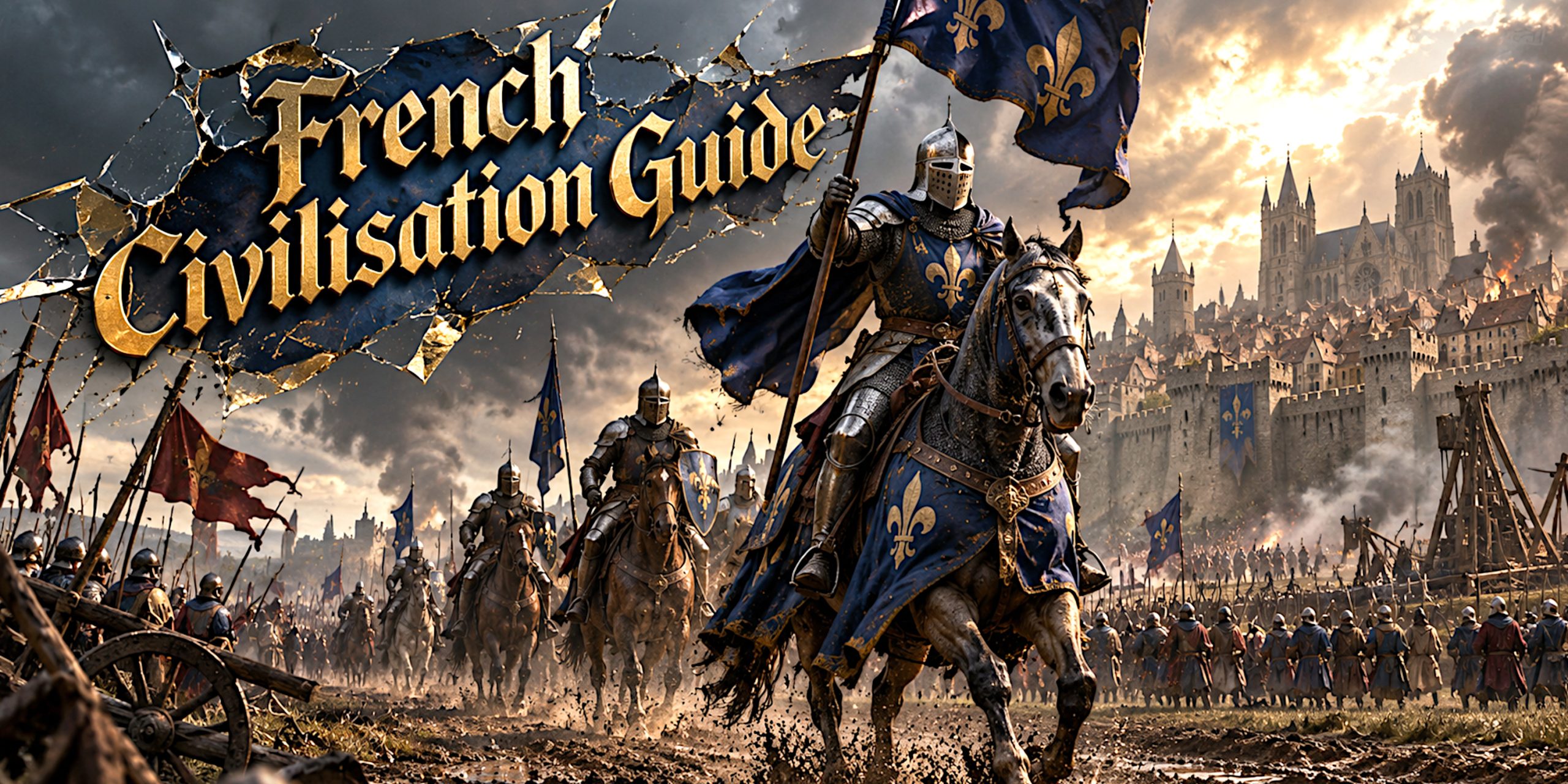
The French civilisation in Age of Empires IV offers a wonderfully direct proposition: build an efficient economy, produce Royal Knights in the Feudal Age and make your opponent regret placing their gold mine outside Town Centre range.
It is one of the most accessible civilisations for new players, but that does not make it simplistic. Strong French play depends on careful knight control, economic balance and knowing when early pressure has achieved enough. A handful of dead villagers looks impressive, but forcing idle time, denying resources and keeping every knight alive can be even more valuable.
The French are strongest when they dictate where the fighting happens. If the opponent is comfortably executing their own plan, something has probably gone slightly wrong.
French Civilisation Overview
| Category | Assessment |
|---|---|
| Difficulty | Beginner-friendly, with a high micro ceiling |
| Preferred strategy | Feudal aggression and economic expansion |
| Signature unit | Royal Knight |
| Secondary strength | Arbalétrier |
| Economic identity | Efficient upgrades and strong villager production |
| Best map types | Open land maps and trade-friendly maps |
| Main weakness | Expensive early army and predictable openings |
| Ideal playstyle | Mobile pressure supported by steady economic growth |
The French are particularly effective on open maps where cavalry can move freely between exposed resources. Their early Royal Knights threaten villagers, punish reinforcements and force opponents to spend resources on defensive units.
Behind that pressure, the French economy develops efficiently. Their bonuses make economic technologies cheaper, resource buildings less costly and villager production stronger. This creates a useful imbalance: the French player can apply pressure without necessarily sacrificing long-term growth.
Why Play the French?
The French suit players who enjoy taking the initiative. You do not need to launch reckless attacks every thirty seconds, but you should usually be asking questions of your opponent.
Can they protect their gold?
Are their spearmen covering the woodline?
Have they invested so heavily in defence that you can take a second Town Centre?
These are the decisions that make the civilisation interesting. French aggression is not simply about charging knights into whatever happens to be nearby. That approach usually produces several dead horses and a quiet sense of embarrassment.
Major strengths
- Royal Knights are available from the Feudal Age
- Strong early map control
- Faster villager production supports economic growth
- Economic technologies are more affordable
- Resource drop-off buildings cost less
- Excellent cavalry and ranged unit combinations
- Traders can return different resources
- Powerful defensive and artillery landmarks
- Strong transitions into the Castle and Imperial Ages
Main weaknesses
- Royal Knights require a large food and gold investment
- Early strategies can become predictable
- Spearmen and defensive buildings restrict cavalry movement
- Poor knight control can destroy the French economy
- Massed ranged units require protection from enemy cavalry
- The civilisation is less comfortable when trapped inside its base
- Closed maps can reduce the value of early mobility
French Civilisation Bonuses
The French economy is designed to develop efficiently while supporting expensive military units.
Their most important advantages include:
- Town Centres produce villagers more quickly as the match progresses
- Economic technologies are cheaper
- Resource drop-off buildings cost less
- Trade Posts are revealed on the map
- French traders can be assigned to return a chosen resource
- Blacksmith melee damage technologies are granted without the usual research process
- Keeps provide an influence that reduces the cost of units produced from nearby Archery Ranges and Stables
These bonuses work together neatly. Cheaper infrastructure helps the opening, faster villager production strengthens the middle game and military discounts become increasingly useful once French Keeps begin controlling important positions.
The civilisation rewards continuous production. If the Town Centre sits idle while the Stable is empty, the French bonuses are doing very little beyond looking decorative.
The Royal Knight
The Royal Knight is the centrepiece of the French army. It arrives in the Feudal Age, earlier than the standard heavy cavalry available to many civilisations.
Royal Knights combine mobility, armour and strong melee damage. They are excellent for:
- Raiding exposed villagers
- Denying gold and stone
- Intercepting reinforcements
- Hunting archers
- Controlling sacred sites and relic routes
- Forcing defensive structures
- Protecting French trade
- Supporting larger late-game armies
Royal Knights also benefit from abilities and technologies that improve their performance after charging or fighting. Exact values can change between balance updates, but their battlefield purpose remains consistent: hit vulnerable targets, disengage before the enemy surrounds them and attack again from another direction.
How to control Royal Knights
Do not leave them fighting spearmen simply because you looked away for a moment. Heavy cavalry is durable, but counter-units remain counters.
Use Royal Knights to circle the enemy position and approach from unexpected angles. A knight standing near a woodline can force villagers away without landing a single attack. That idle time matters.
Damaged knights should be withdrawn and preserved whenever possible. Early Royal Knights represent a major resource investment, and keeping them alive allows the pressure to grow. A group of veteran raiders is far more dangerous than a succession of heroic but extremely brief solo charges.
The French Economy
French military pressure relies on a powerful but demanding economy. Royal Knights consume substantial quantities of food and gold, while archers require wood. Expanding into siege, upgrades and additional Town Centres adds further strain.
Early economic priorities
The opening economy should concentrate on:
- Food for villagers and Royal Knights
- Gold for ageing up and producing heavy cavalry
- Wood for houses, military buildings and archers
- Stone only when planning a second Town Centre or defensive structure
Food and gold are the critical resources during the initial Feudal attack. Wood becomes increasingly important once the opponent begins producing spearmen and the French need archers to answer them.
Cheaper economic development
French economic technologies cost less than those of most civilisations. This makes technologies such as Wheelbarrow and resource-gathering improvements easier to incorporate.
Cheaper does not mean free. Researching every upgrade immediately can still delay military production. Prioritise technologies that benefit the resources carrying your strategy.
If most villagers are collecting food, an early food upgrade offers more value than improving a nearly empty lumber camp. It sounds obvious, yet strategy games have a special ability to make perfectly sensible people research things they are not using.
Faster villager production
The French produce villagers more rapidly, allowing their worker count to pull ahead naturally. This advantage becomes significant when both players maintain uninterrupted Town Centre production.
It also makes an additional Town Centre especially powerful. A French two-Town-Centre economy can grow rapidly while surviving on relatively modest military production, provided the first wave of knights has created enough safety.
The School of Cavalry Opening
The School of Cavalry is the standard Feudal Age landmark for aggressive French play. It functions as a Stable and helps establish Royal Knight production quickly.
This opening gives the French an immediate objective: reach the Feudal Age, produce a Royal Knight and threaten an exposed economic resource.
General opening structure
- Begin with a strong food income while assigning enough villagers to gold for the Feudal Age.
- Add the necessary house before reaching the population limit.
- Advance with the School of Cavalry in a forward but defensible part of the base.
- Maintain food and gold income during the age-up.
- Produce a Royal Knight as soon as resources allow.
- Scout the enemy gold, woodline and food sources.
- Add archers if the opponent responds with multiple spearmen.
- Continue making villagers throughout the attack.
This is a strategic framework rather than a rigid tournament build order. Map generation, sheep numbers, nearby resources and enemy civilisation all affect the ideal allocation.
Choosing the first target
The first Royal Knight does not need to kill a villager to be successful. Good targets include:
- An exposed gold mine
- Villagers building a military structure
- A distant deer pack
- Reinforcements moving across the map
- Workers constructing a second Town Centre
- A vulnerable trade route
Attack where the opponent is least prepared. Charging directly beneath the Town Centre because it is the first building you see is rarely the beginning of a sophisticated military career.
Royal Knights and Archers
The classic French Feudal army combines Royal Knights with archers.
Spearmen counter Royal Knights, while archers counter spearmen. The knights then protect the archers from enemy horsemen and other mobile units. It is a simple relationship, but positioning determines whether it works.
How to use the composition
- Keep Royal Knights ahead of the archers without becoming isolated
- Use archers to remove spearmen before committing the cavalry
- Attack from several directions when possible
- Avoid narrow spaces that allow spearmen to trap the knights
- Target enemy ranged units once the spearman screen breaks
- Preserve archers by moving them behind the cavalry
- Add a Battering Ram only when a committed push is likely to succeed
A small group of Royal Knights can remain active while the archers gather into a larger mass. This forces the opponent to defend several locations and makes it harder for them to position their spearmen correctly.
Chamber of Commerce and French Trade
The Chamber of Commerce offers a trade-focused alternative to the School of Cavalry. Its usefulness depends heavily on the map, the position of neutral Trade Posts and whether the route can be defended.
French traders have unusual economic flexibility because they can return a selected resource. This allows trade to support whatever the army currently requires, whether that is food, wood or gold.
A trade opening may be effective when:
- A long and relatively safe trade route is available
- The opponent lacks immediate raiding potential
- Team-mates can help protect the route
- The map encourages commercial play
- You intend to build a large mid-game economy
Trade is powerful, but exposed traders are fragile. A route that looks wonderfully profitable on paper becomes less convincing when six enemy horsemen arrive and begin conducting an aggressive audit.
Castle Age Landmarks
The French Castle Age landmarks support two distinct approaches.
Royal Institute
The Royal Institute improves access to the civilisation’s unique technologies and supports an elite military strategy.
Choose it when:
- Royal Knights remain central to your army
- You already control sufficient resources
- You want stronger unit quality
- The opponent is struggling to contain your field army
- You plan to press the advantage during the Castle Age
It is the natural landmark for players who want their Feudal aggression to develop into a more powerful cavalry assault.
Guild Hall
The Guild Hall stores resources and generates additional value over time. Its strength comes from patience and planning.
Choose it when:
- You expect a longer match
- You need a future resource reserve
- The immediate military upgrades from the Royal Institute are unnecessary
- The game has slowed into economic expansion
- You are preparing for an expensive technology or siege transition
The Guild Hall is at its best when the stored resource is left to accumulate. Constantly withdrawing tiny amounts wastes much of its economic potential. Think of it as a long-term investment, except one occasionally threatened by trebuchets.
Arbalétriers and the Castle Age Army
The Arbalétrier is the French unique crossbow unit. It is particularly effective against heavily armoured opponents, including men-at-arms and enemy knights.
A strong Castle Age composition may include:
- Royal Knights for mobility and frontline pressure
- Arbalétriers against armoured units
- Archers against spearmen and light infantry
- Mangonels against dense ranged formations
- Springalds or Culverins against enemy siege
- Monks for healing and relic control
- Battering Rams or Trebuchets against buildings
Royal Knights and Arbalétriers create a dangerous core because each unit helps address threats faced by the other. The cavalry can attack siege and vulnerable ranged units, while the crossbows punish the heavy infantry and cavalry that might otherwise hold the frontline.
Do not produce every available unit simply because the icons are attractive. Build according to what the opponent has actually fielded.
Imperial Age Landmarks
Red Palace
The Red Palace is a powerful defensive landmark with formidable ranged attacks. It can secure a vital route, resource cluster or vulnerable section of the base.
Good locations include:
- A central choke point
- The approach to the French trade line
- A large gold deposit
- A sacred site
- The centre of a forward production base
The Red Palace is strongest when it protects something strategically valuable. Placing it behind three layers of existing defences may keep it safe, but also turns a serious landmark into an unusually expensive garden ornament.
College of Artillery
The College of Artillery supports advanced siege warfare and gives the French access to improved artillery options.
Choose it when:
- The match has become siege-heavy
- The enemy relies on Keeps and fortified positions
- You need stronger anti-siege capability
- Your economy can sustain expensive artillery
- You are preparing a decisive Imperial Age push
French artillery can be devastating, but it needs protection. Royal Knights should patrol the flanks and intercept enemy cavalry attempting to reach the siege line.
Feudal Age Pressure
French Feudal aggression works best when it creates several forms of damage at once.
Direct damage includes killed villagers and destroyed buildings. Indirect damage includes idle workers, forced defensive units, delayed expansions and lost access to resources.
A successful attack might kill only one villager but still force the opponent to:
- Produce several spearmen
- Build an Outpost
- Abandon an exposed gold mine
- Delay their Castle Age
- Keep their army at home
- Give up control of deer or sacred sites
That is a perfectly good exchange. The French economy continues growing while the opponent pays for safety.
The danger comes from overcommitting. If the opponent has secured every resource with spearmen, walls and Outposts, repeatedly charging into the same position will not improve matters. Use the map control to expand, trade or advance to the Castle Age.
The Two-Town-Centre Strategy
The French are excellent at converting early pressure into economic expansion.
A common sequence is:
- Produce a small group of Royal Knights
- Force defensive units from the opponent
- Secure map control
- Gather stone
- Build a second Town Centre
- Continue light cavalry pressure
- Outgrow the opponent through faster villager production
The placement of the second Town Centre matters. Ideally, it should secure valuable resources such as food, wood and gold while remaining defensible.
This strategy is vulnerable during the transition. Stone collection and Town Centre construction temporarily reduce military output. Scout carefully before committing. If the opponent is preparing a large attack, adding more knights may be wiser than laying the foundations for an economic future you will not live to enjoy.
How to Play Against Spearmen
Spearmen are the most obvious answer to Royal Knights. They are inexpensive, accessible and dangerous when they brace against a cavalry charge.
The correct response is rarely to stop producing Royal Knights entirely.
Instead:
- Add Archery Ranges
- Produce archers
- Avoid direct frontal charges
- Force spearmen to move between several locations
- Attack reinforcements before they join the main army
- Use cavalry to threaten the economy
- Engage only after the archers weaken the spear line
Spearmen are slow. Royal Knights are not. Use that difference.
A defensive group of spearmen can protect one gold mine effectively. It cannot protect the gold, woodline, deer pack and reinforcements simultaneously unless the French player kindly attacks the same spot every time.
How to Play Against Defensive Bases
Walls, towers and tightly packed resources can make early raiding difficult. The French player then has several alternatives.
Expand economically
Use the opponent’s passive defence as permission to take additional resources, add a Town Centre or establish trade.
Attack elsewhere
Control neutral food, sacred sites and important crossings. The opponent may be safe inside their base but unable to access much of the map.
Prepare siege
Add Battering Rams for a serious Feudal push or advance towards Trebuchets in the Castle Age.
Deny reinforcements
Even when the main economy is protected, military units moving across the map may be exposed. Royal Knights are excellent at intercepting small groups before they combine.
Patience matters. A fortified opponent often wants the French player to become frustrated and take an awful fight. There is no requirement to fulfil their emotional needs.
French Play in Team Games
The French are particularly dangerous in team games because larger maps provide more space for cavalry movement and longer trade routes.
Royal Knights can move rapidly between opponents, punish isolated economies and reinforce allies. French trade also becomes easier to establish when a friendly market creates a long route behind the team’s defensive line.
Strong team-game roles include:
- Early cavalry pressure
- Raiding several enemy economies
- Protecting allied ranged armies
- Establishing a large trade economy
- Producing elite cavalry in the late game
- Destroying enemy siege
- Supporting a combined push with artillery
Communication is important. Royal Knights can arrive quickly, but only if the French player knows where help is needed.
French Play on Closed Maps
Closed maps reduce the immediate value of cavalry raids. Narrow approaches, walls and protected resources make it harder to threaten villagers during the Feudal Age.
The French can still succeed by leaning into:
- Economic upgrades
- Fast villager production
- Trade
- Relic control
- Arbalétriers
- Keep influence
- Imperial artillery
On these maps, the civilisation becomes less focused on early harassment and more concerned with efficient scaling. Royal Knights remain useful, especially for map control and counter-attacks, but they may not define the entire match.
Common French Mistakes
Producing too many early knights
Royal Knights are powerful but expensive. Producing them continuously without achieving damage can delay upgrades, archers and the Castle Age.
Ignoring villager production
Military pressure does not excuse an idle Town Centre. The French economic bonus depends on consistent worker production.
Fighting spearmen head-on
The knight is elite heavy cavalry, not a magical horse-shaped solution to every military problem.
Forgetting ranged support
Once the opponent masses spearmen, archers become essential. Cavalry mobility creates openings, but ranged units make those openings usable.
Remaining in the Feudal Age too long
Early pressure should produce an advantage, not become a lifestyle. If the opponent has stabilised, convert map control into an expansion or age-up.
Neglecting scouting
The French opening is strongest when it responds to enemy decisions. Without scouting, you may build the wrong army or discover an enemy second Town Centre several minutes too late.
Throwing away damaged knights
Withdraw weakened units, heal them where possible and return later. Preserving expensive cavalry is a major part of French efficiency.
Match-Up Principles
Exact build orders change with maps, opponents and balance patches, but several principles remain reliable.
| Opponent’s approach | French response |
|---|---|
| Massed spearmen | Add archers and raid several locations |
| Early men-at-arms | Advance towards Arbalétriers or maintain mobility |
| Ranged infantry | Use Royal Knights to flank and engage |
| Defensive expansion | Pressure exposed resources or expand yourself |
| Fast Castle Age | Deny gold and punish the weak transition |
| Cavalry raids | Defend with spearmen, walls and careful knight positioning |
| Siege-heavy army | Flank with cavalry and add anti-siege units |
| Static fortifications | Expand, control the map or prepare dedicated siege |
A Simple French Game Plan
Dark Age
- Gather food and gold efficiently
- Scout the opponent and locate vulnerable resources
- Build the School of Cavalry for a standard aggressive opening
- Avoid supply blocks
Feudal Age
- Produce the first Royal Knight quickly
- Pressure gold, food or wood
- Add archers against spearmen
- Research relevant economic technologies
- Decide between continued aggression, a second Town Centre or a Castle Age transition
Castle Age
- Add Arbalétriers against armoured armies
- Collect relics where possible
- Establish Keeps around important production areas
- Improve unit quality
- Introduce siege based on the enemy composition
Imperial Age
- Protect siege and trade
- Use the Red Palace to secure a critical position or the College of Artillery to strengthen offensive siege
- Maintain raids against remote resources
- Replace losses without collapsing the economy
- Force the enemy to defend several areas at once
Advanced French Tactics
The charge and disengage
Use the Royal Knight’s initial impact, then pull back before enemy spearmen surround it. Re-engage once the opposing formation breaks or the spearmen begin chasing.
Multi-directional raiding
Split cavalry into small groups and threaten several resource lines. This demands more control, but it stretches defensive armies and increases idle time.
Vision pressure
A Royal Knight does not always need to attack. Keeping one near an exposed resource provides vision and discourages villagers from returning.
Production under Keep influence
Place Stables and Archery Ranges near a French Keep to benefit from reduced unit costs. Over a long match, this can save a considerable quantity of resources.
Strategic resource switching
When using trade, direct traders towards the resource your current plan consumes most heavily. Cavalry production needs food and gold, while massed archers and siege place greater pressure on wood.
Hiding the transition
Continue showing a few Royal Knights while secretly gathering stone or advancing to the Castle Age. The opponent may continue overproducing spearmen against an attack that is no longer coming.
Are the French Good for Beginners?
Yes. The civilisation has a clear identity, straightforward economic bonuses and an early unit that can recover from positioning mistakes more easily than fragile infantry.
The French also teach several useful fundamentals:
- Constant villager production
- Scouting before attacking
- Managing food and gold
- Combining complementary units
- Preserving expensive troops
- Converting military pressure into economic advantage
- Using mobility instead of taking every available fight
However, climbing beyond the beginner level requires better cavalry control. Royal Knights invite aggressive play, but careless aggression becomes expensive very quickly.
Final Verdict
The French remain one of the clearest examples of tempo-based civilisation design in Age of Empires IV. Their Royal Knights apply immediate pressure, their economic bonuses support sustained production and their later armies combine elite cavalry, crossbows and powerful artillery.
Their game plan is easy to understand but difficult to perfect. The real skill lies in judging how much pressure is enough. Sometimes the correct move is another wave of knights. Sometimes it is a second Town Centre. Occasionally it is leaving one deeply irritating cavalry unit beside the enemy gold mine while quietly building an economy twice the size of theirs.
Play actively, preserve your Royal Knights and treat map control as an economic resource. The French are at their best when the opponent is reacting to them rather than the other way around.