Bellerophon was one of the great heroes of early Greek mythology, a monster-slayer who mastered Pegasus, defeated the Chimera and survived every attempt to have him discreetly killed. He possessed courage, divine favour and the sort of heroic pedigree that usually ended with a kingdom.
Instead, his story closes with isolation.
According to Homer, Bellerophon became hated by the gods and wandered alone across the Aleian Plain, avoiding humanity and consuming his own spirit. Later poets connected this downfall with an attempt to ride Pegasus to Mount Olympus. The hero who had conquered the sky forgot that it still belonged to the gods.
It is a wonderfully Greek ending. Success is permitted. Excellence is admired. Trying to park your horse outside the palace of Zeus is generally considered excessive.
Who Was Bellerophon?
Bellerophon, also called Bellerophontes, was a Corinthian hero most famous for killing the Chimera. His story connects Corinth in mainland Greece with Lycia in south-western Anatolia, where he completed his greatest deeds and established a heroic dynasty.
The earliest substantial surviving account appears in Book 6 of Homer’s Iliad. It is told by the Lycian warrior Glaucus, Bellerophon’s grandson, during an encounter with the Greek hero Diomedes.
| Detail | Mythological tradition |
|---|---|
| Homeland | Corinth, also called Ephyra in early poetry |
| Mortal father | Glaucus, son of Sisyphus |
| Divine father | Poseidon in some traditions |
| Mother | Eurynome or Eurymede |
| Famous mount | Pegasus |
| Greatest enemy | The Chimera |
| Other opponents | The Solymi, Amazons and Lycian warriors |
| Wife | A daughter of the Lycian king, usually called Philonoe |
| Children | Isander, Hippolochus and Laodamia |
| Grandson | Glaucus, a Lycian commander in the Iliad |
| Principal weapon | Spear |
| Fatal failing | An attempt to rise beyond mortal limits in later accounts |
Bellerophon belongs to an older generation of heroes than those who fought at Troy. His grandson Glaucus served among the Trojan allies, placing Bellerophon in the age before Achilles, Hector and Odysseus.
He is sometimes overshadowed today by Heracles and Perseus, partly because later retellings often give Pegasus to Perseus. Ancient Greek tradition was much clearer: Perseus produced Pegasus by killing Medusa, but Bellerophon was the hero who rode him.
The Meaning of Bellerophon’s Name
The name Bellerophontes appears to mean “slayer of Belleros”, although the identity of Belleros is uncertain. Later commentators attempted to explain this by claiming that the hero had killed a Corinthian named Belleros, either accidentally or deliberately.
Another tradition gives Bellerophon the original name Hipponous. After committing the killing, he supposedly became known by the name commemorating his victim. Greek heroic names can be brutally literal.
The murder does not appear in Homer’s account. It may have developed later to explain both the hero’s unusual name and his need to leave Corinth. Some versions instead say that he accidentally killed his brother, whose name varies between Deliades, Peiren and Alcimenes.
Whatever the victim’s identity, Bellerophon travelled to the court of King Proetus at Tiryns to receive ritual purification. In Greek thought, even an accidental killing created a form of religious pollution. A person could not simply feel rather bad about it and carry on.
The Accusation of Queen Anteia
At Tiryns, Bellerophon became the guest of King Proetus. The king’s wife, called Anteia by Homer and Stheneboea in later traditions, desired the young hero and attempted to seduce him.
Bellerophon refused her.
Humiliated by the rejection, Anteia accused him of trying to violate her. She demanded that Proetus kill him, but the king faced a serious religious problem. Bellerophon had entered his household as a guest, and the sacred rules of hospitality protected him.
Rather than murder Bellerophon directly, Proetus sent him to Lycia carrying a folded tablet marked with signs instructing the recipient to kill its bearer. The message went to Anteia’s father, the Lycian king usually known as Iobates.
This episode provided later literature with the idea of a “Bellerophontic letter”, meaning a message unknowingly carried by someone that orders their own death.
The accusation resembles several stories from the ancient Mediterranean and Near East, including the tale of Joseph and Potiphar’s wife. It belongs to a wider narrative pattern in which rejected desire becomes a false charge, leaving an innocent man to face punishment.
What makes the Bellerophon story particularly cruel is its politeness. Nobody wishes to violate the rules of hospitality, so the intended murder is passed from one royal household to another.
Bellerophon Arrives in Lycia
King Iobates welcomed Bellerophon and entertained him for nine days before examining the message from Proetus. Once he discovered what his guest was carrying, he found himself trapped by the same religious customs.
Killing a guest at his own table would offend Zeus Xenios, the divine protector of hospitality. Iobates therefore devised a more respectable form of murder: an impossible military assignment.
He ordered Bellerophon to kill the Chimera.
The king expected the monster to solve his problem without leaving any awkward bloodstains in the palace.
How Bellerophon Tamed Pegasus
Homer does not say that Bellerophon rode Pegasus against the Chimera. The winged horse became central to the story in other early Greek traditions, most famously in Pindar’s thirteenth Olympian Ode.
Bellerophon longed to capture Pegasus at the spring of Peirene in Corinth but could not master him. The seer Polyeidos advised the hero to sleep at an altar of Athena. During the night, the goddess appeared and gave him a golden bridle.
When Bellerophon awoke, he found the bridle beside him. He sacrificed to Poseidon and established an altar to Athena Hippia, Athena in her equestrian aspect. With the divine bridle, he approached Pegasus and brought the winged horse under control.
Pindar presents the moment as a union of courage, religious obedience and divine assistance. Bellerophon does not conquer Pegasus through brute strength. He succeeds because he listens, performs the correct rituals and accepts a gift from Athena.
Pegasus was no ordinary horse. In Hesiod’s Theogony, he sprang from the severed neck of Medusa after Perseus killed her. Poseidon was his father, which creates an intriguing relationship with Bellerophon, who was also considered a son of Poseidon in some traditions.
Rider and horse may therefore have been half-brothers. Greek mythology occasionally produces family arrangements that make even the Olympian genealogists reach for another cup of wine.
The Chimera
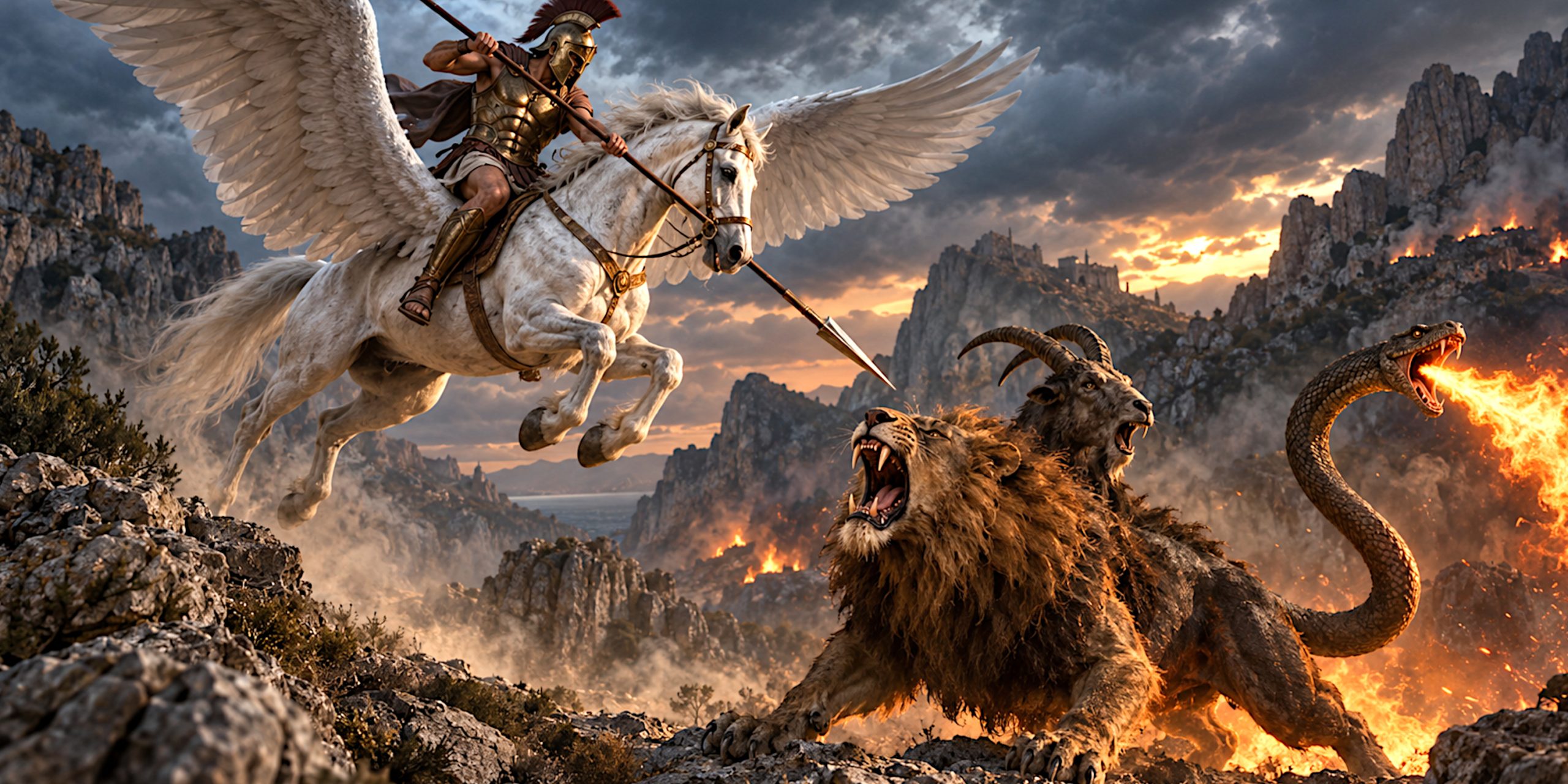
The Chimera was one of the most disturbing composite creatures in Greek mythology. Homer describes it as divine rather than mortal, with the front of a lion, the middle of a goat and the rear of a serpent. It breathed fire.
Later artists and writers varied its anatomy, but the usual image shows a lion with a goat’s head rising from its back and a snake forming its tail.
The monster was associated with Lycia and was said to be the offspring of Typhon and Echidna, the monstrous pair responsible for several of Greek mythology’s less welcoming creatures. Its siblings included Cerberus and the Lernaean Hydra.
Bellerophon attacked from the back of Pegasus, using the horse’s flight to stay beyond the Chimera’s claws and flames. Ancient vase paintings normally show him striking with a spear.
A later version claims that he fixed a lump of lead to his spear and thrust it into the Chimera’s mouth. The creature’s fiery breath melted the metal, which ran into its throat and killed it. It is an ingenious story, although it is not found in Homer and should not be treated as part of the earliest surviving tradition.
The essential act remains the same: Bellerophon defeated a creature that combined animal savagery, supernatural fire and a landscape hostile to human settlement.
What Did Bellerophon’s Victory Mean?
Monster-slaying myths often place a hero between civilisation and chaos. The monster occupies land, blocks travel or makes ordinary life impossible. The hero removes it and restores a habitable world.
The Chimera may also reflect Greek impressions of the unfamiliar geography and traditions of Lycia. Ancient writers later attempted to rationalise its flames through reports of burning gases emerging from the Lycian landscape. Such explanations are interesting, but they do not necessarily tell us how the myth began.
The story also had political importance at Corinth. Pegasus became one of the city’s most recognisable symbols and appeared extensively on Corinthian coinage. The tale linked a prestigious local hero with Athena, Poseidon and the celebrated spring of Peirene.
Bellerophon was therefore more than an entertaining monster-slayer. He helped Corinth describe itself.
The Solymi and the Amazons
Killing the Chimera should have ended Bellerophon’s troubles. Iobates, however, was still trying to fulfil the request contained in Proetus’ message.
The king next sent him against the Solymi, a fierce people associated with the mountains of south-western Anatolia. Homer calls this the most difficult battle Bellerophon fought.
After defeating the Solymi, Bellerophon was ordered to fight the Amazons. He overcame them as well. Later accounts naturally place him on Pegasus during these campaigns, although Homer again says nothing about the horse.
Finally, Iobates selected the strongest Lycian warriors and placed them in ambush. Bellerophon killed every one of them.
At this point, the evidence was becoming difficult for the king to ignore. Either Bellerophon was favoured by the gods, or Lycia was suffering an extraordinary run of recruitment problems.
Bellerophon Becomes a Lycian Prince
Iobates eventually abandoned his attempts to kill Bellerophon. He showed the hero Proetus’ message, recognised his divine ancestry and offered him his daughter in marriage.
Bellerophon received half the royal honours and was granted a fertile estate by the Lycians. He had survived exile, a false accusation, a fire-breathing monster, two military campaigns and an ambush. For a time, his story appeared to have reached the traditional heroic conclusion.
His children were:
- Isander, who was killed while fighting the Solymi
- Hippolochus, father of the Trojan warrior Glaucus
- Laodamia, also called Deidamia in some sources, who bore Sarpedon to Zeus
Laodamia was later killed by Artemis. Homer presents these family deaths as part of Bellerophon’s wider decline. His victories were immense, but they did not protect his household from divine hostility.
Bellerophon’s Weapons and Fighting Style
Ancient art most often depicts Bellerophon as a mounted spearman. His weapons belong to the visual language of the Greek warrior, even when the flying horse makes the scene rather less conventional.
Spear
The spear was Bellerophon’s principal weapon against the Chimera. On painted pottery, he is usually shown driving it downwards while Pegasus passes above or beside the monster.
A spear made practical sense for a mounted attack. It allowed the rider to strike while keeping some distance from the Chimera’s jaws, claws and flames. Whether Greek artists were considering practical aerial combat is another matter.
Sword
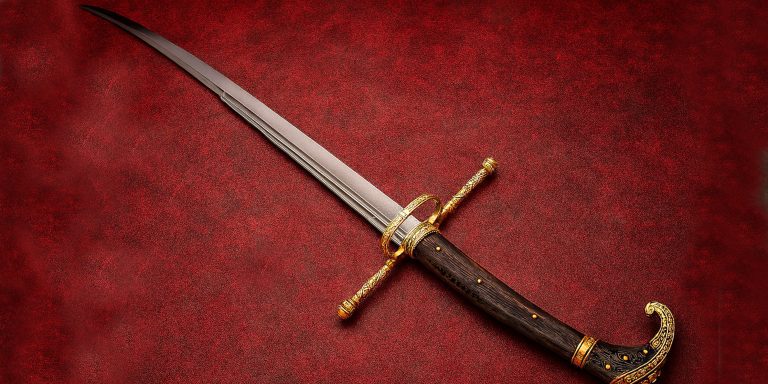
Bellerophon occasionally appears with a sword as part of his warrior’s equipment, although it is not normally the weapon used to kill the Chimera. Depending on the artistic period, this might resemble the straight, double-edged swords carried by Greek warriors.
It would be misleading to assign him one fixed historical sword type. Bellerophon was represented for centuries, and artists dressed mythical figures according to the military equipment familiar in their own age.
Armour
Early representations may show Bellerophon wearing a helmet, cuirass and greaves, while other images present him in lighter clothing or heroic nudity. His equipment changes with artistic fashion.
The consistent elements are Pegasus, the spear and the Chimera. Without those, he risks looking like almost any other Greek hero having a difficult afternoon.
The Attempt to Reach Olympus
Homer never explains why Bellerophon became hated by the gods. He simply gives us the haunting conclusion:
“He wandered alone over the Aleian plain, eating out his own heart, shunning the paths of men.”
Later tradition supplied a cause. Having achieved more than almost any mortal hero, Bellerophon attempted to ride Pegasus to Mount Olympus, the home of the gods.
His motives vary. Some writers present the journey as outright arrogance. Others imply that he wished to expose the gods, prove his own divinity or escape the limits of mortal life.
Zeus prevented the ascent. In the familiar version, he sent a gadfly to sting Pegasus. The horse reared, and Bellerophon fell back to earth. Pegasus continued to Olympus, where he entered the service of Zeus and carried the god’s thunderbolts.
The fate of Bellerophon after the fall is inconsistent. He may have been crippled, blinded or left to wander in misery. The details matter less than the reversal. The master of the skies was returned violently to the ground.
Was Bellerophon Guilty of Hubris?
Bellerophon is frequently described as a straightforward example of hubris, the excessive pride that leads a mortal to challenge divine order. That interpretation suits the attempted flight to Olympus, but it simplifies the older story.
In the Iliad, Bellerophon’s offence is never identified. Homer’s silence makes the ending more unsettling. Divine favour can disappear without a clear explanation, and heroic success provides no lasting security.
Pindar’s treatment is more explicit. He warns that a person should seek what is appropriate to mortals and presents Bellerophon’s final ambition as a violation of that boundary.
Yet Bellerophon had good reason to believe himself exceptional. He may have been the son of Poseidon. Athena had assisted him. Pegasus accepted him. He survived every ordeal set before him.
His mistake was not imagining that he was favoured by the gods. He plainly was. His mistake was assuming that divine favour made him one of them.
That distinction gives the myth its lasting force. Bellerophon is not destroyed because he lacks greatness, but because greatness distorts his sense of where he belongs.
Pegasus After Bellerophon
Pegasus survives the fall and reaches Olympus. There he becomes associated with Zeus, carrying thunder and lightning for the king of the gods.
Later tradition also connected Pegasus with the Muses. A strike of his hoof was said to have created the Hippocrene spring on Mount Helicon, whose waters inspired poets.
This creates a bitter contrast between horse and rider. Pegasus completes the ascent that Bellerophon could not. The immortal creature enters the divine world, while the mortal hero is left below.
Modern retellings sometimes treat Pegasus as Bellerophon’s loyal companion in a sentimental sense. Ancient myth is less comforting. Pegasus was a divine animal temporarily ridden by a human being. He was never truly Bellerophon’s possession.
Bellerophon in Ancient Greek Art
Bellerophon’s battle with the Chimera appeared in Greek art from an early period. The subject was particularly important at Corinth, where both the hero and Pegasus had strong local associations.
Artists represented the pair on:
- Painted pottery
- Corinthian coins
- Terracotta plaques
- Architectural decoration
- Engraved gems
- Mosaics and Roman reliefs
A famous Proto-Corinthian example appears on an aryballos found at Thebes and generally dated to the seventh century BCE. Bellerophon rides Pegasus towards the Chimera, creating one of the earliest surviving visual treatments of the battle.
The popularity of the scene in seventh-century Corinthian art suggests that the myth already held considerable civic importance. Pegasus later became so closely associated with Corinthian coinage that the coins themselves were sometimes called “colts”.
The image was perfectly suited to a coin. It was distinctive, local and immediately recognisable, which is more than can be said for several ancient rulers whose portraits seem to consist mainly of an ambitious chin.
The Lost Tragedies of Bellerophon
Bellerophon appeared in several Greek tragedies, although most survive only in fragments.
Euripides wrote plays titled Bellerophon and Stheneboea. The first seems to have explored the hero’s suffering, doubt and attempted ascent to heaven. Fragments suggest a Bellerophon deeply troubled by apparent injustice in the world.
In Stheneboea, Euripides developed the story of Proetus’ wife and her false accusation. Later summaries claim that Bellerophon took revenge by persuading her to mount Pegasus, then throwing her into the sea.
This version makes him considerably less sympathetic. It may also reflect tragedy’s habit of complicating heroic reputations rather than preserving spotless moral examples.
Bellerophon was never a single, stable character. Homer’s doomed warrior, Pindar’s overreaching rider and Euripides’ embittered hero overlap, but they are not identical.
Bellerophon and Perseus: Who Rode Pegasus?
Bellerophon rode Pegasus. Perseus did not, at least not in the standard ancient Greek accounts.
The confusion arose largely through later art, literature and popular culture. Pegasus was born when Perseus beheaded Medusa, so the two naturally became associated. Later artists sometimes placed Perseus on the winged horse during the rescue of Andromeda.
| Hero | Connection with Pegasus |
|---|---|
| Perseus | His killing of Medusa caused Pegasus to be born |
| Bellerophon | Tamed and rode Pegasus against the Chimera |
| Zeus | Received Pegasus on Olympus after Bellerophon’s fall |
If a hero is shown fighting a sea monster to rescue Andromeda, it is Perseus. If he is driving a spear into a fire-breathing hybrid creature, it is Bellerophon.
The distinction is simple, although modern films and paintings have spent several centuries making it less so.
The Historical Landscape Behind the Myth
Bellerophon’s story moves between Corinth, Tiryns and Lycia, linking communities on opposite sides of the Aegean. This geographical reach may preserve memories of early contact between Greece and Anatolia, but the myth cannot be read as a straightforward record of migration or warfare.
Lycia was a real region with its own language, political traditions and cultural identity. Greek settlement and influence developed there over time, particularly during the Archaic and Classical periods.
The Solymi may reflect peoples associated with the mountains around Lycia and Pisidia, although attempts to identify them precisely remain uncertain. The Chimera also became connected with the burning ground near Mount Chimaera, where natural gas vents produced persistent flames.
Ancient authors noticed the landscape and used it to rationalise the monster. Whether the natural fires originally inspired the myth is impossible to prove. Myth and geography tend to grow together until separating them becomes rather like trying to return wine to the grape.
Why Bellerophon Matters
Bellerophon’s career follows a striking rise and fall:
- He begins as a polluted exile.
- He resists temptation but is falsely accused.
- He receives divine assistance.
- He masters Pegasus.
- He kills the Chimera.
- He defeats armies and survives an ambush.
- He marries into royalty.
- He loses his children and the favour of the gods.
- He attempts to rise to Olympus.
- He ends alone.
The structure feels almost modern in its severity. Bellerophon earns his success through courage and restraint, yet achievement gradually separates him from ordinary humanity. Flight becomes both his greatest power and the source of his ruin.
His story also questions the relationship between talent and entitlement. Divine gifts may raise a mortal above other people, but they do not erase mortality. The Greeks admired exceptional individuals while remaining suspicious of anyone who believed the normal limits no longer applied to them.
Bellerophon’s Legacy
Bellerophon never achieved the later fame of Heracles, Achilles or Odysseus, but his imagery has proved remarkably durable. A warrior riding a winged horse against a fire-breathing monster requires very little explanation.
His influence survives in literature, visual art, heraldry, astronomy and modern fantasy. The name “Bellerophon” has been applied to ships, military operations and fictional characters, usually with an emphasis on daring or ascent. Anyone choosing the name might wish to read the final chapter first.
Pegasus eventually escaped the boundaries of Bellerophon’s myth and became an independent symbol of imagination, poetry and freedom. The rider was left behind.
That may be the final irony of the story. Bellerophon achieved the impossible, but the world remembered his horse more fondly.
Takeaway
Bellerophon is often introduced as the man who killed the Chimera. That is accurate, but it is not what makes him compelling.
His defining moment comes later, when triumph has already become familiar. He possesses fame, military power, royal status and the only reliable means of air travel in the heroic age. Still, it is not enough.
As a historian, I find Homer’s quieter ending more affecting than the spectacular fall from Pegasus. There is no thunderbolt and no neat explanation. The hero simply loses his place among gods and people, wandering alone while his victories recede behind him.
The later flight to Olympus gives the story a moral. Homer gives it loneliness.
Both versions understand something uncomfortable about ambition. Reaching extraordinary heights does not teach a person when to stop climbing.