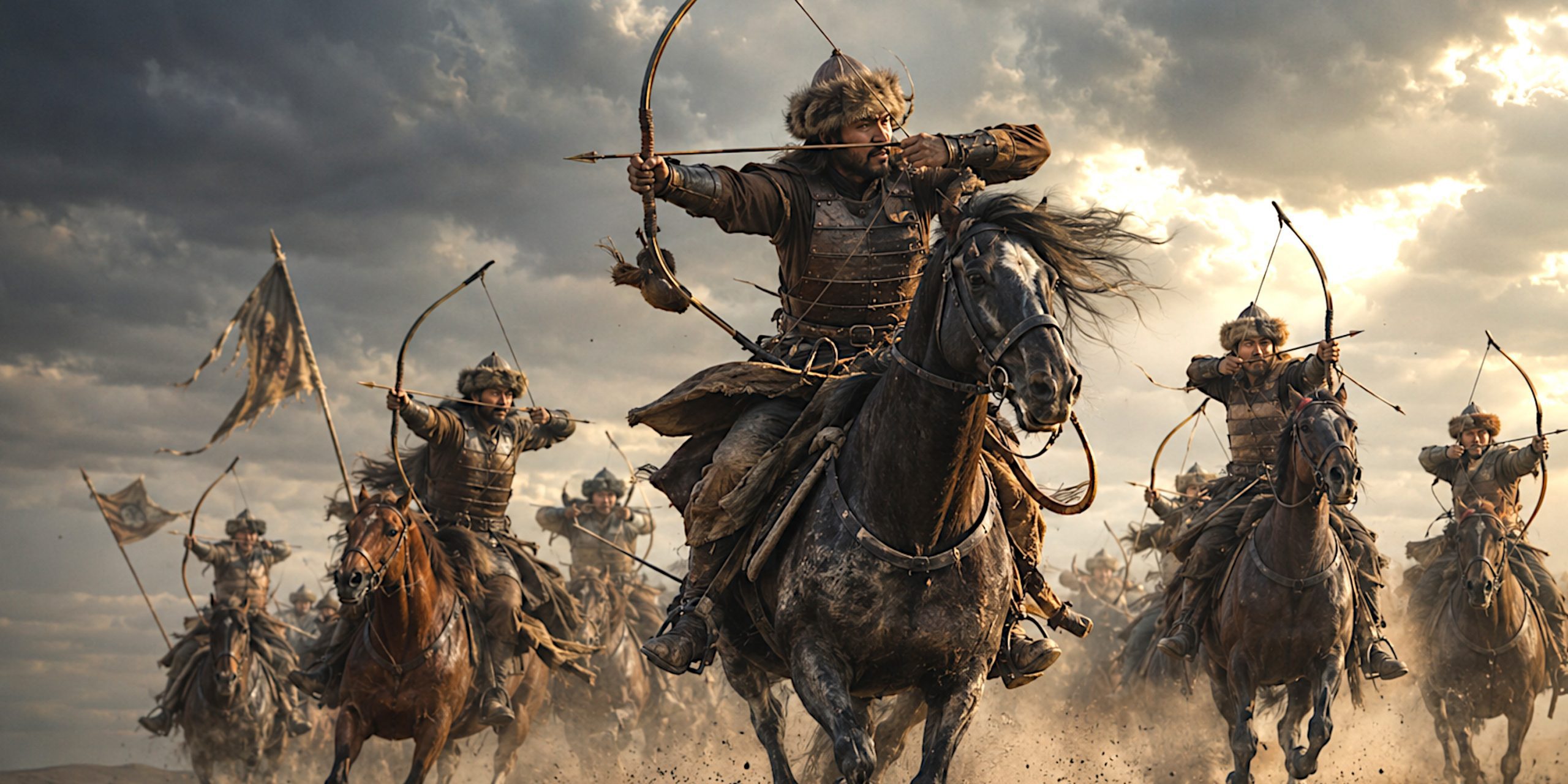
The Magyar horse archers were among the most feared warriors of early medieval Europe. Fast, disciplined and masters of mounted archery, they appeared almost without warning across the continent during the late ninth and early tenth centuries, raiding as far west as Spain and as far south as Italy. To their enemies, they often seemed impossible to catch. Armies that expected a straightforward battle instead found themselves chasing riders who fired deadly arrows while retreating, only to wheel around and attack again.
It is tempting to dismiss the Magyars as little more than raiders on horseback. That would be a mistake. Behind their spectacular campaigns lay a sophisticated military tradition inherited from centuries of life on the Eurasian Steppe. Their methods reflected generations of adaptation, combining mobility, discipline and remarkable horsemanship into one of the most effective military systems of the early Middle Ages.
Ironically, their greatest victories also hastened their transformation. By the end of the tenth century, the Magyars had begun abandoning the nomadic military traditions that had made them famous, replacing them with the feudal armies of Christian Europe. The horse archers who once terrified kings gradually became legends.
Origins of the Magyar Horse Archers
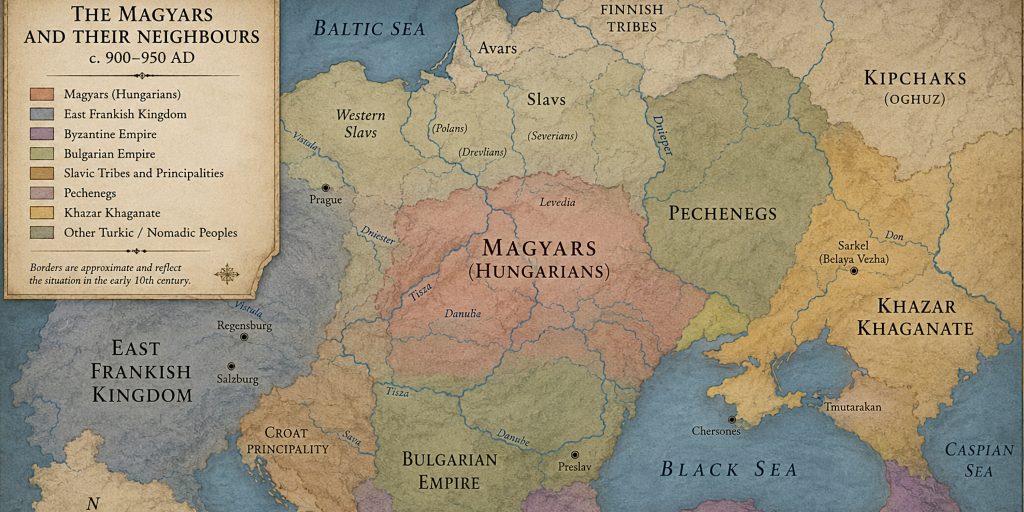
The ancestors of the Magyars originated east of the Carpathian Mountains on the vast Eurasian Steppe. Their culture shared many characteristics with neighbouring Turkic and Ugric peoples, although their language belongs to the Uralic family.
For centuries they lived as semi-nomadic pastoralists, raising horses, cattle and sheep while migrating across enormous distances. Survival demanded exceptional riding skills from childhood. Boys learned to ride almost before they could walk, while hunting from horseback developed the same skills later used in warfare.
By the late ninth century, pressure from rival peoples, particularly the Pechenegs, pushed the Magyar tribal confederation westward under the leadership traditionally associated with Grand Prince Árpád.
In about 895 they crossed the Carpathians and settled in the Carpathian Basin, laying the foundations of medieval Hungary.
A Warrior Society Built Around Horses
The horse shaped almost every aspect of Magyar life.
A successful warrior might own several horses, each trained for different purposes. Campaigns often involved changing mounts throughout the day, allowing remarkable operational endurance that astonished western observers.
Unlike many contemporary European armies, which relied upon seasonal levies, Magyar warriors belonged to a military culture where mounted combat was part of everyday existence.
Their mobility allowed them to:
- Travel extraordinary distances in short periods
- Live off the land
- Cross rivers rapidly
- Avoid prolonged sieges
- Strike vulnerable targets unexpectedly
- Withdraw before larger armies assembled
This flexibility made them extraordinarily difficult opponents.
The Magyar Way of War
The Magyar military system revolved around speed rather than brute force.
Instead of seeking immediate decisive battles, commanders preferred to exhaust, confuse and isolate opponents.
Typical campaigns followed a familiar pattern.
- Long-distance reconnaissance
- Rapid advance
- Surprise attack
- Mounted archery harassment
- Feigned retreat
- Encirclement
- Final assault against exhausted enemies
These methods had been perfected across generations of steppe warfare.
Many western commanders underestimated them, assuming apparent retreats signalled panic. Instead, they often found themselves lured into carefully prepared ambushes.
As military traps go, pretending to lose remains surprisingly effective. Human optimism has always been wonderfully exploitable.
Mastery of Mounted Archery
Mounted archery was the defining skill of Magyar warfare.
Unlike infantry archers, Magyar horsemen remained in constant motion. Riders controlled their horses with knees and body movement while drawing powerful composite bows.
Experienced archers could fire accurately:
- While galloping
- During rapid turns
- While retreating
- From either side of the horse
- Behind themselves using the famous “Parthian shot”
Continuous movement made them exceptionally difficult targets.
Rather than overwhelming opponents with a single volley, they gradually wore enemy formations down through repeated attacks before exploiting gaps with close combat.
Arms and Armour
Composite Bow
The composite bow formed the heart of Magyar military power.
Constructed from layers of wood, horn and sinew bonded with natural adhesives, these bows generated exceptional power despite their compact size.
They were ideal for mounted warfare because they remained short enough for use on horseback while delivering tremendous penetrating force.
Archaeological examples suggest draw weights capable of piercing mail armour at practical combat ranges.
Swords
Although remembered primarily as archers, the Magyars carried an impressive range of swords.
Common examples included:
Steppe Sabres
The slightly curved sabre became increasingly common during the ninth and tenth centuries.
Advantages included:
- Excellent cutting ability
- Fast recovery between strikes
- Effective from horseback
- Ideal for slashing attacks during high-speed passes
Many excavated sabres display elegant curved blades with simple crossguards and suspension fittings designed for mounted use.
Straight Double-Edged Swords
Some wealthier warriors carried straight swords influenced by Carolingian or Frankish designs.
These weapons offered:
- Greater thrusting capability
- Better performance in close infantry combat
- High prestige among elite warriors
Imported Frankish blades occasionally appear in Magyar graves, reflecting trade, diplomacy and perhaps battlefield trophies.
Spears
Light lances and throwing spears supplemented bows.
These weapons became particularly useful once enemy formations began breaking apart.
Axes
Axes appear less frequently than among Scandinavian warriors but were still present, especially among wealthier fighters.
Daggers and Knives
Every warrior carried utility knives alongside dedicated fighting blades.
Armour and Protective Equipment
The typical Magyar warrior relied upon mobility rather than heavy protection.
Equipment varied according to wealth.
Common protection included:
- Leather armour
- Quilted jackets
- Fur-lined clothing
- Reinforced lamellar armour among elites
Mail shirts existed but appear relatively uncommon compared with western Europe.
Helmets often consisted of:
- Iron conical helmets
- Nasal guards
- Segmented construction
- Decorative bronze fittings for high-status warriors
Shields were generally small and practical for mounted combat, allowing greater freedom while shooting.
Horses: The Greatest Weapon
Without exceptional horses there would have been no Magyar military success.
Steppe horses were:
- Tough
- Hardy
- Small but remarkably resilient
- Able to survive on poor grazing
- Adapted to long-distance travel
Warriors frequently rode multiple horses during campaigns.
This allowed astonishing operational speed that western chroniclers struggled to comprehend.
Famous Campaigns
The Battle of Pressburg (907)
Perhaps the greatest Magyar victory came near Pressburg, where they decisively defeated Bavarian forces attempting to drive them from the Carpathian Basin.
The battle secured Magyar settlement and effectively guaranteed the survival of the emerging Hungarian state.
Although details remain debated, mounted archery almost certainly played a decisive role.
Raids Across Western Europe
Throughout the early tenth century Magyar armies appeared across much of Europe.
Targets included:
- East Francia
- Bavaria
- Italy
- Burgundy
- Provence
- Northern Spain
Their speed repeatedly overwhelmed local defences.
The Battle of Lechfeld (955)
The turning point came when King Otto I confronted the Magyars near Augsburg.
Unlike earlier opponents, Otto maintained discipline, resisted provocation and forced the Magyars into a more conventional engagement.
The result proved disastrous for the raiders.
Many leading commanders were captured and executed.
The defeat marked the end of large-scale Magyar raids into western Europe.
Archaeology
Archaeological discoveries have transformed our understanding of the Magyar horse archers.
Elite burials across Hungary have yielded remarkable finds.
Recovered items include:
- Composite bow fittings
- Bone bow reinforcements
- Iron arrowheads
- Curved sabres
- Stirrups
- Spurs
- Horse harness
- Saddle components
- Lamellar armour fragments
- Decorative belt fittings
One striking feature is the frequency of horse burials.
Some graves contain partial horse skeletons or complete riding equipment placed beside warriors, reflecting the profound importance of horses in Magyar identity.
Richly decorated belts also appear regularly.
Far from simple accessories, these represented military rank, wealth and social prestige.
Many display intricate silver or gilded mounts with sophisticated geometric decoration influenced by wider steppe artistic traditions.
Contemporary Descriptions
Western chroniclers viewed the Magyars with a mixture of terror and fascination.
The tenth-century chronicler Liudprand of Cremona described their speed and ferocity:
“They come unexpectedly and depart before they can be pursued.”
Widukind of Corvey wrote of their battlefield tactics:
“They pretend flight in order to deceive those who pursue.”
The Byzantine emperor Leo VI, discussing steppe warfare in general, offered observations that closely reflect Magyar methods:
“Their strength lies in mounted combat and in fighting from afar with arrows.”
Such descriptions consistently emphasise mobility, deception and relentless mounted archery.
Organisation and Leadership
The Magyar tribal federation united several major tribes under powerful leaders.
Military leadership rested with experienced nobles and tribal commanders rather than permanent standing generals.
Campaigns required remarkable coordination.
Scouting parties identified opportunities long before the main force arrived.
Communication relied upon:
- Horn signals
- Flags
- Mounted messengers
- Pre-arranged manoeuvres
Despite popular stereotypes, these armies were highly organised.
One does not accidentally conduct simultaneous raids across half a continent.
Decline of the Horse Archer Tradition
After Lechfeld, Hungary gradually changed direction.
Under Stephen I of Hungary, the kingdom embraced Christianity, feudal institutions and western military organisation.
Heavy cavalry became increasingly important.
Castles replaced mobile encampments.
Knights gradually supplanted traditional horse archers.
The transformation was political as much as military.
Hungary ceased to be an outsider threatening Europe and instead became one of its major kingdoms.
Legacy
The Magyar horse archers represent one of the final great expressions of classical Eurasian steppe warfare in Europe.
Their influence extended beyond Hungary.
Military historians continue to study their:
- Operational mobility
- Mounted archery
- Intelligence gathering
- Psychological warfare
- Feigned retreat tactics
- Flexible command structures
Modern reconstructions, experimental archaeology and mounted archery competitions have deepened appreciation of just how demanding their skills truly were.
A rider controlling a galloping horse while drawing a composite bow and hitting a moving target was performing a feat that required years of practice, not cinematic convenience.
What We Still Do Not Know
Many aspects remain uncertain.
Historians continue debating:
- Exact tribal organisation
- Numbers involved in major campaigns
- Degree of Turkic influence
- Variations in equipment between tribes
- The precise development of the early Magyar sabre
- The balance between raiding and organised conquest
Archaeology continues to answer some questions while raising many more.
That is the enduring charm of early medieval history. Every excavation has the potential to rewrite what seemed settled only yesterday.