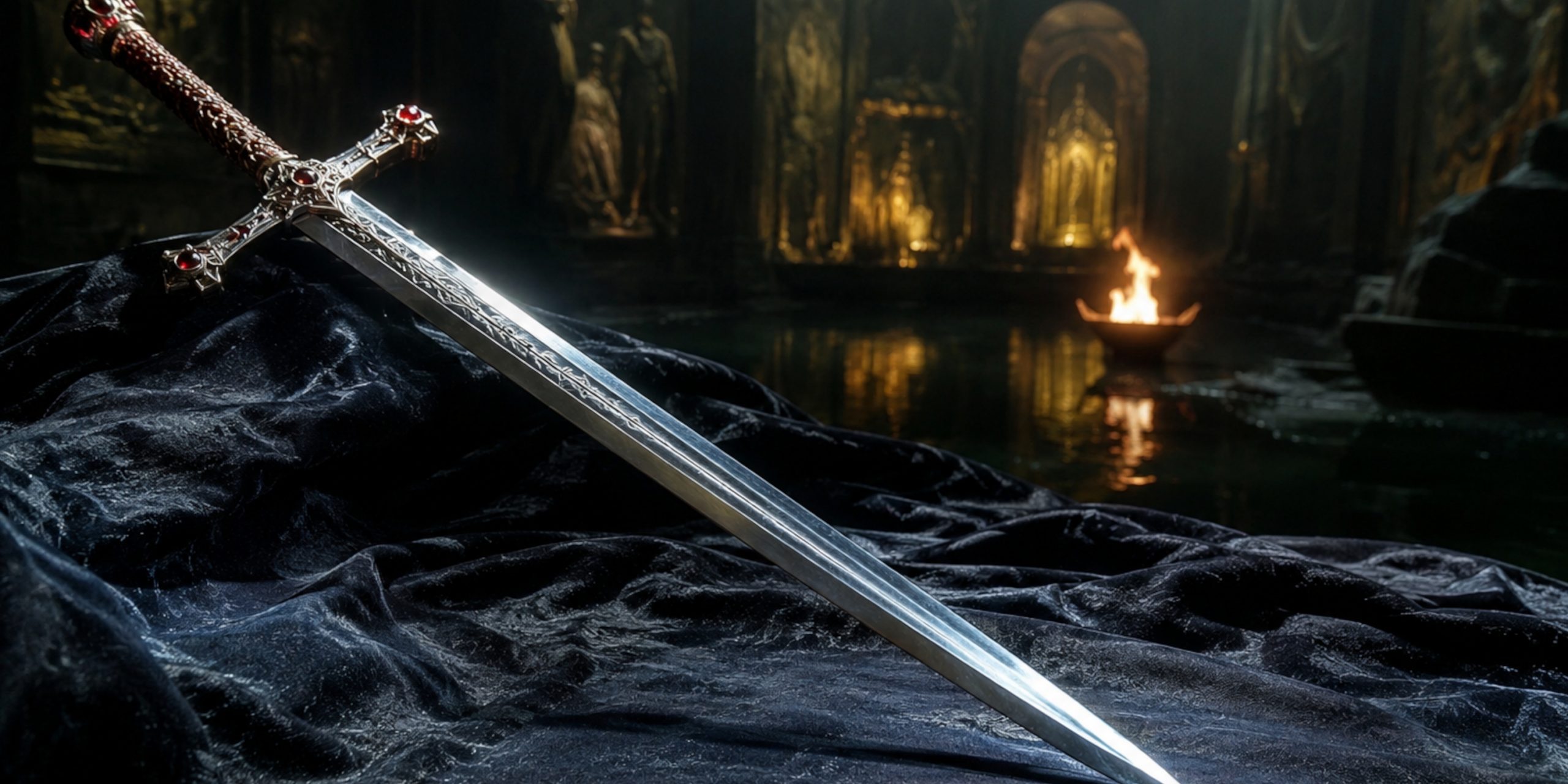
Some fantasy swords are famous because they conquer kingdoms. Others because they are impossibly beautiful. The Sword of Gryffindor manages something slightly more unusual. It spends most of its existence hiding in hats, disappearing for decades at a time, and then showing up precisely when someone is having a truly terrible day.
It is one of the most iconic magical weapons in modern fantasy, yet it is surprisingly understated. There are no flaming runes, no glowing crystals, and no prophecy etched into the blade. Instead, its reputation comes from what it represents. Courage. Loyalty. Self sacrifice. The willingness to charge headfirst into danger despite having every sensible reason not to.
Within the Harry Potter series, the Sword of Gryffindor becomes far more than an heirloom of Hogwarts. By the end of the story, it has become one of the few weapons capable of destroying Lord Voldemort’s Horcruxes, making it one of the most important objects in the entire Wizarding World.
What Is the Sword of Gryffindor?
The Sword of Gryffindor was forged over a thousand years before Harry Potter’s time for Godric Gryffindor, one of the four founders of Hogwarts School of Witchcraft and Wizardry.
Unlike ordinary medieval swords, it was crafted by goblins, whose metalworking skills were considered unmatched by wizarding standards. Goblin-made weapons possess unique magical properties that allow them to become stronger over time rather than deteriorate.
The sword is traditionally associated with the Gryffindor House values of courage, bravery, nerve and chivalry.
Although it physically exists within Hogwarts for much of its history, the sword has an unusual magical quality. It can present itself to any true Gryffindor who genuinely needs it.
That distinction matters enormously. Owning the sword is meaningless if the sword decides you are not worthy.
Physical Description
Despite its immense magical power, the Sword of Gryffindor is surprisingly elegant.
Its defining features include:
| Feature | Description |
|---|---|
| Blade | Bright silver with an immaculate polished finish |
| Material | Goblin-forged silver |
| Hilt | Ruby-encrusted crossguard and pommel |
| Inscription | Name of Godric Gryffindor beneath the hilt |
| Weight | Balanced like a high-quality knightly sword |
| Condition | Never rusts or loses its edge |
The rubies decorating the hilt symbolise Gryffindor House colours of red and gold, giving the weapon an instantly recognisable appearance.
Unlike many fantasy swords, there is little emphasis on exaggerated size. The Sword of Gryffindor resembles a practical medieval longsword, reflecting Gryffindor’s identity as a warrior rather than a ceremonial king.
Who Forged the Sword?
The blade was created by the legendary goblin smith Ragnuk the First.
Goblins were widely acknowledged as superior craftsmen, particularly when working precious metals. Their philosophy differed sharply from that of wizard society.
Goblins believed that objects they created always remained goblin property, regardless of who paid for them.
This disagreement eventually led to one of the Wizarding World’s oldest disputes.
Ragnuk admired Godric Gryffindor greatly but later claimed ownership of the sword despite willingly creating it for him. Gryffindor refused to surrender it, arguing that payment had been agreed and completed.
The disagreement became legendary and fuelled centuries of distrust between goblins and wizards.
It is a fascinating little detail because neither side is presented as entirely right or entirely wrong. Their cultures simply view ownership through completely different lenses.
Magical Properties
The Sword of Gryffindor possesses several unique magical abilities.
It Only Appears to Worthy Gryffindors
The sword can magically present itself to a true Gryffindor in moments of genuine need.
This explains why it emerges from the Sorting Hat for:
- Harry Potter
- Neville Longbottom
Simply wanting the sword is never enough.
The sword effectively judges character rather than status.
It Absorbs Only That Which Strengthens It
Perhaps its greatest magical property is that goblin silver absorbs substances that improve it.
Unlike steel, which eventually dulls, chips or corrodes, goblin silver becomes stronger through use.
After Harry uses the sword to kill the Basilisk in the Chamber of Secrets, basilisk venom becomes permanently infused into the blade.
Since basilisk venom is one of the rare substances capable of destroying Horcruxes, the sword becomes permanently transformed into one of the deadliest magical weapons in existence.
This tiny piece of magical worldbuilding quietly changes the outcome of the entire series.
It Never Requires Cleaning
Goblin silver repels dirt and damage.
The blade never rusts.
It never stains.
It never loses its edge.
Considering how often it ends up covered in monster remains, that is probably quite convenient.
Godric Gryffindor and the Sword
Very little is known about Godric Gryffindor’s life beyond the founding of Hogwarts.
However, the sword reinforces his image as both wizard and warrior.
Unlike modern witches and wizards, the founders lived during a dangerous era where magical combat was considerably more physical. Carrying a sword alongside a wand was not unusual.
The blade therefore reflects an older magical world where steel and spellcraft existed side by side.
It also fits Gryffindor’s personality perfectly.
He never seems like the sort of founder who would stay safely behind everyone else while explaining strategy.
The Sword Throughout Harry Potter
The sword appears at several crucial moments throughout the series.
Harry Potter and the Chamber of Secrets
Harry receives the sword from the Sorting Hat during his battle with the Basilisk beneath Hogwarts.
Using it, he kills the giant serpent and unknowingly transforms the blade forever by exposing it to basilisk venom.
Without this moment, the sword would never become capable of destroying Horcruxes.
Harry Potter and the Deathly Hallows
The sword becomes central to Voldemort’s defeat.
Harry, Ron and Hermione spend much of the novel attempting to recover it after learning its unique properties.
Key moments include:
- Ron retrieves the sword from the icy pool after rescuing Harry.
- Ron destroys Salazar Slytherin’s locket Horcrux.
- Neville Longbottom later draws the sword from the Sorting Hat.
- Neville kills Nagini, Voldemort’s final Horcrux.
Each appearance reinforces the same magical rule.
The sword always comes to those who display genuine courage.
Famous Owners and Wielders
Although permanently associated with Godric Gryffindor, several characters wield the sword throughout history.
| Character | Role |
|---|---|
| Godric Gryffindor | Original owner |
| Harry Potter | Basilisk slayer and Horcrux hunter |
| Ron Weasley | Destroyed Slytherin’s Locket |
| Neville Longbottom | Killed Nagini |
| Various Headmasters | Temporary custodians within Hogwarts |
Interestingly, none of these characters truly “own” the sword.
They simply become worthy of wielding it.
Why the Sword Chose Harry
Harry embodies many Gryffindor traits long before receiving the sword.
He repeatedly demonstrates:
- Self sacrifice
- Courage under pressure
- Moral conviction
- Loyalty to friends
- Determination despite fear
Dumbledore later explains that only a true Gryffindor could have summoned the weapon from the Sorting Hat.
Harry earns the sword through character rather than destiny.
That distinction is important because Harry Potter consistently argues that our choices matter more than inherited greatness.
The sword quietly reinforces that message.
Goblin Ownership Controversy
One of the more interesting pieces of lore surrounding the sword concerns ownership.
When Harry encounters Griphook during Deathly Hallows, the goblin insists the sword rightfully belongs to goblins rather than wizards.
From the goblin perspective:
- Goblins create masterpieces.
- Wizards merely commission them.
- Ownership returns to the maker after the buyer dies.
From the wizard perspective:
- Payment transfers ownership permanently.
Neither interpretation is entirely dismissed.
Instead, the disagreement illustrates how cultural assumptions shape ideas of property and history.
For a series aimed at younger readers, it is a surprisingly thoughtful exploration of competing traditions.
Symbolism
The Sword of Gryffindor represents far more than a magical weapon.
It symbolises:
- Courage over fear
- Character over bloodline
- Action over status
- Worthiness over inheritance
- Hope during impossible odds
Unlike the Elder Wand, which revolves around power and conquest, Gryffindor’s sword rewards virtue.
That contrast feels deliberate.
One weapon seeks the strongest master.
The other seeks the bravest.
How Powerful Is the Sword?
Among magical weapons in Harry Potter, the Sword of Gryffindor ranks near the very top.
Its advantages include:
| Strength | Effect |
|---|---|
| Goblin craftsmanship | Extraordinary durability |
| Self-improving metal | Grows stronger through use |
| Basilisk venom | Destroys Horcruxes |
| Magical selection | Appears only to worthy Gryffindors |
| Perfect condition | Never degrades |
Its only real limitation is accessibility.
You cannot simply borrow it whenever convenient.
The sword decides.
How Historically Accurate Is the Sword?
Visually, the Sword of Gryffindor resembles a medieval knightly longsword with decorative gemstones and a straight crossguard.
Its proportions are broadly inspired by real European swords of the High Middle Ages rather than oversized fantasy weapons.
The idea of a founder carrying both sword and wand also reflects genuine medieval traditions, where nobles and military leaders commonly wore swords regardless of whether combat was expected.
The magical elements are, naturally, another matter entirely.
Sadly, no surviving museum examples have yet been confirmed to absorb basilisk venom.
Legacy
The Sword of Gryffindor remains one of the defining weapons of the Harry Potter universe because it earns its significance rather than demanding attention.
Its appearance is rare.
Its powers evolve naturally through the story.
Its greatest moments belong to ordinary people choosing courage when fear would have been much easier.
That may be why the sword has endured in popular culture. It is not merely a magical artefact waiting for a hero. It actively rewards heroism itself.
For a series built around the idea that choices define us more than destiny, there could hardly be a more fitting weapon.