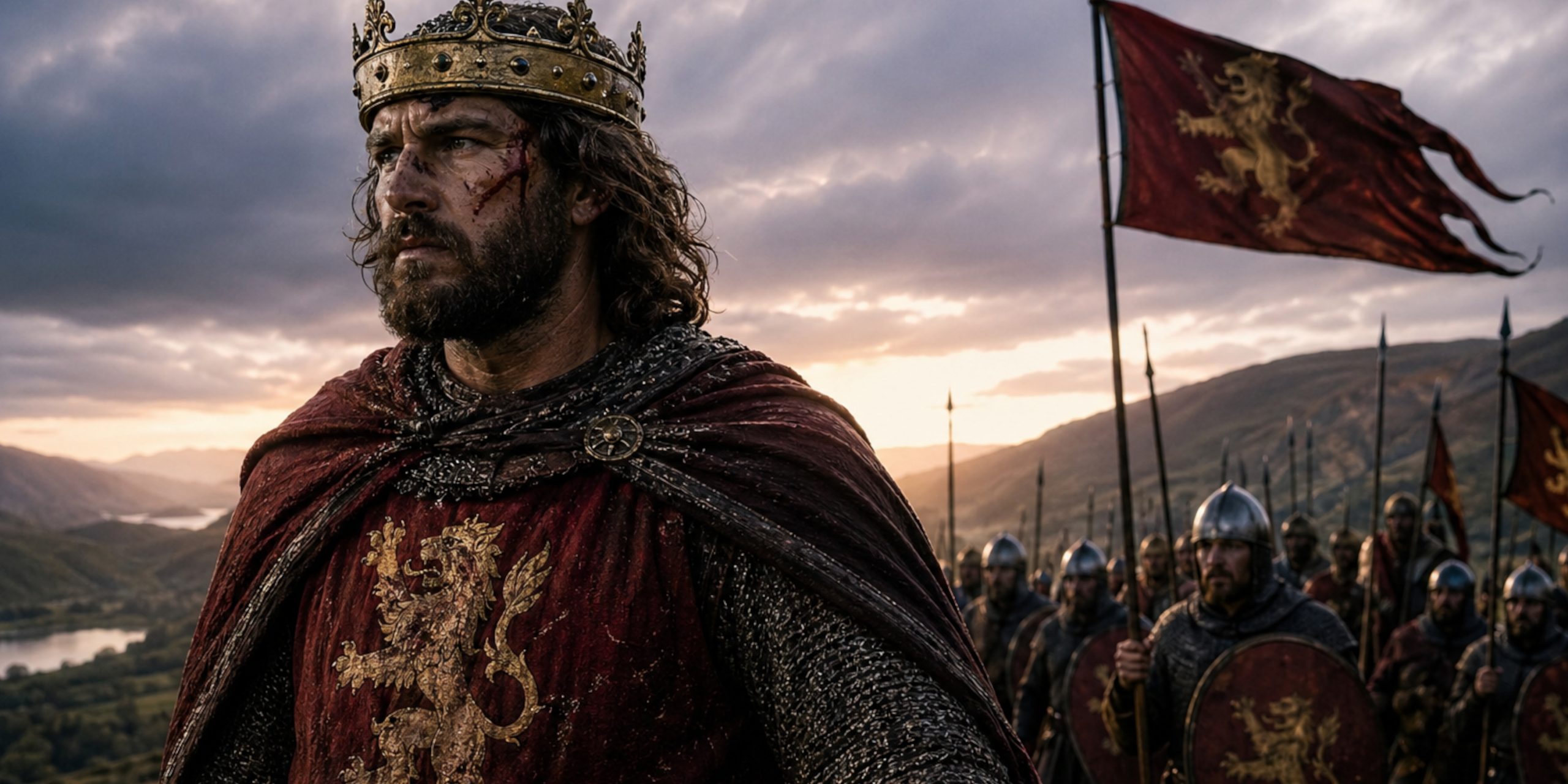
Llywelyn ap Gruffudd stands as a figure both defiant and tragic, the last native Prince of Wales to hold real authority before English conquest tightened its grip. His life sits at that uneasy point where medieval ambition meets the slow, grinding reality of a stronger neighbour. He inherited not just a title, but a problem that had plagued Welsh rulers for generations, how to unite a fractured land while holding off England.
He managed the first task with skill. The second proved less forgiving.
Early Life and Rise to Power
Born around 1223, Llywelyn was the grandson of Llywelyn the Great, a name that cast a long shadow. He was not handed power neatly. Wales at the time was a tangle of rival princes, each keen to assert independence while also fearing English intervention.
His rise involved careful alliances, sharp political instincts, and no small amount of force. By the 1250s he had emerged as the dominant Welsh ruler. In 1267, the Treaty of Montgomery formally recognised him as Prince of Wales. It was a rare moment when Welsh authority was acknowledged rather than contested.
It did not last.
Rule and Governance
Llywelyn’s rule was not simply about war. He worked to impose a sense of order across Welsh territories, reinforcing legal systems and consolidating power in ways that felt almost administrative by medieval standards.
He sought legitimacy through diplomacy as much as conquest. Marriage alliances, negotiations with the English crown, and attempts to stabilise internal rivalries all featured heavily in his reign.
Still, the political landscape shifted sharply with the rise of Edward I. Llywelyn was dealing with a king who approached Wales not as a neighbour, but as a problem to be solved permanently.
Arms and Armour
Llywelyn’s forces reflected a distinctly Welsh approach to warfare, shaped by terrain and tradition rather than the heavy feudal model favoured in England.
Typical Arms
- Spears and javelins, often used in quick strikes and ambushes
- Swords of mixed types, including straight double edged blades influenced by Norman styles
- Long knives and short blades suited to close combat in rough ground
- Bows, though not yet the fully developed longbow of later centuries
Armour and Equipment
- Light mail shirts, sometimes supplemented with padded garments
- Round or oval shields, often decorated but built for mobility
- Helmets of simple iron construction, practical rather than ornate
Welsh forces were not designed for prolonged set piece battles. They excelled in mobility, surprise, and knowledge of the landscape. Against a determined and well supplied English army, that advantage could only go so far.
Battles and Military Acumen
Llywelyn was not reckless. He understood that Wales could not win through brute strength. His strategy leaned heavily on terrain, timing, and disruption.
Key Military Traits
- Preference for defensive warfare in mountainous regions
- Use of ambush tactics and rapid withdrawal
- Avoidance of large scale open battle when possible
Notable Campaigns
Conflict with Henry III
Early in his career, Llywelyn successfully resisted English incursions and expanded his influence. His ability to navigate both battlefield and negotiation table secured his position.
War with Edward I
This was the defining struggle. Edward’s campaigns in the late 1270s and early 1280s were systematic and relentless. Castles rose across Wales like a chain tightening around the country.
Llywelyn’s resistance was stubborn but increasingly strained. Supplies ran thin, allies faltered, and internal divisions resurfaced.
His final campaign in 1282 ended at the Battle of Orewin Bridge. Llywelyn was killed, reportedly separated from his forces, an end that feels almost symbolic of the wider collapse.
Personality and Leadership
There is a certain restraint in the records about Llywelyn. He was not prone to grand gestures or theatrical displays. Instead, he appears as a measured and cautious leader, one who understood the stakes perhaps too well.
As a historian, I find him frustratingly human. He made sensible choices in a situation that may not have allowed for success. His caution preserved his rule for decades, yet it could not outlast Edward’s determination.
He was not outmatched in intelligence, but in resources and timing.
Artefacts and Where to See Them
Material remains tied directly to Llywelyn are limited, which says something about the nature of his struggle.
Key Locations
- Gwynedd, particularly sites associated with his administration and strongholds
- Aberconwy, where his court once operated
- English-held castles built during and after his fall, which indirectly reflect the consequences of his defeat
Museums in Wales hold artefacts from the period, including weapons, fragments of armour, and everyday objects that give context to his reign rather than direct personal relics.
The absence of grand surviving treasures speaks quietly but clearly. This was a prince defending a land, not building an empire of monuments.
Archaeology and Latest Findings
Archaeological work across North Wales continues to shed light on the late thirteenth century.
Excavations have revealed:
- Settlement patterns disrupted during Edward’s campaigns
- Evidence of burned structures, likely tied to conflict
- Fortifications that suggest rapid adaptation to military pressure
Recent studies have also focused on landscape archaeology, mapping how Welsh forces used terrain to their advantage. It reinforces what written sources hint at, that Llywelyn’s war was one fought as much with hills and forests as with steel.
Death and Legacy
Llywelyn’s death in 1282 marked more than the fall of a prince. It marked the end of an independent Welsh political identity at the highest level. His brother Dafydd continued the fight briefly, but the outcome was already decided.
Edward I moved quickly, imposing control and building the now famous ring of castles that still dominate the landscape.
Llywelyn became, in memory, a symbol. Not flawless, not invincible, but resolute. The last figure to hold Wales together under native rule.
Seven Swords Takeaway
There is a tendency to frame Llywelyn ap Gruffudd as a doomed hero. That is tidy, perhaps too tidy. He was a capable ruler operating in a narrowing space, making decisions that often bought time rather than victory.
His story is not just about defeat. It is about persistence in the face of inevitability, which is a quieter kind of courage.
And if one is allowed a small historian’s indulgence, there is something admirable in a man who saw the storm coming and chose to stand anyway.