Kilij Arslan I has a habit of appearing in history books as the man who lost Nicaea and then, rather inconveniently for the crusaders, nearly destroyed them anyway.
He was the Seljuk Sultan of Rum from around 1092 until his death in 1107. During those years he faced the Byzantines, rival Turkish princes, Danishmends, Fatimids, crusaders and fellow Seljuks. It was not the sort of reign that allowed for a quiet afternoon.
What makes Kilij Arslan so fascinating is that he was not simply a doomed opponent of the First Crusade. He adapted. He learned from defeat faster than many of his enemies did from victory. By the end of his life he had transformed the Sultanate of Rum from a fragile frontier state into a serious military power in Anatolia.
Who Was Kilij Arslan I?
Kilij Arslan I was the son of Suleiman ibn Qutulmish, founder of the Seljuk Sultanate of Rum in Anatolia. After his father’s death in 1086, the young prince spent years in captivity under the Great Seljuk court. He eventually returned to Anatolia and took control of the Sultanate around 1092.
At the time, the Sultanate of Rum was precarious.
- Byzantine power still lingered in western Anatolia
- Turkish beyliks competed with one another
- The Danishmends threatened Seljuk authority in central Anatolia
- The arrival of the First Crusade would soon change everything
Kilij Arslan established his capital at Nicaea, a wealthy and heavily fortified city close to Constantinople. It was a bold choice. It also placed him directly in the path of Byzantine ambitions and, before long, a vast crusading army.
The Political World of Anatolia
Late eleventh-century Anatolia was less a tidy kingdom and more a collection of ambitious men with cavalry, grudges and a distressing tendency to betray one another at inconvenient moments.
Kilij Arslan ruled over a state that sat between several worlds:
| Rival Power | Relationship with Kilij Arslan |
|---|---|
| Byzantine Empire | Frequent warfare, occasional diplomacy |
| Danishmendids | Rivals and occasional allies |
| Great Seljuk Empire | Nominal overlords, often suspicious |
| Crusader States | Bitter enemies after 1097 |
| Fatimid Caliphate | Temporary diplomatic contacts |
His great strength was his ability to manoeuvre between these powers. He could be pragmatic, ruthless and surprisingly patient. He was not above making peace with one enemy to destroy another.
The Fall of Nicaea
The defining disaster of Kilij Arslan’s early reign came in 1097.
When the First Crusade arrived in Anatolia, Kilij Arslan badly underestimated it. He assumed the crusaders would be little different from the earlier People’s Crusade, a chaotic mass of poorly armed pilgrims whom he had already crushed with ease.
That assumption proved costly.
The crusader princes arrived with a disciplined army supported by Byzantine forces under Emperor Alexios I Komnenos. While Kilij Arslan was campaigning against the Danishmends in the east, Nicaea came under siege.
He hurried back and attempted to relieve the city, but his forces were defeated outside the walls on 21 May 1097.
Nicaea then surrendered to the Byzantines.
For Kilij Arslan, it was a humiliation. For the crusaders, it was their first great success. For the inhabitants of Nicaea, it was probably a relief that the city escaped a sack. Medieval sieges rarely ended with polite discussion and a signed receipt.
The Battle of Dorylaeum and Kilij Arslan’s Finest Hour
If Nicaea showed Kilij Arslan at his weakest, the Battle of Dorylaeum on 1 July 1097 showed him at his most dangerous.
After the crusaders marched east, Kilij Arslan gathered a coalition of Seljuk and Danishmendid forces. Rather than fight a conventional battle, he used the tactics at which Turkish cavalry excelled.
He struck the crusaders while they were divided.
The vanguard under Bohemond of Taranto was isolated and attacked by mounted archers. Kilij Arslan’s men rode around the crusader camp, showering it with arrows, avoiding close combat and gradually wearing the enemy down.
For several hours the crusaders were close to disaster.
Kilij Arslan nearly succeeded because he understood exactly how to fight western heavy cavalry:
- Avoid direct charges
- Keep moving
- Use horse archery to exhaust and confuse the enemy
- Strike baggage, camp followers and horses
- Break enemy cohesion before closing in
The arrival of the second crusader column eventually turned the battle. Kilij Arslan withdrew in good order.
Although he lost, Dorylaeum taught the crusaders a hard lesson. From that point onward they crossed Anatolia in constant fear of Turkish ambushes, harassment and scorched earth tactics.
As a historian, this is where Kilij Arslan becomes far more than a defeated ruler. He learned faster than the crusaders did. By the time they reached Syria, much of Anatolia behind them had become a wasteland of burnt crops, poisoned wells and dead horses. Kilij Arslan had realised that if he could not stop them in one battle, he could make every mile cost them dearly.
Battles and Military Acumen
Kilij Arslan was not a reckless battlefield hero in the mould of a crusading knight. He was something more elusive and, frankly, more intelligent.
He preferred mobility, attrition and surprise.
| Battle or Campaign | Date | Result | Kilij Arslan’s Role |
| Destruction of the People’s Crusade | 1096 | Seljuk victory | Destroyed an undisciplined crusading force near Civetot |
| Defence of Nicaea | 1097 | Defeat | Attempted to relieve Nicaea but failed |
| Battle of Dorylaeum | 1097 | Defeat, but nearly decisive | Used horse archers and mobile warfare brilliantly |
| Campaigns against the Danishmends | 1090s | Mixed | Fought for control of central Anatolia |
| Reconquest of Anatolian territory | 1097–1104 | Success | Gradually recovered much of the Sultanate |
| Campaign in Mosul and Upper Mesopotamia | 1107 | Defeat and death | Attempted to expand eastward before being overwhelmed |
His Military Strengths
- Exceptional use of mounted archers
- Skilled at choosing ground and avoiding disadvantageous battles
- Effective use of scorched earth tactics
- Ability to recover politically after severe defeats
- Strong understanding of enemy weaknesses
His Weaknesses
- Underestimated the First Crusade at the start
- Struggled to maintain stable alliances with other Turkish rulers
- Sometimes expanded too aggressively, especially in Mesopotamia
His final campaign in 1107 revealed both his ambition and his flaws. After seizing Mosul, he confronted the forces of the Great Seljuk Sultan Muhammad I Tapar. Defeated near the River Khabur, Kilij Arslan attempted to escape but drowned while crossing the river.
It was a dramatic end, though perhaps not the one he would have chosen. Few rulers plan to conclude their careers by being swept away in full armour.
Arms and Armour of Kilij Arslan and His Army
The army of Kilij Arslan reflected the military traditions of the Seljuk Turks. It relied heavily on fast cavalry supported by archers and lighter infantry.
Weapons
The typical Seljuk warrior under Kilij Arslan carried a combination of bow, lance and sword.
| Weapon | Description |
| Composite Bow | The most important weapon. Made from wood, horn and sinew, capable of remarkable power and range from horseback |
| Lance | Used by heavier cavalry for charges after the enemy had been weakened |
| Straight Turkic Sword | Early Seljuk swords were often relatively straight and single-edged, before the later curved kilij became widespread |
| Sabre-like Blades | Some cavalry used early curved swords influenced by Central Asian styles |
| Mace and Axe | Secondary weapons for close combat |
| Dagger | Carried as a last resort and for everyday use |
The famous curved kilij sword associated with later Ottoman cavalry had not yet reached its classic form. Kilij Arslan’s warriors more commonly used transitional sabres and straight Turkic blades. The irony is difficult to miss. Kilij Arslan himself gave his name to a weapon that became far more famous centuries after his death.
Armour
Seljuk armour balanced protection with mobility.
| Armour Type | Who Used It |
| Lamellar Armour | Elite cavalry and officers |
| Mail Hauberk | Wealthier soldiers and nobles |
| Scale Armour | Some heavy cavalry |
| Quilted Armour | Lighter cavalry and infantry |
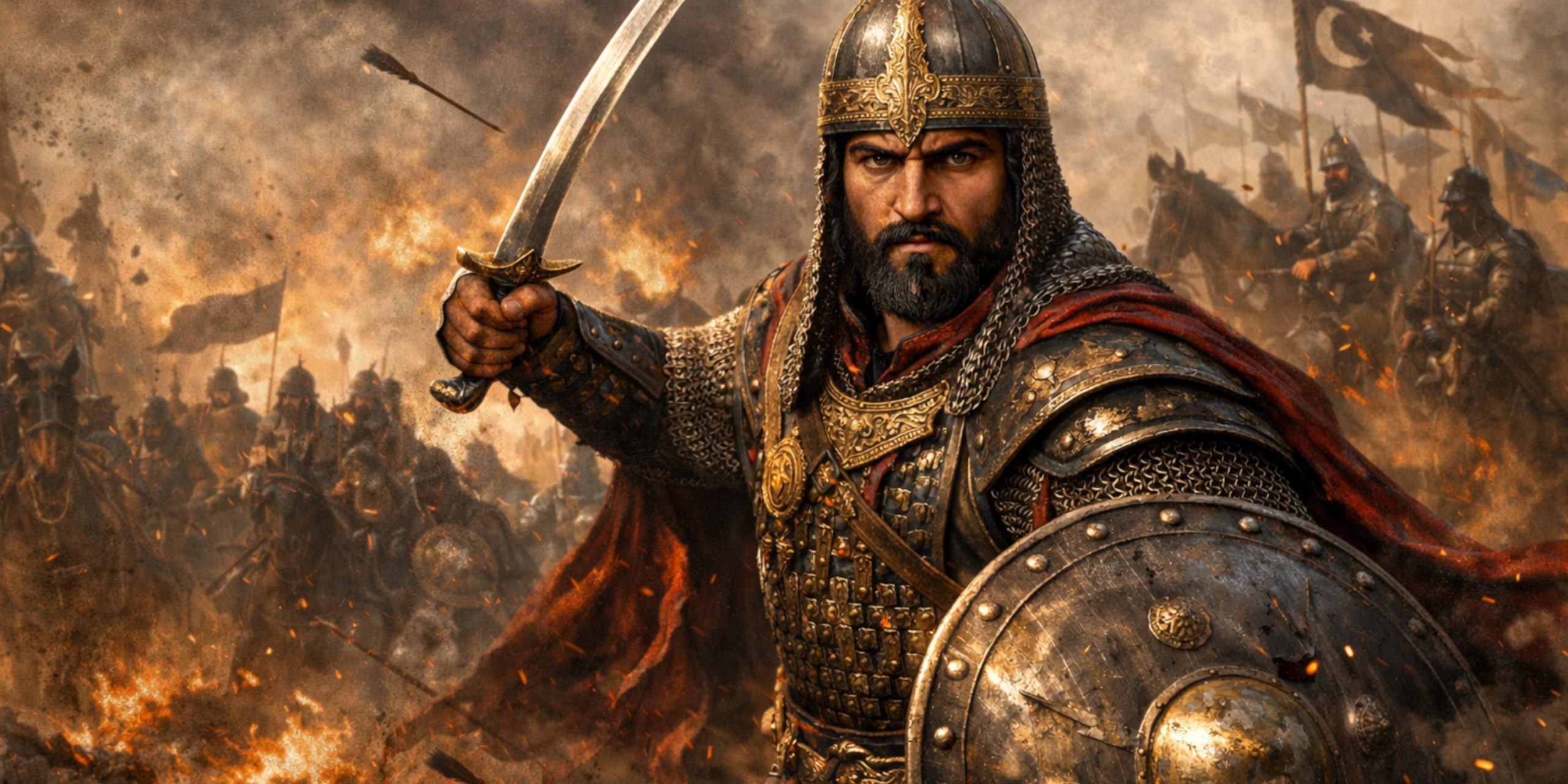
| Conical Helmet with Nasal Guard | Common among Turkish cavalry |
| Round or Kite Shield | Used by both cavalry and infantry |
Elite Turkish cavalry probably resembled a blend of steppe warrior and Islamic noble.
- Mail shirt or lamellar cuirass
- Silk or padded undergarments beneath armour
- Tall conical helmet, sometimes with aventail
- Bow case and quiver at the waist
- Lance and sword carried from the saddle
Compared with the crusaders, Kilij Arslan’s men were lighter, faster and considerably less interested in standing still while heavily armoured knights thundered towards them.
Personality and Leadership
The medieval chroniclers portray Kilij Arslan as proud, determined and intelligent.
The crusader sources often respected him despite themselves. They regarded him as dangerous and difficult to pin down. Byzantine writers saw him as a persistent threat but also as a ruler capable of diplomacy.
He seems to have possessed several qualities that often mark successful frontier rulers:
- Adaptability
- Personal courage
- Political pragmatism
- Ruthlessness when necessary
He also had a tendency to take risks. Sometimes they worked. Sometimes they ended with him trying to swim across a river while wearing armour, which is one of history’s less advisable decisions.
Artefacts and Where to See Them
No object can be linked with certainty to Kilij Arslan himself, but several important artefacts survive from the Seljuk Sultanate of Rum and the period in which he ruled.
Konya Archaeological Museum, Turkey
The museum contains Seljuk military equipment, inscriptions, ceramics and architectural fragments from the early Sultanate of Rum.
Particularly important are:
- Seljuk arrowheads
- Fragments of mail and armour
- Stone inscriptions from the reigns of early Seljuk rulers
Museum of Anatolian Civilisations, Ankara
This museum preserves a substantial collection of Seljuk material culture.
Visitors can see:
- Seljuk swords and sabres
- Decorative horse fittings
- Ceramics and metalwork from eleventh and twelfth-century Anatolia
- Coins struck by Seljuk rulers
Nicaea, Modern İznik
The walls of ancient Nicaea still survive in remarkable condition.
Although much restored, parts of the fortifications Kilij Arslan defended in 1097 can still be seen. Walking along the walls today gives an odd sense of just how difficult the city must have been to attack. One can also understand why the crusaders preferred to let the Byzantines negotiate the surrender rather than storm the place.
Diyarbakır and Mosul Region Finds
Excavations in south-eastern Turkey and northern Iraq have uncovered military artefacts linked to the broader Seljuk world:
- Arrowheads
- Horse harness fittings
- Ceremonial metalwork
- Fortification remains
Latest Archaeology and Recent Discoveries
Recent archaeology has improved our understanding of the world Kilij Arslan ruled.
Excavations at İznik
Archaeologists continue to investigate the walls and gates of medieval Nicaea. Evidence from the fortifications has helped historians better understand the siege of 1097 and the city’s defensive system.
Recent work has identified:
- Repairs made shortly before the First Crusade
- Arrow damage and later rebuilding phases
- Sections of Byzantine and Seljuk occupation layers
Battlefield Research at Dorylaeum
Near modern Eskişehir, researchers have attempted to locate the precise battlefield of Dorylaeum.
Finds include:
- Iron arrowheads
- Horse fittings
- Fragments of military equipment
The evidence remains debated, but it supports the written accounts of a mobile battle fought across open ground rather than a single fixed position.
Seljuk Coinage
Coins from Kilij Arslan’s reign continue to appear in excavations and collections.
These coins are important because they show the growing authority of the Sultanate of Rum. Some bear inscriptions linking Kilij Arslan to the wider Seljuk world while also emphasising his own legitimacy in Anatolia.
Legacy
Kilij Arslan I died in 1107, but his work outlived him.
The Sultanate of Rum survived and eventually became the dominant Turkish power in Anatolia. Later Seljuk rulers built upon the foundations he laid, and centuries later the Ottoman Turks inherited much of that same political and military landscape.
His reputation rests on three things:
- He destroyed the People’s Crusade
- He nearly shattered the First Crusade at Dorylaeum
- He helped ensure that Turkish power in Anatolia survived despite early setbacks
He was not the greatest conqueror of his age, nor the most famous. Yet he may have been one of the most underestimated. The crusaders remembered him because he taught them that Anatolia was not empty land waiting to be crossed. It belonged to an enemy who knew every road, every hill and every weakness.
For that reason alone, Kilij Arslan deserves far more attention than he usually receives.
Further Reading
- Anna Komnene, The Alexiad
- Fulcher of Chartres, A History of the Expedition to Jerusalem
- Steven Runciman, A History of the Crusades
- Carole Hillenbrand, The Crusades: Islamic Perspectives
- David Nicolle, First Crusade 1096–99: Conquest of the Holy Land