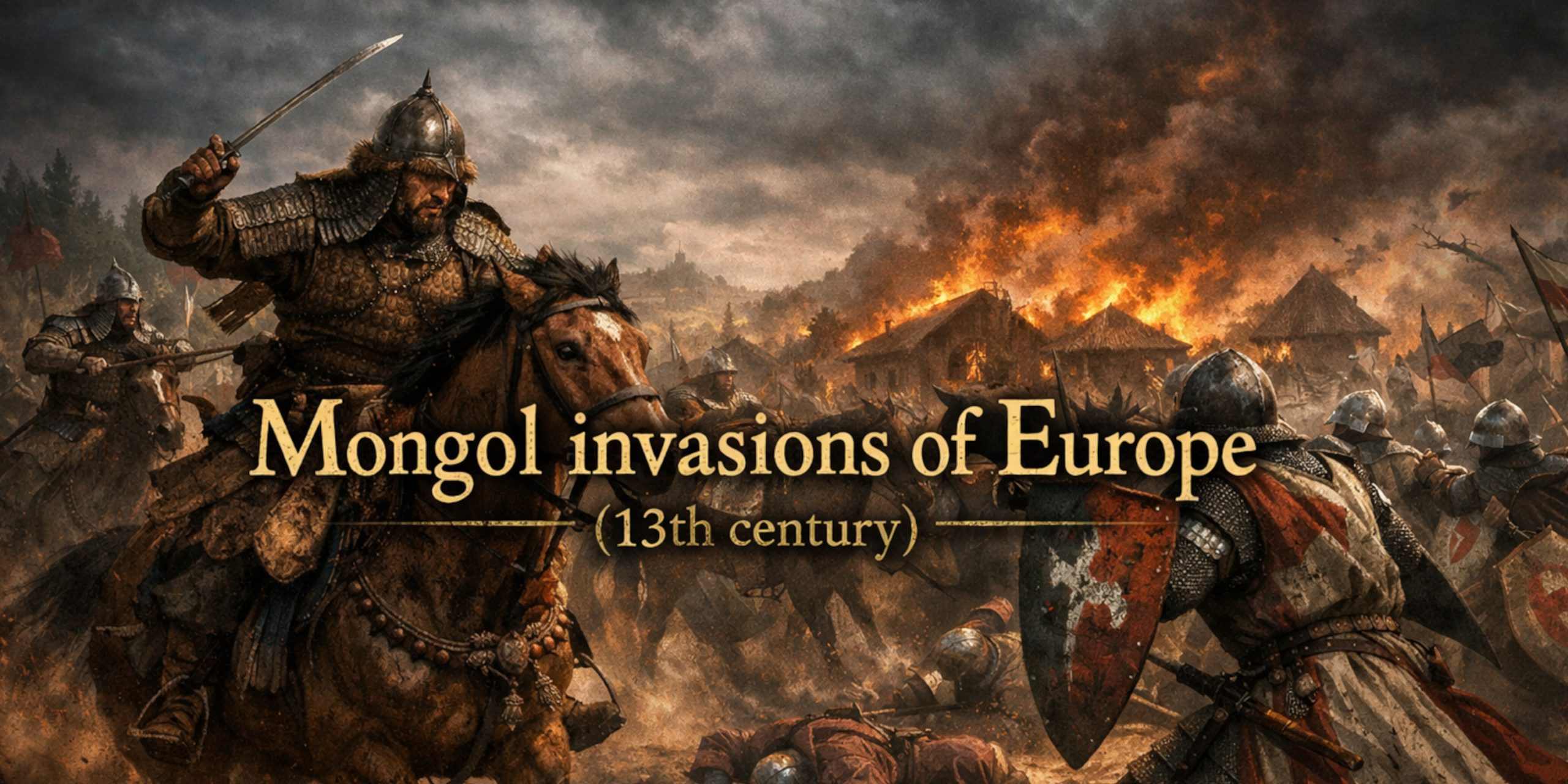
The Mongol invasions of Europe remain one of the great historical what-ifs. In little more than two years, Mongol armies smashed through eastern Europe, destroyed kingdoms, annihilated armies and left chroniclers sounding somewhere between horrified and faintly offended that cavalry could move this quickly.
From Poland to Hungary, the invaders led by Batu Khan and the brilliant general Subutai seemed almost unstoppable. European rulers had spent centuries fighting one another in a rather enthusiastic and chaotic fashion. They were not prepared for an enemy who combined discipline, speed, intelligence gathering and terrifying coordination.
For a brief moment in the 1240s, it looked entirely possible that much of Europe might follow the fate of Kievan Rus. Then, rather suddenly, the Mongols withdrew. Historians have been arguing about why ever since.
Who Were the Mongols?
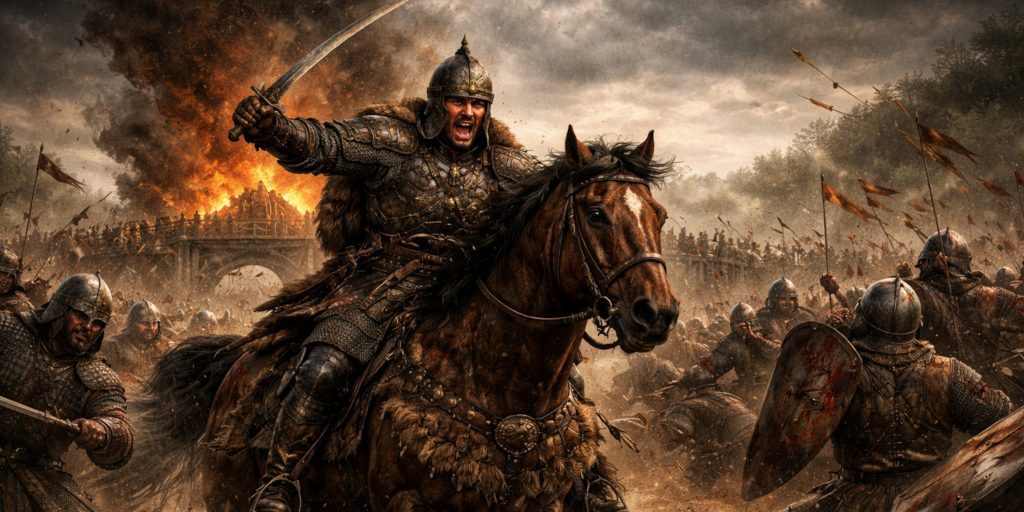
The Mongols were a confederation of steppe peoples united by Genghis Khan in the early 13th century. By the time of the invasions of Europe, the Mongol Empire stretched from northern China to the edge of the Holy Roman Empire.
After the death of Genghis Khan, his descendants continued to expand the empire. The invasion of Europe was largely carried out under Batu Khan, grandson of Genghis Khan, with the veteran strategist Subutai directing operations.
Subutai is one of the most remarkable military commanders in history and, frustratingly for European princes of the time, he was very good at his job. He had already campaigned across Asia and eastern Europe before launching the great invasion of 1236 to 1242.
Why Did the Mongols Invade Europe?
The Mongols did not begin by setting out to conquer France or England. Their immediate goal was the destruction of the surviving powers of Kievan Rus and the securing of the western frontier of the empire.
The invasion widened after several European states gave refuge to enemies of the Mongols, especially the Cumans. When King Béla IV of Hungary sheltered the Cumans, the Mongols treated this as an act of hostility.
There was also a larger strategic logic:
- Destroy states that might threaten the Mongol frontier
- Secure trade routes into Europe
- Punish rulers who resisted or insulted Mongol envoys
- Gather intelligence for possible future campaigns
The Mongols often sent demands for submission before invading. European rulers tended to ignore these demands or respond with the sort of confidence usually associated with people who have not yet realised what is about to happen.
The Course of the Invasion
The Destruction of Kievan Rus
Before entering central Europe, the Mongols devastated the lands of Kievan Rus between 1237 and 1240.
Major cities including Ryazan, Vladimir and Kiev were destroyed. Kiev fell in 1240 after a brutal siege. Contemporary accounts describe the city as almost entirely ruined.
This campaign gave the Mongols a secure base from which to launch attacks deeper into Europe.
The Invasion of Poland
In 1241, one Mongol army advanced into Poland. Their aim was not necessarily the permanent conquest of the country, but to prevent Polish and German forces from supporting Hungary.
The Mongols defeated Polish forces in a series of clashes before meeting a larger Christian army at Legnica.
The Invasion of Hungary
The main Mongol force entered Hungary in 1241. Hungary was a wealthy kingdom and one of the strongest states in eastern Europe. It also happened to sit in precisely the wrong place.
King Béla IV attempted to rally his nobles and army, but internal divisions weakened the Hungarian response. The Mongols crossed the Carpathians through multiple passes and converged on the Hungarian plain.
What followed was catastrophic.
Major Battles
Battle of Legnica, 1241
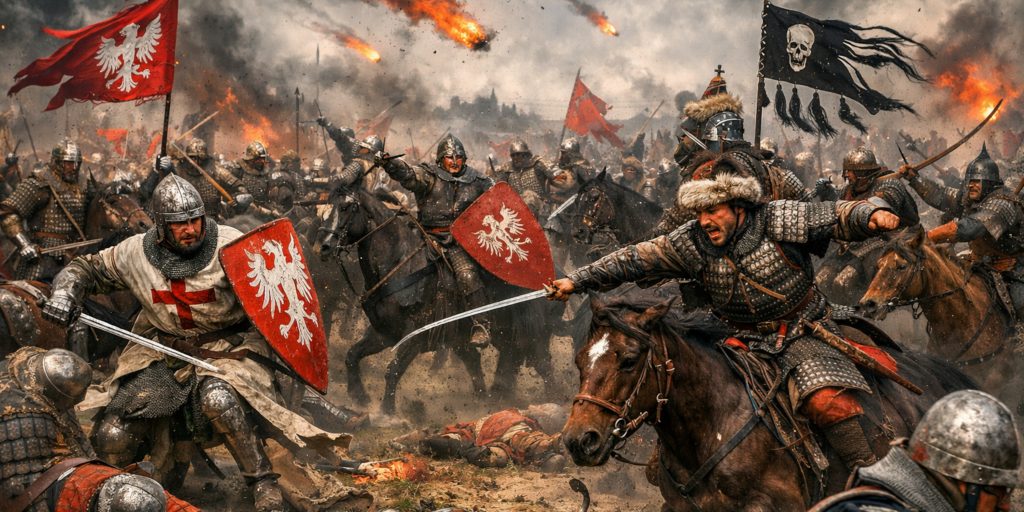
The Battle of Legnica, fought in modern Poland on 9 April 1241, was one of the most famous clashes of the invasion.
A coalition army led by Henry II the Pious, Duke of Silesia, faced a Mongol force under Baidar, Kadan and Orda.
| Side | Estimated Strength | Commanders |
|---|---|---|
| European coalition | 15,000 to 25,000 | Henry II the Pious |
| Mongols | 8,000 to 12,000 | Baidar, Kadan, Orda |
The European army included Polish knights, German troops, Templar contingents and local infantry. Henry hoped to stop the Mongols before they could push further west.
Instead, the Mongols used feigned retreats and clouds of arrows to break up the European attack. Once the knights were separated from their infantry, the Mongols surrounded and destroyed them.
Henry II was killed in the battle. According to later tradition, his severed head was displayed on a spear outside the city walls. Medieval warfare was rarely short of theatrical unpleasantness.
Arms and Armour at Legnica
European forces used:
- Knightly swords of Oakeshott Types XII and XIII
- Lances and spears
- Mail hauberks and great helms
- Crossbows and infantry axes
The Mongols used:
- Composite bows
- Sabres and curved steppe swords
- Lances
- Lamellar armour made from leather, iron or horn
Battle of Mohi, 1241
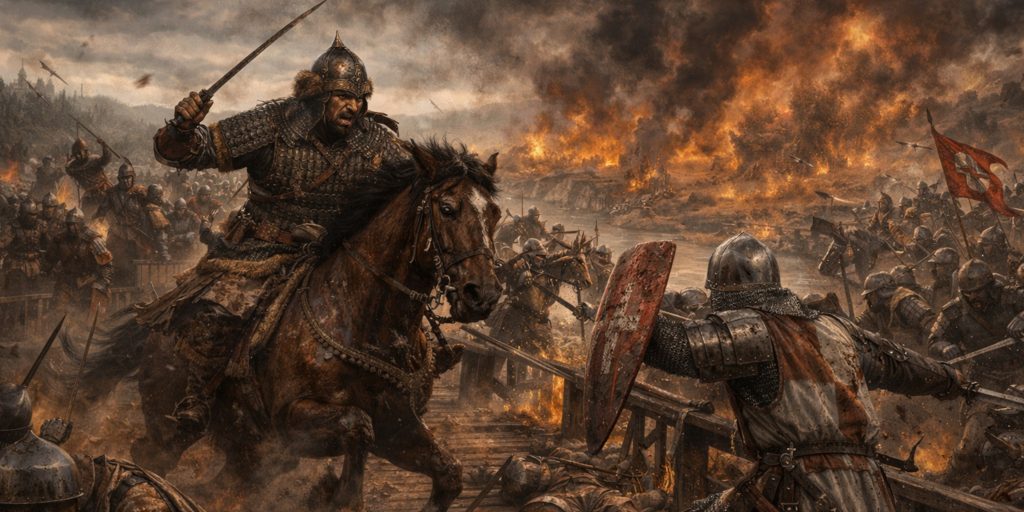
The most decisive battle of the invasion took place at Mohi in Hungary on 11 April 1241.
King Béla IV and the Hungarian army camped beside the Sajó River. They believed the river crossing would protect them. Subutai disagreed.
| Side | Estimated Strength | Commanders |
| Hungary | 25,000 to 35,000 | Béla IV, Archbishop Ugrin |
| Mongols | 40,000 to 50,000 | Batu Khan, Subutai |
The Mongols launched a diversionary attack on the bridge while Subutai secretly crossed the river elsewhere and attacked the Hungarian camp from the rear.
The Hungarian army was trapped and overwhelmed. Thousands were killed. Béla IV escaped only with difficulty and fled west.
Hungary was left devastated. Whole regions were depopulated and many settlements disappeared entirely.
Arms and Armour at Mohi
Hungarian and allied forces used:
- Straight double-edged knightly swords
- Spears and heavy cavalry lances
- Crossbows
- Chainmail, shields and conical helmets
The Mongols relied on:
- Mounted archery
- Light and heavy cavalry
- Fire arrows and siege engines
- Curved sabres and long lances
The Mongols also appear to have used Chinese-style gunpowder bombs and primitive incendiary devices. European chroniclers were particularly alarmed by smoke, noise and explosions appearing in places where they had very much hoped there would not be smoke, noise and explosions.
Other Important Battles and Sieges
| Battle or Siege | Date | Result |
| Siege of Kiev | 1240 | Mongol victory |
| Battle of Chmielnik | 1241 | Mongol victory |
| Battle of Sajo River | 1241 | Mongol victory |
| Siege of Esztergom | 1241 | Partial Mongol success |
| Siege of Klis | 1242 | Mongol withdrawal |
Mongol Tactics
The Mongols defeated European armies not because they were larger, but because they were far more flexible and disciplined.
Their methods included:
- Rapid movement across huge distances
- Extensive use of scouts and spies
- Feigned retreats to lure enemies into traps
- Coordination between separate armies
- Relentless mounted archery
European armies often charged directly at the Mongols, believing they were fleeing. The Mongols were usually not fleeing. They were inviting their opponents to make a terrible decision.
Subutai coordinated several armies operating hundreds of miles apart. In an age when some European kings struggled to organise lunch, this was extraordinary.
Contemporary Quotes
European chroniclers left vivid descriptions of the invasions.
“They are inhuman monsters rather than men.”
Matthew Paris, English chronicler
“The whole kingdom of Hungary was laid waste.”
Rogerius of Apulia, writing after the invasion
“They fight not hand to hand, but with arrows.”
From the account of Giovanni da Pian del Carpine
The chroniclers were horrified by Mongol tactics, but there is often a note of grudging admiration beneath the panic. They had encountered an army unlike anything they had seen before.
Archaeology and What It Reveals
Archaeology has added a great deal to our understanding of the invasions.
Excavations at destroyed towns in Ukraine, Poland and Hungary have uncovered:
- Burn layers dating to the 1240s
- Arrowheads of Mongol type
- Mass graves
- Ruined fortifications and collapsed churches
At Mohi, archaeologists have identified battlefield remains and traces of the temporary Hungarian camp. Excavations in Hungary have also shown that many settlements were rebuilt only after Béla IV ordered the construction of stronger stone castles.
In recent years, researchers in Hungary and Croatia have discovered evidence for Mongol winter camps and temporary encampments. This suggests the Mongols were preparing for a longer occupation before suddenly abandoning the campaign.
The destruction layers in Kiev are particularly striking. Entire districts were burned, and the city did not recover its former importance for centuries.
Why Did the Mongols Withdraw?
In 1242, after their victories in Poland and Hungary, the Mongols withdrew from Europe.
The traditional explanation is that Ögedei Khan died in December 1241, forcing Batu Khan and other princes to return east to take part in the succession.
This certainly mattered, but it is probably not the whole story.
Other possible reasons include:
- The exhaustion of men and horses
- Difficulty operating in western Europe’s forests and fortified regions
- The growing number of stone castles
- Political disagreements among the Mongol princes
Western Europe was also less suited to Mongol warfare than the open plains of Hungary or southern Russia. Charging across the Hungarian plain was one thing. Trying the same trick in the Alps or the forests of Germany would have been considerably less convenient.
The Legacy of the Invasions
The Mongol invasions changed Europe even though they did not result in permanent conquest.
In eastern Europe, the invasions destroyed Kievan Rus and strengthened Mongol control over Russia for centuries through the Golden Horde.
In Hungary and Poland, rulers built more stone castles and improved frontier defences. Béla IV of Hungary became known as the kingdom’s second founder because of the rebuilding that followed.
The invasions also forced Europeans to think differently about warfare. Heavier cavalry and isolated knightly charges looked much less impressive when faced with disciplined mounted archers.
Diplomatic missions soon followed. European rulers and the papacy sent envoys east in an attempt to understand the Mongols and perhaps even ally with them against Islamic powers. Medieval diplomacy could be wonderfully optimistic.
Could the Mongols Have Conquered Western Europe?
This is one of history’s great unanswered questions.
The Mongols probably could have defeated more European armies in the short term. Germany, Austria and perhaps northern Italy were vulnerable in 1241 and 1242.
Yet conquering and holding western Europe would have been far more difficult. The region contained more stone fortresses, denser forests, stronger cities and less open ground for cavalry.
The Mongols excelled at speed and movement. Europe, by contrast, offered a growing collection of castles, marshes, mountain passes and stubborn local rulers who rarely agreed on anything except the belief that they ought to be fighting someone.
Still, if Batu and Subutai had remained in Europe for another few years, the map of medieval Europe might have looked very different indeed.
Takeaway
The Mongol invasions of Europe were among the most dramatic military campaigns of the Middle Ages. In only a few years, Mongol armies swept across eastern Europe and inflicted defeats that shocked the continent.
Their victories at Legnica and Mohi revealed the weakness of European armies and the extraordinary effectiveness of Mongol tactics.
Yet the invasions also showed the limits of Mongol power. Europe was not conquered, and the Mongols withdrew before they could press deeper into the west.
That narrow escape left Europe with a story part history, part warning and part lingering curiosity about what might have happened had the horsemen from the steppe kept riding.