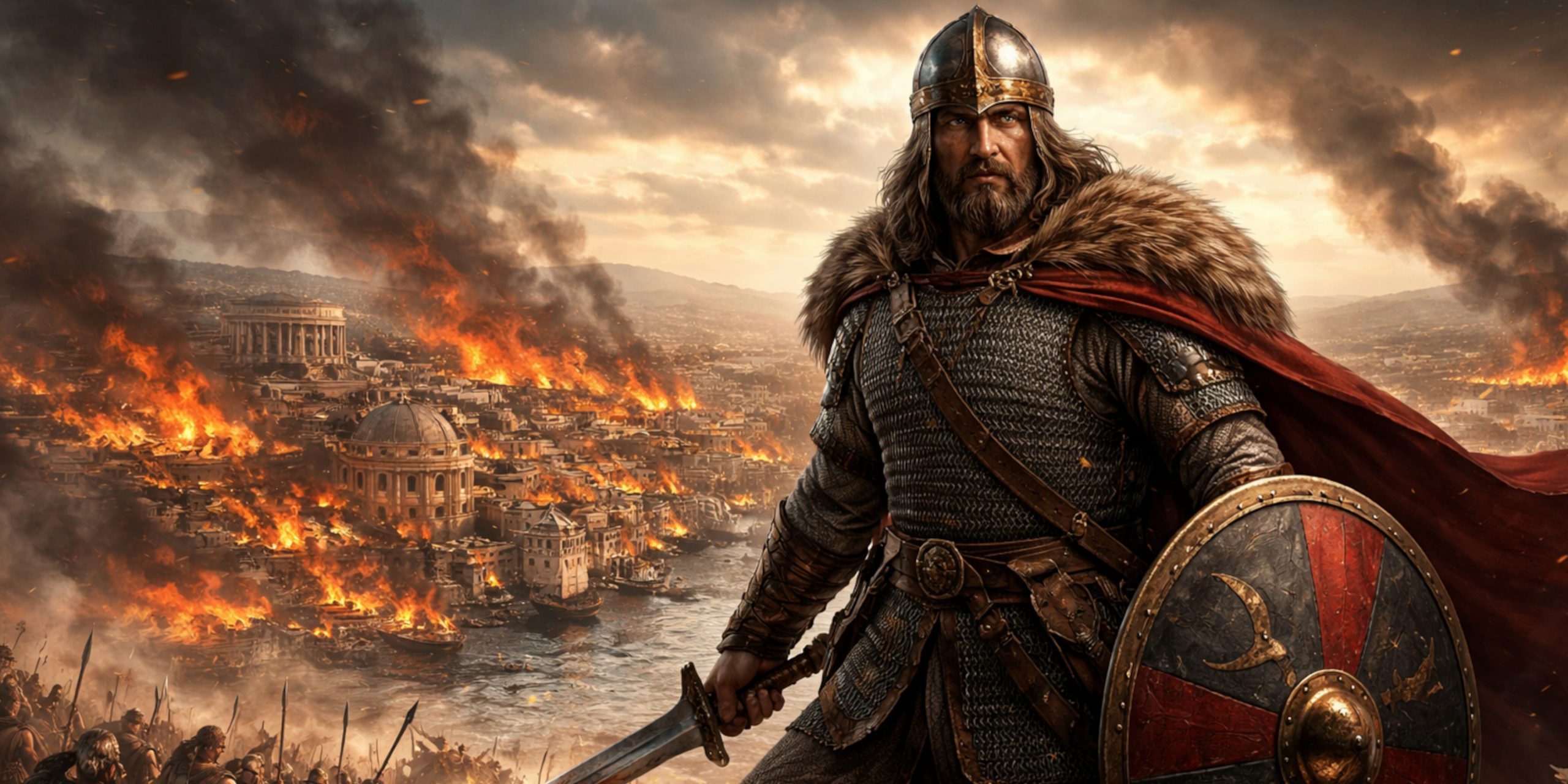
Genseric, sometimes written as Gaiseric, rarely gets the attention given to Attila or Alaric, yet he quietly achieved something arguably more enduring. He did not simply raid the Roman world. He carved out a functioning kingdom on its richest western province and held it for decades.
There is a certain cold efficiency to his career that stands out. No grand speeches survive, no romanticised last stands. Just careful planning, opportunism, and a habit of surviving situations that should have swallowed lesser rulers whole.
Origins and Rise to Power
Genseric was born around 389 into the Hasding branch of the Vandals. By the early fifth century, this was a people on the move, pushed westward through Gaul and into Hispania amid the wider collapse of Roman authority.
When his half-brother King Gunderic died in 428, Genseric took control. Contemporary writers note his physical lameness, possibly from a fall from a horse. It did nothing to slow him down politically.
His defining early decision came quickly. Rather than remain in unstable Hispania, he led his people across the Strait of Gibraltar into North Africa in 429. It was a bold gamble. It paid off spectacularly.
Conquest of North Africa
Roman North Africa was the breadbasket of the western empire. Whoever held it controlled grain, wealth, and shipping routes.
Genseric moved with speed and discipline:
- 429 to 435, systematic campaigning across Mauretania and Numidia
- 435, treaty with Rome recognising Vandal control of parts of North Africa
- 439, sudden seizure of Carthage, the real prize
The capture of Carthage transformed everything. It gave Genseric a capital, a fleet, and direct access to Mediterranean trade.
From this point onward, he was not merely a barbarian king. He was a Mediterranean power.
Battles and Military Acumen
Genseric’s reputation rests less on pitched battles and more on strategy. He understood mobility, supply, and timing with unusual clarity.
Key Campaigns and Actions
- Conquest of Carthage (439), a surprise seizure rather than a siege
- Naval raids across Sicily, Italy, and Greece
- Sack of Rome (455), following political instability in the western empire
- Defeat of the massive Roman expedition of 468, one of the largest naval operations of antiquity
The Sack of Rome (455)
The sack itself was less chaotic than later legend suggests. According to some sources, Genseric agreed to spare the city from widespread destruction after negotiations with Pope Leo I.
Still, Rome was stripped of immense wealth. Statues, treasures, even the Temple of Jupiter’s spoils were carried off to Carthage.
It was not mindless destruction. It was calculated extraction.
The Battle of Cape Bon (468)
The Romans launched a vast fleet to crush Genseric. It should have worked.
Genseric instead used fireships and timing to devastating effect. The Roman fleet was destroyed or scattered, and the western empire never truly recovered.
It is one of those moments where the scale of what almost happened is more impressive than what did.
Arms and Armour
The Vandals were not dramatically different from other Germanic groups of the period, though their long exposure to Roman military culture shaped their equipment.
Typical Arms
- Spatha, a long straight sword suited for cavalry and infantry use
- Spears and lances, versatile and widely used
- Seaxes, shorter blades for close work
- Composite bows, especially among cavalry and allied troops
Armour and Protection
- Mail shirts, often Roman in origin or influence
- Helmets such as spangenhelms
- Round or oval shields, sometimes decorated with bold patterns
- Limited use of heavier Roman-style armour among elite warriors
Naval Warfare
Genseric’s real innovation was naval. His fleets were fast, opportunistic, and difficult to pin down. He understood that Rome’s weakness lay in its overstretched coasts.
In many ways, his navy mattered more than any sword.
Rule and Governance
Genseric ruled for nearly fifty years, an extraordinary tenure for the period.
His kingdom was centred on Carthage and structured around:
- Control of grain supply
- Taxation and redistribution of Roman estates
- A Vandal elite ruling over a largely Roman population
Religion created tension. Genseric was an Arian Christian, while most of his subjects were Nicene Christians. There were periods of persecution, though his policies shifted depending on political needs.
He could be ruthless, but rarely without purpose.
Personality and Reputation
Contemporary Roman writers depict Genseric as cunning, ruthless, and calculating. None of this is surprising. He was their enemy, and a successful one.
What stands out is his restraint. He avoided unnecessary battles, preferred negotiation when useful, and retreated when it suited him.
There is a quiet intelligence in that approach. He did not chase glory. He accumulated advantage.
Artefacts and Where to See Them
Direct artefacts tied specifically to Genseric himself are scarce. This is typical for rulers of migrating Germanic groups.
However, material from the Vandal Kingdom can be found in several locations:
- Bardo National Museum, Tunis
Holds mosaics and material culture from Vandal-era North Africa - Carthage archaeological site, Tunisia
Remains of the city Genseric made his capital - Museo Archeologico Nazionale, Naples
Some items linked to late Roman and Vandal interactions - Various European collections
Weapons and grave goods attributed to Vandal or related Germanic contexts
The frustrating truth is that Genseric’s legacy is more visible in texts than in named objects.
Archaeology and Latest Findings
Archaeology has slowly reshaped how we see the Vandals.
Recent work in North Africa suggests:
- Continued urban life in Carthage under Vandal rule
- Evidence of trade networks that remained active across the Mediterranean
- Adaptation rather than collapse of Roman infrastructure
The old image of the Vandals as purely destructive has softened. They were disruptive, certainly, but also administrators.
In some respects, they preserved parts of the Roman system they inherited.
Death and Legacy
Genseric died in 477, still in power, which in itself says a great deal. He left behind a stable kingdom that lasted until the Byzantine reconquest in 533.
His legacy is complicated:
- He weakened the western Roman Empire at a critical moment
- He demonstrated the power of naval warfare in late antiquity
- He built a kingdom that outlived many of his contemporaries
There is a temptation to see him as a villain because of Rome. It is a narrow view.
From another angle, he looks like one of the most effective rulers of his age.
Takeaway
Genseric is not a romantic figure. He does not lend himself to heroic paintings or sweeping epics. He is something else entirely.
He is the ruler who saw the cracks in Rome and quietly widened them.
There is a certain admiration in that, even if one feels slightly uneasy admitting it