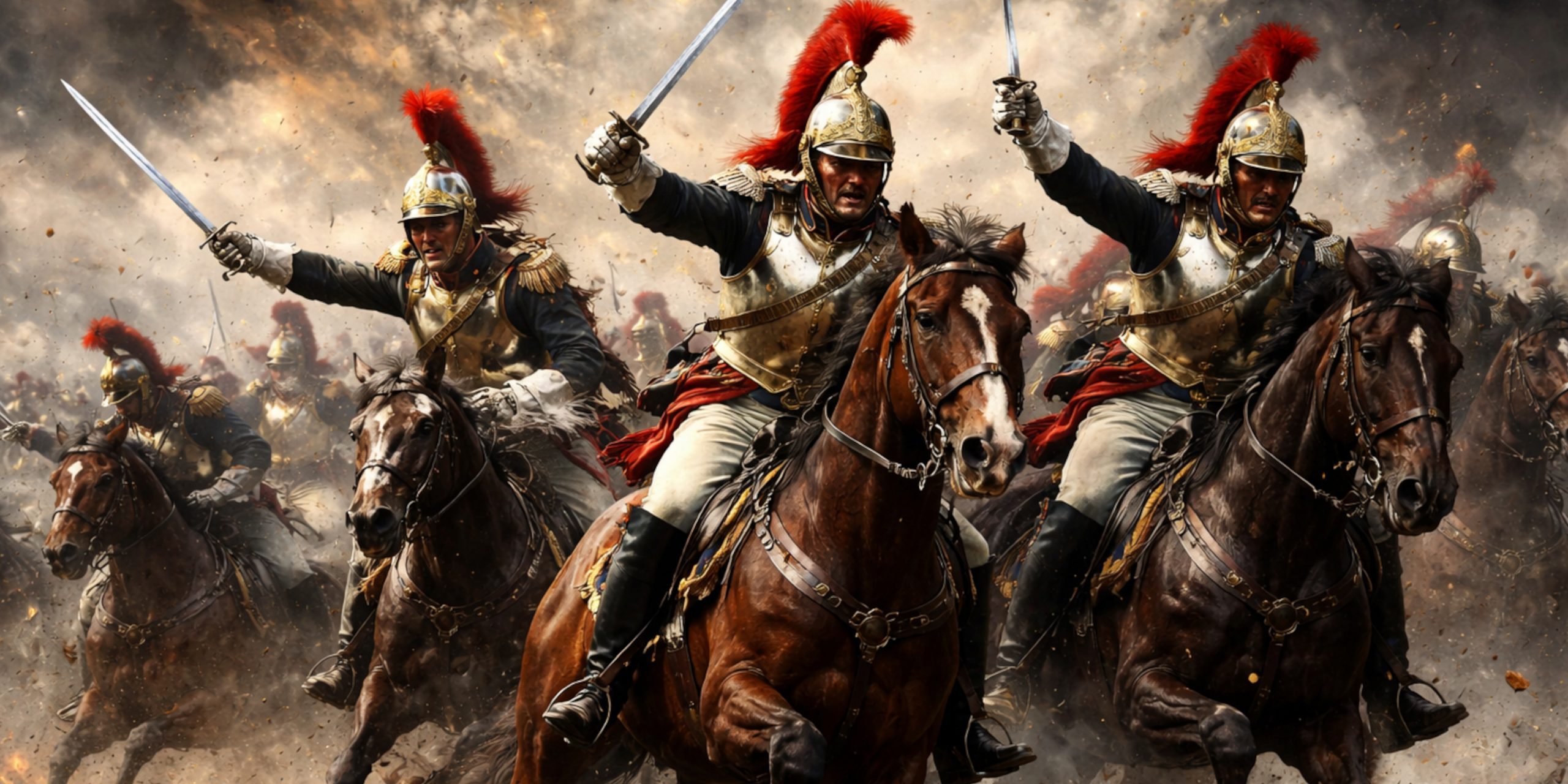
A gleaming arm of Napoleon’s heavy cavalry, stubbornly brave and occasionally too visible for their own good
There is something faintly theatrical about the French Carabiniers. They were, in many ways, the showpiece cavalry of Napoleonic France, tall men on large horses, clad in polished metal and radiating confidence. If one were to design a regiment specifically to impress both allies and enemies, this would be it.
Yet beneath the shine sat a more complicated truth. They were not merely decorative. They fought hard, suffered badly, and adapted in ways that reveal much about the changing nature of warfare in the early nineteenth century.
Origins and Early Role
The Carabiniers trace their roots back to the late seventeenth century under Louis XIV. Initially, they were selected companies drawn from existing cavalry regiments, intended to act as elite marksmen armed with carbines. Hence the name.
By the eighteenth century, they had evolved into a distinct corps of heavy cavalry. Their role shifted from skirmishing to shock action, charging alongside cuirassiers and forming part of France’s decisive mounted arm.
By the time of the Revolutionary Wars, two regiments remained. These would carry the tradition forward into the Napoleonic period.
Transformation Under Napoleon
Napoleon inherited the Carabiniers as elite heavy cavalry, but early campaigns exposed a problem. Unlike the cuirassiers, they lacked body armour. This was not a minor oversight when facing artillery and musket fire at close range.
After heavy losses, particularly against Austrian forces, Napoleon ordered a transformation. By 1809, the Carabiniers were equipped with brass cuirasses and distinctive helmets with red plumes. The result was striking. One might even say dazzling, though not always in a tactically helpful way.
The polished brass cuirass reflected sunlight brilliantly. It also made the wearer rather easy to spot.
Organisation and Structure
By the height of the Napoleonic Wars, the Carabiniers consisted of:
- 2 regiments
- Each regiment typically fielding 4 squadrons
- Around 800 to 1,000 troopers per regiment in ideal conditions
They were brigaded with cuirassiers and formed part of the heavy cavalry reserve, often committed at critical moments.
Their horses were large and powerful, selected for shock action rather than speed.
Arms and Armour
The Carabiniers were equipped for close combat and decisive charges. Their kit reflected both tradition and the evolving demands of the battlefield.
Weapons
- Straight heavy cavalry sword, similar to the AN XI pattern
- Carbine, though increasingly secondary in battlefield use
- Pistols carried in saddle holsters
The sword was the primary weapon in action. Designed for cutting and thrusting, it was effective in the chaotic press of cavalry engagements.
Armour
- Brass cuirass, front and back plates
- Steel helmet with brass fittings and red plume
- White uniform with sky blue facings
The brass cuirass offered protection against sword blows and some small arms fire, though it was far from invulnerable. It did, however, provide a psychological edge. A wall of armoured horsemen advancing at speed tends to focus the mind.
One French officer remarked:
“The Carabinier fears neither steel nor fire, for he rides encased in both courage and iron.”
That said, iron occasionally proved more reliable than courage.
Battlefield Role and Tactics
The Carabiniers were used as shock cavalry. Their task was simple in theory and terrifying in practice.
- Charge enemy infantry at the decisive moment
- Break weakened lines
- Exploit gaps created by artillery or infantry assault
They were not skirmishers. They were not subtle. Their effectiveness depended on timing, terrain, and discipline.
When committed correctly, they could shatter formations. When committed poorly, they could be cut down with grim efficiency.
Major Battles
Battle of Austerlitz, 1805
The Carabiniers played a supporting role in one of Napoleon’s greatest victories. Though not central to the decisive manoeuvre, they contributed to the cavalry presence that secured French dominance.
Battle of Wagram, 1809
Here their lack of armour became painfully clear. Facing Austrian fire, the Carabiniers suffered heavy casualties. This experience directly led to their re-equipment with cuirasses.
A French account noted:
“They advanced with admirable firmness, yet fell in numbers that demanded remedy.”
Napoleon agreed. Hence the brass.
Battle of Borodino, 1812
At Borodino, the Carabiniers charged repeatedly against Russian positions. The fighting was brutal and confused. Heavy cavalry clashed in dense formations, often at close quarters.
Their armour offered some protection, but not enough to prevent severe losses.
Battle of Waterloo, 1815
At Waterloo, the Carabiniers took part in the massed cavalry charges against Allied infantry squares.
The results were predictably costly.
British infantry, formed in squares, repelled repeated assaults. The Carabiniers displayed courage, but courage alone does not break disciplined infantry with steady volleys.
One British observer wrote:
“They came on in glittering order, yet recoiled as often as they advanced.”
It was a grim end to a proud arm of cavalry.
Archaeology and Material Evidence
Napoleonic battlefields have yielded a range of artefacts linked to heavy cavalry, including the Carabiniers.
Finds include:
- Sword fragments and scabbard fittings
- Musket and pistol balls
- Uniform buttons and helmet pieces
- Occasional cuirass fragments
Sites such as Waterloo and Borodino continue to produce material evidence. The condition of recovered armour suggests that while cuirasses could deflect glancing blows, they were often penetrated at close range.
Modern battlefield archaeology has also revealed horse remains, offering insight into the scale and intensity of cavalry engagements.
There is something quietly sobering about these finds. The polished spectacle fades quickly when reduced to fragments in the soil.
Appearance and Identity
The Carabiniers stood apart visually from other cavalry units.
- White coats rather than darker uniforms
- Brass cuirasses that gleamed rather than dulled
- Red plumes that caught the eye even at distance
They were, quite deliberately, conspicuous.
This was not accidental. Elite units were meant to be seen. Visibility reinforced morale and reputation. It also, rather inconveniently, made them excellent targets.
Decline and Legacy
The decline of the Carabiniers mirrors the broader fate of heavy cavalry.
By the later stages of the Napoleonic Wars, improvements in infantry firepower and discipline reduced the effectiveness of massed cavalry charges. The battlefield was becoming less forgiving.
After Napoleon’s fall, the Carabiniers continued to exist within the French army, though their role diminished. Armour gradually disappeared from practical use.
Their legacy, however, endures.
- They represent the last great age of armoured cavalry in Europe
- Their image influenced military dress and ceremonial units
- They remain a symbol of Napoleonic martial spectacle
Where to See Artefacts
Artefacts associated with the Carabiniers can be found in several museums:
- Musée de l’Armée, Paris
- National Army Museum, London
- Waterloo battlefield collections in Belgium
These collections include helmets, cuirasses, swords, and personal items. Seeing them in person gives a clearer sense of scale and craftsmanship. They are impressive objects, even when slightly dented by history.
Takeaway
The French Carabiniers occupy an interesting place in military history. They were both practical soldiers and living symbols.
They charged into musket fire wearing polished brass, which feels equal parts brave and optimistic. One suspects they knew the risks. One also suspects they preferred not to dwell on them.
As a historian, I find them hard to dislike. There is something admirable in their stubborn adherence to a form of warfare that was already beginning to slip away.
They rode forward anyway.