Harthacnut is one of those kings who sits awkwardly in the margins of English history. He ruled both Denmark and England, inherited the legacy of one of the most formidable conquerors of the medieval world, and died suddenly while still a young man. Yet he rarely gets the attention given to his father, Cnut the Great, or to the Anglo Saxon kings who came before and after him.
As a historian, I find Harthacnut fascinating precisely because of that awkward position. He was the final attempt to hold together the North Sea Empire that Cnut had built. England, Denmark and Norway had once been tied into a single political orbit. By the time Harthacnut died in 1042, that experiment had quietly collapsed.
His reign in England lasted barely two years, but the story around him is far richer than the length of his rule suggests.
Origins and Early Life
Harthacnut was born around the early years of the eleventh century, most likely between 1016 and 1018. He was the son of Cnut the Great, king of England, Denmark and Norway, and Emma of Normandy, one of the most politically astute queens of the age.
This family background mattered enormously.
Cnut ruled a maritime empire built on fleets, tribute and personal loyalty. His son was therefore raised in a world that was both royal and aggressively martial. Power in the North Sea world still depended on warriors, ships and the ability to command loyalty from armed men.
By the early 1030s Harthacnut was already positioned as Cnut’s successor in Denmark. That kingdom would become his power base.
The Succession Crisis After Cnut
When Cnut died in 1035, the empire he built began to unravel almost immediately.
Harthacnut was the legitimate heir through Queen Emma, yet he could not immediately travel to England. Denmark was under threat from Magnus of Norway and Anund Jacob of Sweden, and the young prince needed to remain in Scandinavia to defend his position.
England therefore fell under the control of his half brother Harold Harefoot, who ruled as regent and then king.
The result was a tense and sometimes brutal political standoff.
Emma supported Harthacnut’s claim and held power in southern England for a time. But Harold gradually consolidated control and Harthacnut was forced to wait.
Only after Harold died in 1040 did Harthacnut finally arrive with a fleet and claim the English throne.
Harthacnut as King of England
Harthacnut became king of England in 1040 and ruled until his sudden death in 1042.
His reign was short and, according to many contemporary sources, deeply unpopular. One reason was taxation. Maintaining fleets and armies required money, and Harthacnut demanded large payments to support his forces.
The most infamous example was the heavy taxation used to pay the royal fleet. According to chroniclers, the tax collectors who enforced this policy were sometimes brutally resisted. One revolt in Worcester ended with royal forces burning the town.
The picture painted by the sources is of a king attempting to govern England through the mechanisms of Danish style military kingship. In Scandinavia this model worked well. In England, where aristocratic power was already shifting toward large earldoms and regional authority, it proved less stable.
Battles and Military Acumen
Although Harthacnut is remembered more for politics than battlefield heroics, his career was shaped by military realities.
His early years in Denmark required constant readiness for war.
Key military pressures during his reign
• Threat of invasion from Norway under Magnus the Good
• Political rivalry within England following the death of Harold Harefoot
• Need to maintain naval power across the North Sea
Harthacnut relied heavily on fleets. In many ways he represented the final generation of rulers whose power rested on Viking style naval mobilisation.
Chroniclers describe him arriving in England with a large fleet in 1040. This display of force ensured that his claim was accepted with little resistance.
He also took a dramatic step after taking power. Harold Harefoot’s body was dug up and thrown into the Thames. The gesture was both symbolic and political. It signalled the complete reversal of the previous regime.
Strategically Harthacnut seems to have understood one important reality. The North Sea world was becoming harder to control as a single empire. He made peace with Magnus of Norway and reportedly agreed that whichever king died first would leave his kingdom to the other. It was a pragmatic solution to a looming war.
Arms and Armour of Harthacnut’s Warriors
Although we lack direct descriptions of Harthacnut’s personal equipment, we have a clear understanding of the arms used by elite Scandinavian and Anglo Danish warriors of the early eleventh century.
Typical equipment of Harthacnut’s household troops
| Weapon or Armour | Description |
|---|---|
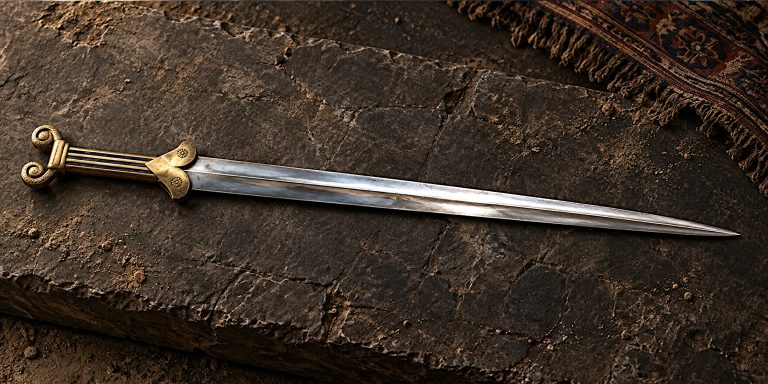
| Viking sword | Double edged iron blade often around 90 cm long, pattern welded or steel edged |
| Spear | The most common battlefield weapon, used both for throwing and thrusting |
| Danish axe | Large two handed axe capable of penetrating shields and armour |
| Round shield | Wooden shield with iron boss, often painted or decorated |
| Mail shirt | Interlinked iron rings providing strong protection against cuts |
| Conical helmet | Iron helmet sometimes fitted with a nasal guard |
The famous Danish axe deserves special mention. By the eleventh century it had become the signature weapon of elite Scandinavian infantry, including the English royal housecarls. These warriors served kings like Cnut and later the Anglo Saxon rulers who followed.
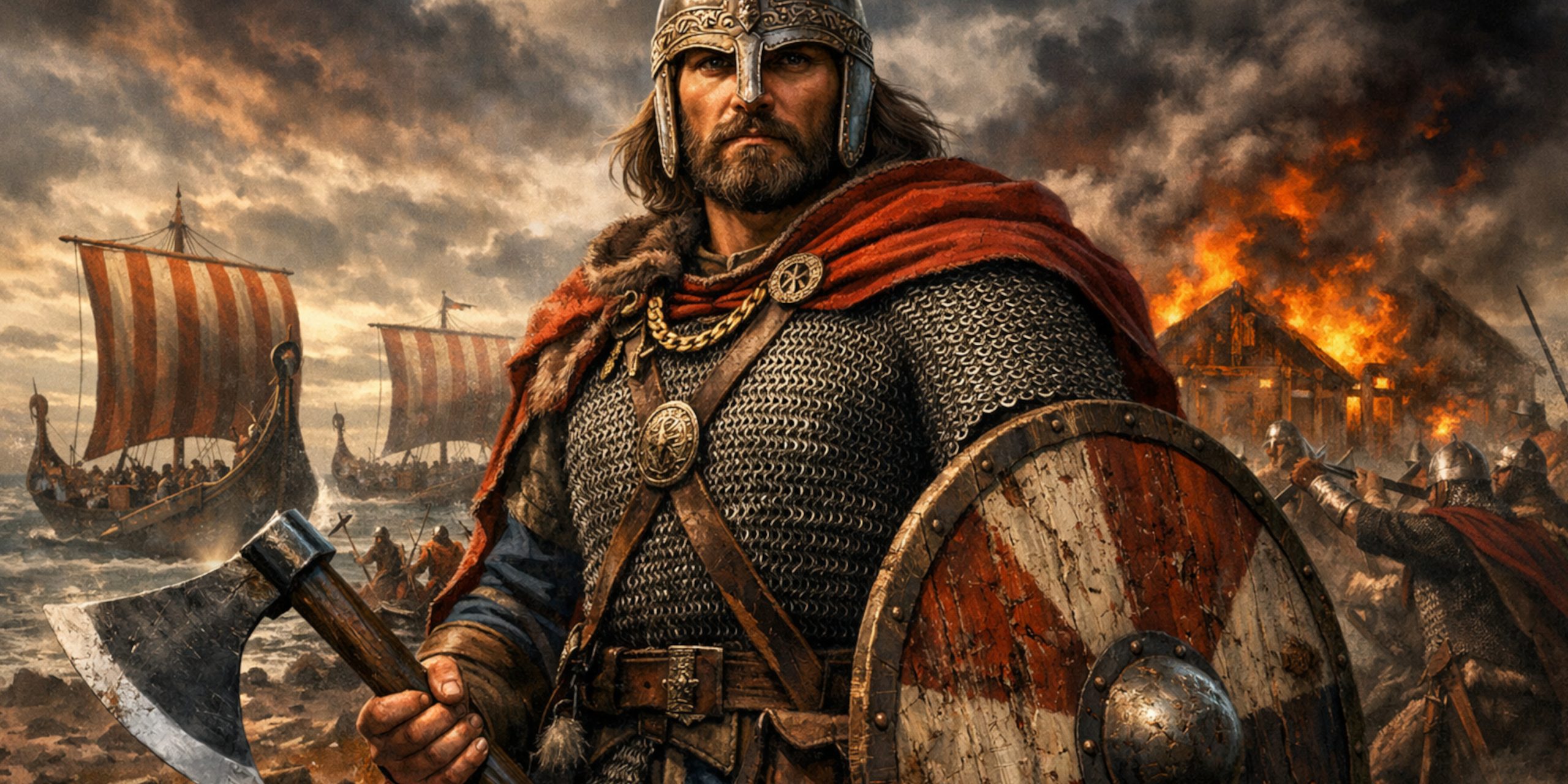
When we picture Harthacnut’s military household, the image is therefore one of mail clad warriors carrying long axes and swords, fighting in tight shield formations.
Relationship with Edward the Confessor
One of the most significant political decisions of Harthacnut’s reign was inviting his half brother Edward, later known as Edward the Confessor, back from exile in Normandy.
Edward had spent many years abroad after the Danish conquest of England. Harthacnut’s decision to bring him back suggests that he was preparing a succession plan.
If Harthacnut died without heirs, Edward would inherit the throne.
That is exactly what happened in 1042.
Sudden Death
Harthacnut died suddenly on 8 June 1042 during a wedding feast in Lambeth.
According to the Anglo Saxon Chronicle he collapsed while drinking and died almost immediately. Chroniclers describe the event in dramatic terms, suggesting either a stroke or heart failure.
He was probably still in his early twenties.
His death ended Danish rule in England. Edward the Confessor became king and the political centre of England shifted away from Scandinavia and back toward the continent.
Within a generation the Norman Conquest would reshape the entire kingdom.
Artefacts from the Reign of Harthacnut
Although physical objects directly tied to Harthacnut are rare, several categories of artefacts survive from his reign.
Coins
The most important artefacts are silver pennies minted during his rule.
These coins were produced in several English mints including London and Winchester. They typically display a crowned bust of the king and inscriptions naming Harthacnut as ruler.
Many examples are now held in:
• The British Museum
• The Fitzwilliam Museum in Cambridge
• The Ashmolean Museum in Oxford
Coins are crucial historical evidence because they demonstrate royal authority, economic networks and artistic styles of the period.
Royal burial
Harthacnut was buried in Winchester Cathedral, a major royal burial site during the late Anglo Saxon period.
His remains are believed to be among the bones preserved in the cathedral mortuary chests, although the remains were disturbed during the English Civil War.
Visiting Winchester still gives a powerful sense of the royal world he inhabited.
Latest Archaeological Insights
Recent archaeology has shed more light on the world in which Harthacnut ruled rather than on the king himself.
Viking and Anglo Danish sites in England
Excavations across England continue to reveal the military and economic systems established during Danish rule.
Important discoveries include:
• Weapon finds from Scandinavian style warrior graves
• Ship rivets and maritime infrastructure linked to naval mobilisation
• Hoards of silver coins dating to the late reign of Cnut and the time of Harthacnut
These discoveries help historians understand the scale of the North Sea political network.
Winchester archaeology
Work in and around Winchester has revealed evidence of royal administration and minting activity during the early eleventh century. The city functioned as one of the administrative centres for the Danish kings of England.
Material evidence from this period includes coin dies, metalworking debris and fragments of high status objects.
Historical Legacy
Harthacnut’s reign marked the final chapter of a remarkable political experiment.
Cnut the Great had built an empire that connected England, Denmark and Norway through naval power and personal loyalty. For a brief moment the North Sea functioned almost like a shared political space.
Harthacnut inherited that structure at the moment it was already starting to fracture.
His short reign, heavy taxation and sudden death meant he never had the chance to stabilise the system. With his passing the Danish line of kings in England ended.
From a historian’s perspective, Harthacnut feels like the closing scene of a long saga. The Viking age in England did not vanish overnight, but his death signalled that the political world created by Scandinavian conquest was coming to an end.
Two decades later, another invasion from across the sea would reshape England once again. This time the conquerors would come not from Denmark, but from Normandy.