The Battle of Degsastan, fought in 603, rarely receives the same attention as later showdowns like Battle of Chester or Battle of Hatfield Chase. Yet in many ways it was the moment that fixed the political map of northern Britain for a generation.
Here, the expanding kingdom of Northumbria under King Æthelfrith of Northumbria collided with the Gaelic forces of Áedán mac Gabráin, ruler of Dál Riata. The result was decisive. The consequences were long lasting. And the sources, frustratingly, are thin.
Still, what we can piece together is enough to show that this was no minor skirmish on a windswept border. It was a struggle for dominance in the north.
Political Background
By the turn of the seventh century, Æthelfrith had forged the Bernician and Deiran realms into a single Northumbrian power. He was energetic, ambitious, and not inclined to leave rival kings in peace.
To the north-west, Áedán mac Gabráin ruled Dál Riata, a kingdom straddling western Scotland and parts of Ulster. He was no passive neighbour. Irish annals suggest he had campaigned widely, even against the Picts and the Britons of Strathclyde.
A clash was almost inevitable.
The exact location of Degsastan remains uncertain. Many scholars place it near modern Dawston in Liddesdale, close to the Anglo Scottish border. The terrain, if this identification is correct, would have favoured defensive infantry formations, with rolling ground broken by streams and marshy patches. Not ideal cavalry country.
Foces
Precise numbers are unknown. Early medieval chroniclers were far more interested in outcomes than logistics. That said, relative scale can be inferred.
| Kingdom | Estimated Strength | Composition |
|---|---|---|
| Northumbria | Several thousand | Anglo Saxon heavy infantry, retinues of thegns, possible light cavalry |
| Dál Riata | Several thousand | Gaelic warbands, elite bodyguard, allied contingents |
Both sides likely fielded forces typical of early seventh century Britain, centred on heavily armed infantry supported by lighter troops.
One detail stands out. According to later tradition, Áedán brought a sizeable host, possibly including allies. The scale of his defeat suggests this was not a token raid but a serious campaign.
Leaders and Troop Composition
Northumbria
- King: Æthelfrith of Northumbria
- Notable casualty: The king’s brother, Theobald
Troop Composition
- Hearth troops equipped with mail shirts
- Shield wall infantry armed with spears
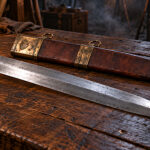
- Noble warriors bearing pattern welded swords, likely early Anglo Saxon spathae
- Seaxes as sidearms
- Round wooden shields with iron bosses
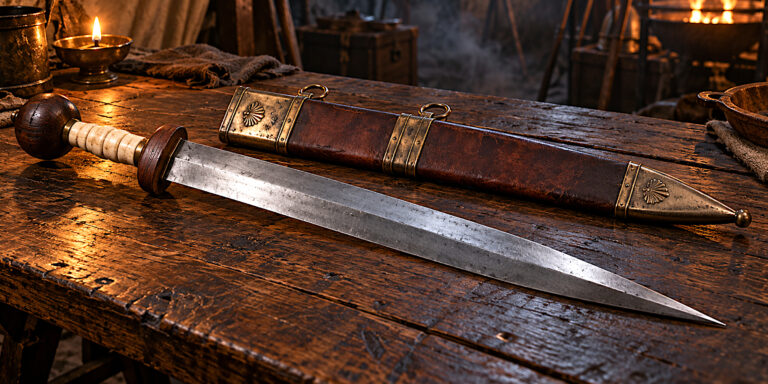
Anglo Saxon swords of this period were typically double edged, around 70 to 80 cm in blade length. Pattern welding was common, creating both strength and distinctive surface patterns. These were prestige weapons, not carried by every man.
Dál Riata
- King: Áedán mac Gabráin
Troop Composition
- Gaelic infantry warbands
- Elite bodyguard, possibly mounted
- Spears and light javelins
- Early insular long swords influenced by Irish and British forms
- Smaller round shields, sometimes with decorative bosses
Gaelic swords of this era were typically straight, double edged weapons derived from late Roman and sub Roman models. While less archaeologically abundant than Anglo Saxon finds, they were no less lethal.
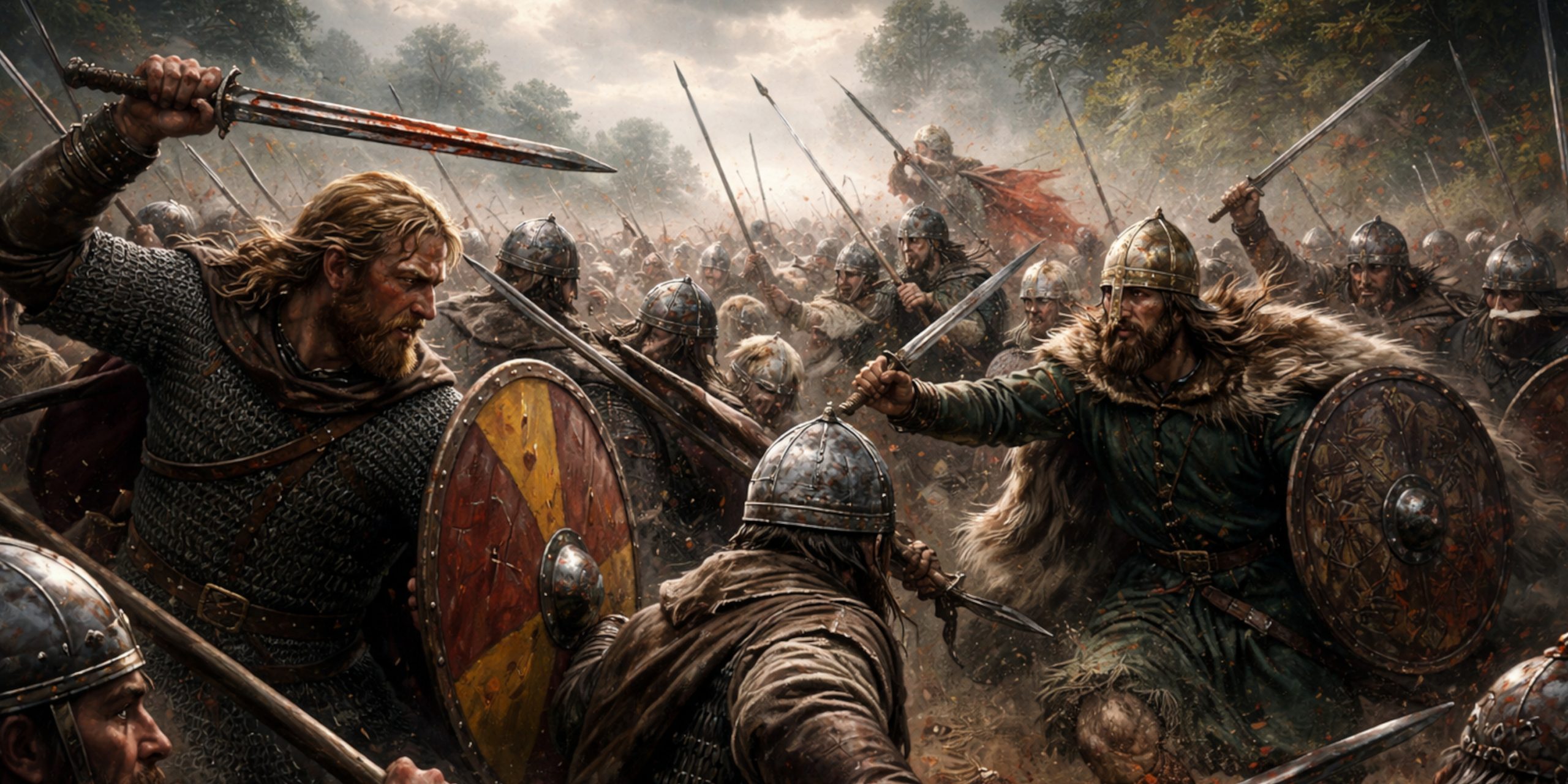
It is tempting to imagine contrasting styles, disciplined Anglo Saxon shield wall against more fluid Gaelic warbands. In reality, both sides would have fought in dense infantry formations, pushing and stabbing in brutal close quarters.
Arms and Armour
Common Equipment
- Iron spearheads with leaf shaped blades
- Pattern welded swords for elites
- Mail hauberks for nobles
- Conical helmets, possibly with simple nasal guards
- Round wooden shields covered in leather
Mail remained expensive. Most warriors would have relied on thick woollen garments and shields for protection. Combat was intimate, noisy, and short lived.
If one is searching for romance here, it is best abandoned. Early medieval warfare was efficient, violent, and over quickly once morale cracked.
The Battle
Our principal narrative source is Bede in his Ecclesiastical History. He tells us that Æthelfrith defeated Áedán decisively, though the king’s brother Theobald was killed.
A brief timeline can be reconstructed.
Battle Timeline
- Áedán advances into Bernician territory
- Northumbrian forces assemble under Æthelfrith
- Engagement at Degsastan, likely involving shield wall confrontation
- Theobald killed in fighting
- Dál Riatan army routed
- Áedán retreats north
Bede remarks that after this defeat, no Irish king dared make war on the English in Britain again during Æthelfrith’s lifetime. That is a strong statement. It suggests not merely victory but humiliation.
Contemporary Sources and Quotes
From Bede:
“From that time no king of the Scots in Britain durst make war against the nation of the English to this day.”
This is classic Bede. Concise, triumphant, and written from a Northumbrian perspective.
Irish annals are quieter, which in itself speaks volumes. Defeats are rarely described in detail.
As a historian, I always find the silence telling. Victors write. Losers move on.
Archaeology
Unlike battles such as Battle of Towton, Degsastan has not yielded a clear archaeological signature. No mass graves, no weapon scatters conclusively tied to the engagement.
The uncertainty of the site complicates matters. Finds in the Anglo Scottish border region include early medieval spearheads and sword fragments, but none can be definitively linked.
This absence is frustrating but typical. Early medieval battlefields are notoriously elusive. Wood, leather, and flesh decay. Iron corrodes. Landscapes change.
Sometimes the only trace is the political shift that follows.
Consequences and Legacy
Degsastan secured Northumbria’s northern frontier. Æthelfrith could now turn his attention south and west. Within a decade he would defeat the Britons at Chester, further consolidating his power.
For Dál Riata, the defeat curtailed ambitions in the east. Áedán fades from the record not long after.
The battle did not end conflict in Britain. That would be far too neat. But it marked the high point of Æthelfrith’s dominance and confirmed Northumbria as a major force.
In the broader sweep of early medieval Britain, Degsastan stands as a hinge moment. Not dramatic in narrative sources, not archaeologically rich, yet politically decisive.
And perhaps that is fitting. Much of early medieval history survives not in grand speeches or detailed chronicles, but in short lines of Latin and the reshaped borders they quietly record.
The Seven Swords Takeaway
The Battle of Degsastan was more than a border clash. It was a contest between two expanding powers at a formative moment in British history.
Æthelfrith emerged victorious. Áedán retreated. Northumbria solidified its strength. The map shifted.
If you look at later Northumbrian dominance and wonder where its confidence came from, Degsastan is a good place to start.
Watch the documentary: