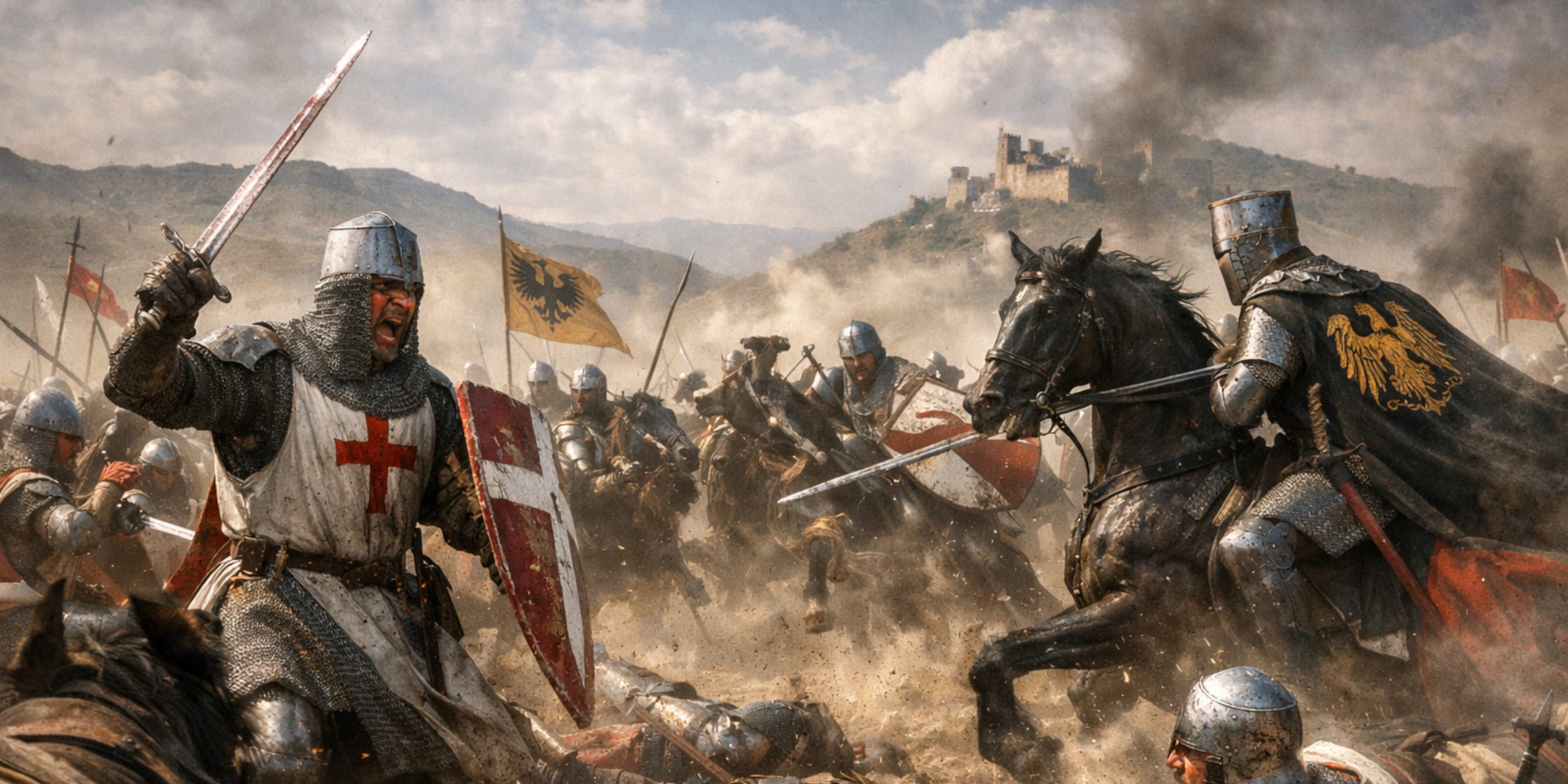
The Battle of Agridi, fought in 1232 near Nicosia in Cyprus, was not one of the largest clashes of the Crusading era, yet it carried consequences that rippled through the politics of the eastern Mediterranean. At its heart stood a dispute over authority, between the local baronage of Cyprus led by the Ibelin family and imperial representatives of the Hohenstaufen emperor.
The confrontation offers a rare, almost theatrical moment in Crusader history, when legal theory, feudal rights and hard steel met on a dusty Cypriot field. It was, in essence, a civil war within the Latin East.
Background to the Conflict
The island of Cyprus had come under the rule of the Lusignan dynasty following the Third Crusade. After the death of King Hugh I, his son Henry I was still a child, and the regency became contested ground.
The central issue concerned imperial authority. The Holy Roman Emperor Frederick II claimed overlordship over the Kingdom of Jerusalem and, by extension, Cyprus. His appointed baillis sought to enforce imperial control. The Cypriot barons, led by John of Ibelin, rejected this encroachment, defending what they regarded as established feudal liberties.
The clash at Agridi formed part of what is often termed the War of the Lombards.
Forces at Agridi
Precise numbers are difficult to establish, yet contemporary accounts suggest a marked disparity.
Ibelin Forces
- Estimated 200 to 300 knights
- Several hundred mounted sergeants
- Local infantry contingents
Imperial Forces
- Estimated 600 or more mounted knights
- Lombard mercenaries
- Imperial household troops
Despite being outnumbered, the Ibelin faction possessed something less tangible but more decisive, cohesion and local support.
Leaders and Command Structure
| Faction | Leader | Role | Notes |
|---|---|---|---|
| Ibelin | John of Ibelin | Regent and commander | Veteran nobleman, experienced in Levantine politics |
| Ibelin | Baldwin of Ibelin | Field commander | Brother of John, active in the charge |
| Imperial | Riccardo Filangieri | Imperial bailli | Representative of Frederick II |
| Imperial | Lombard captains | Cavalry commanders | Led mounted contingents |
John of Ibelin stands out as the central figure. By 1232 he was no impetuous youth but a seasoned statesman. His strength lay as much in legal argument as in mounted combat, though at Agridi he proved capable in both spheres.
Arms and Armour
The equipment used at Agridi reflected standard early thirteenth century Crusader practice.
Ibelin Knights
- Mail hauberk with coif
- Kite or early heater shields
- Conical or flat topped helmets
- Lances for the charge
- Arming swords, typically Oakeshott Type XII blades
- Some use of early great helms
Imperial Knights
- Comparable mail armour
- Heavy cavalry lances
- Arming swords, often broad cutting types
- Shields bearing imperial insignia
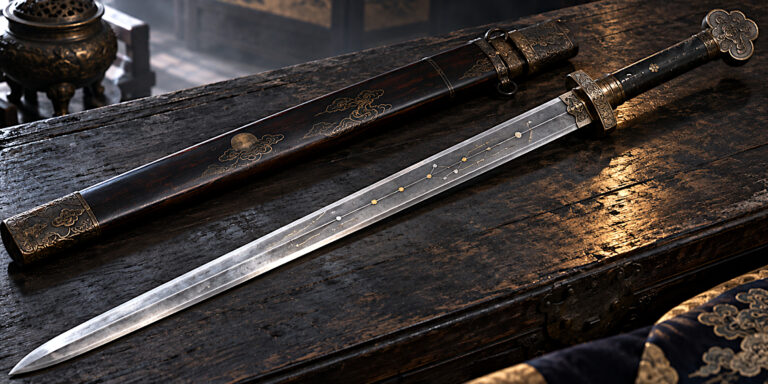
The arming sword of the period, particularly the Type XII, was a broad bladed cut and thrust weapon well suited to mounted combat. In close quarters, these swords were brutally effective. Against mail, they relied on force and precise thrusting rather than clean cuts.
Infantry on both sides would have carried spears, short swords and crossbows. Cyprus had access to experienced crossbowmen, a weapon increasingly decisive in thirteenth century warfare.
The Battle
The engagement took place near Agridi, close to Nicosia.
The Ibelin forces adopted a defensive posture, positioning themselves carefully and relying on discipline. The imperial cavalry, confident in superior numbers, advanced aggressively.
What followed appears to have been a series of mounted charges. The imperial knights attacked repeatedly but struggled to break the Ibelin line. Contemporary sources emphasise the cohesion of the Ibelin formation and the failure of the Lombard troops to coordinate effectively.
At a critical moment, the Ibelins counter attacked. The imperial army collapsed into disorder, and many were captured rather than killed. The defeat was decisive.
It is difficult not to admire the economy of the victory. Fewer men, better control, and a well timed counterstroke.
Battle Timeline
- Early 1232, tensions escalate between Ibelins and imperial authorities
- Spring 1232, imperial forces consolidate near Nicosia
- Mid 1232, opposing armies assemble near Agridi
- Initial imperial cavalry charges
- Ibelin defensive resistance
- Coordinated counter attack by Ibelin cavalry
- Imperial rout and capture of key figures
Archaeology and Physical Evidence
Unlike major Levantine battlefields such as Hattin, Agridi has yielded limited archaeological evidence. The battlefield has not been excavated in a systematic modern campaign.
Cyprus, however, preserves material culture from the Lusignan period:
- Fortifications at Nicosia and nearby castles
- Surviving churches and urban structures from the thirteenth century
- Artefacts including sword fragments, mail links and crossbow bolts recovered in broader regional contexts
Archaeological material from Lusignan Cyprus demonstrates the hybrid character of the Latin East, Western European arms combined with Eastern influences. Crossbows and mail were standard, while imported swords show trade links with Italian and French workshops.
The absence of dramatic finds at Agridi itself is almost fitting. This was a political victory expressed through arms, rather than a slaughter that left heaps of relics.
Contemporary Accounts
The principal narrative source is Philip of Novara, himself closely associated with the Ibelin faction. His chronicle presents the conflict as a defence of lawful custom against imperial overreach.
He writes of the barons standing firm “for the rights of the kingdom and the usages of their fathers”. The tone is legalistic as much as martial.
Naturally, this perspective is partisan. The imperial side offers fewer surviving voices. Even so, the Ibelin victory is not in doubt.
Consequences and Legacy
The defeat at Agridi severely weakened imperial authority in Cyprus. The Ibelins secured control over the regency and preserved local autonomy.
More broadly, the battle forms part of the long struggle between papal and imperial influence in the Crusader states. It illustrates how internal divisions weakened the Latin East at a time when external threats from Muslim powers were growing.
There is something faintly tragic in that observation. While barons debated rights and precedence, the wider strategic situation was deteriorating.
Yet Agridi also demonstrates the resilience of local political culture. Cyprus would remain a significant Christian stronghold long after mainland territories fell.
Takeaway
The Battle of Agridi was not vast in scale, nor especially bloody by medieval standards. Its importance lies in its outcome. A smaller force, guided by experienced leadership and legal conviction, defeated an imperial army and reshaped the governance of Cyprus.
As a historian, I find it refreshing. No grand crusade, no apocalyptic siege, just determined nobles settling a constitutional crisis with lances and swords. Medieval politics, in its most literal form.
Agridi reminds us that the Crusader states were not merely frontier fortresses. They were living societies, complete with rivalries, principles and the occasional well timed cavalry charge.