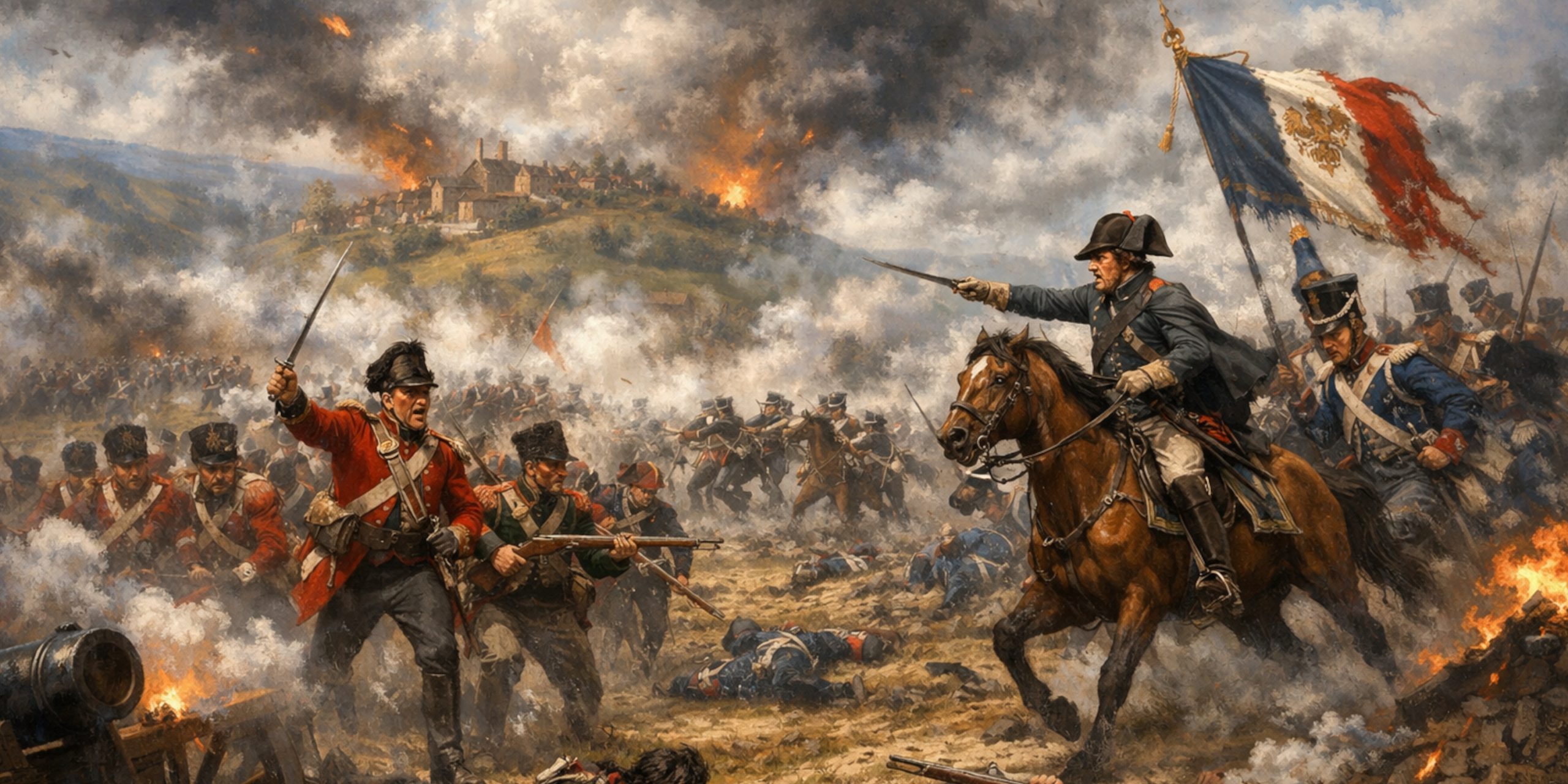
The Battle of Orthez, fought on 27 February 1814, sits in the late phase of the Peninsular War when Napoleon’s empire was clearly wobbling, yet still capable of bloody resistance. It was one of those engagements where the terrain mattered as much as the troops, and where judgement, patience, and a willingness to absorb losses decided the day. As a historian, I find Orthez quietly compelling. It lacks the grand theatrics of Salamanca or Waterloo, but it shows how wars are often really won, by grinding pressure, disciplined command, and soldiers doing unpleasant work on cold hillsides.
Strategic Context
By early 1814, Allied forces had crossed into southern France. The long defensive campaign in Spain was over, and the war had followed the French army home. The Allied commander, the Duke of Wellington, aimed to pin Marshal Soult’s army in place, force a decisive engagement, and prevent any organised French retreat towards Toulouse.
Soult, for his part, chose his ground carefully near the town of Orthez. He hoped strong positions and interior lines would offset Allied numerical strength. It was a sensible plan, though history would not be kind to it.
Forces
Allied Army
The Allied army combined British, Portuguese, and Spanish units. Wellington’s strength lay in coordination and battlefield control rather than raw numbers alone.
| Component | Estimated Strength |
|---|---|
| British infantry and cavalry | 28,000 |
| Portuguese troops | 16,000 |
| Spanish units | 6,000 |
| Artillery | 48 guns |
| Total | 50,000 |
French Army
Soult’s army was smaller but well trained, anchored on ridges and villages that favoured defence.
| Component | Estimated Strength |
|---|---|
| French infantry | 27,000 |
| Cavalry | 4,000 |
| Artillery | 40 guns |
| Total | 31,000 |
Commanders and Leadership
Allied Command
- Arthur Wellesley, overall command
- Sir Rowland Hill, corps commander
- Sir John Hope, reserve and cavalry coordination
French Command
- Jean-de-Dieu Soult, overall command
- General Reille, right wing
- General Clausel, centre and reserves
Wellington’s leadership at Orthez was methodical rather than flashy. He probed, adjusted, and pressed where resistance weakened. Soult fought stubbornly, but once his centre bent, his options narrowed rapidly.
Arms and Armour
Infantry Weapons
- British and Portuguese
- Brown Bess flintlock musket
- Baker rifle used by rifle units
- Infantry hangers and short sabres
- Swords commonly included British 1796 infantry officer’s sword
- French
- Charleville Model 1777 musket
- Briquet short sword for infantry
- French AN XI cavalry sabres in mounted units
Cavalry Arms
- British heavy cavalry wielded straight-bladed heavy sabres
- Light cavalry favoured the curved 1796 light cavalry sabre
- French dragoons and hussars used curved sabres suited to shock and pursuit
Body armour was minimal by this stage of the war. Apart from occasional cuirasses in French heavy cavalry units, most soldiers relied on coats, shakos, and luck. Luck, as ever, was in short supply.
The Battle Timeline
Morning
- Allied columns advanced across the Gave de Pau river crossings
- Initial skirmishing along French outposts and villages
Late Morning
- Wellington ordered a broad frontal assault on Soult’s ridge line
- Allied troops took heavy casualties under artillery and musket fire
Early Afternoon
- French right wing began to falter under sustained pressure
- Allied units exploited gaps between French divisions
Mid Afternoon
- Soult ordered a fighting withdrawal as his centre collapsed
- Cavalry actions covered the French retreat
Evening
- French forces disengaged and withdrew towards Toulouse
- The field remained firmly in Allied hands
Archaeology and the Battlefield Today
Archaeological evidence around Orthez remains modest but telling. Musket balls, uniform buttons, and artillery fragments have been recovered from ridge lines and village approaches, confirming the intensity of fighting where written sources place it. The landscape itself remains recognisable, which is both helpful to historians and slightly unsettling to walkers who know what they are standing on.
Local surveys suggest temporary fieldworks and gun positions rather than permanent fortifications, reinforcing the view that Soult expected to hold, not linger.
Contemporary Accounts
A British officer noted the stubborn resistance of the French position, writing that the advance was made “under a fire that would have checked less resolute troops.” It is understated, which usually means it was horrific.
Soult later reflected that his army “withdrew in good order, having done its duty.” That phrasing is doing a lot of work, but it does capture the professionalism of the French retreat, even in defeat.
Outcome and Significance
The Battle of Orthez was a clear Allied victory. It forced Soult back towards Toulouse and removed any realistic chance of stabilising southern France. Strategically, it tightened the noose around Napoleon at precisely the moment when pressure from all fronts mattered most.
For Wellington, Orthez demonstrated his ability to fight and win major battles on French soil. It was not elegant, but wars rarely are. Sometimes victory comes from simply being willing to keep walking uphill into musket fire until the other side decides it has had enough.