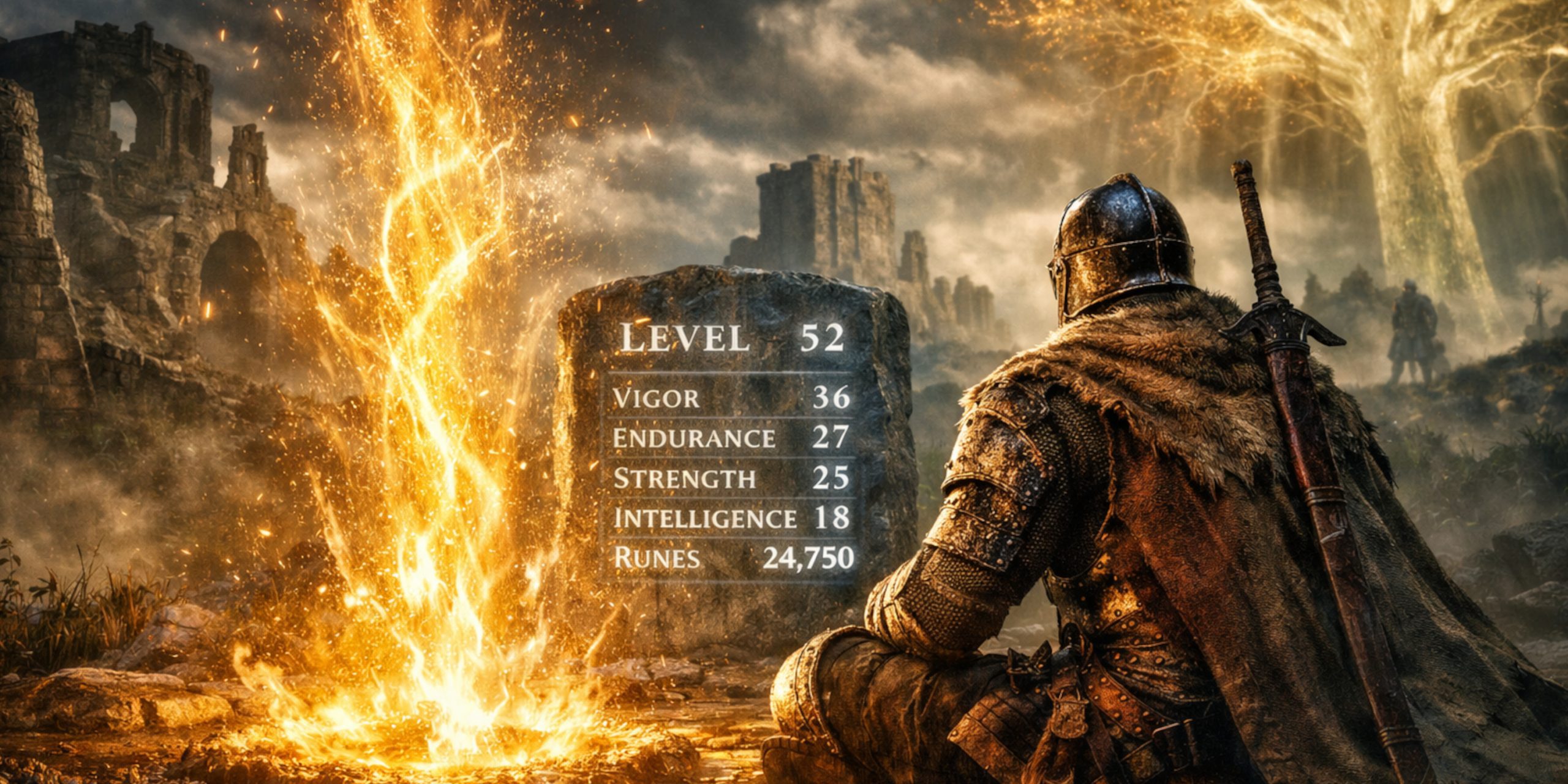
Levelling in Elden Ring looks simple on the surface. Touch a Site of Grace, dump runes into stats, watch numbers go up. In practice, it is one of the game’s quietest traps. The system is generous early, brutally honest later, and absolutely not interested in holding your hand. Understanding how it really works changes how hard the game feels and how much freedom you have.
This is not a beginner checklist. It is the stuff the game never explains but fully expects you to learn the hard way.
What Levelling Actually Does
Levelling does three things and only three things. It increases your attributes, it raises your overall level, and it quietly pushes up the cost of your next level.
What it does not do is scale enemies or unlock power automatically. Elden Ring does not care what level you are. It only cares about your stats and your decisions.
Key points to keep in mind
- Every level costs more runes than the last
- Enemy difficulty does not scale with your level
- Your damage and survivability come from stat breakpoints, not raw level
This is why two players at level 80 can feel like they are playing different games.
Why Early Levels Feel Amazing
The early game is a lie, but a friendly one.
From level 1 to roughly level 40, stat gains are chunky and forgiving. Vigor gives you big chunks of HP. Endurance adds stamina and equip load at a noticeable rate. Damage stats translate quickly into real damage.
This is why early Elden Ring feels generous, even empowering.
What is really happening
- Early stat curves are steep
- Rune costs are low relative to rewards
- Mistakes are easy to correct
The game is quietly teaching you that levelling works. It just stops being this kind later.
Soft Caps Are the Real Rules
Soft caps are where Elden Ring stops rewarding you for piling stats into one place. The game never tells you where these are, but it absolutely balances around them.
You are not punished for going past a soft cap. You are just overpaying.
The big ones that matter for most builds
- Vigor gives strong HP returns until around 40, solid returns until 60
- Endurance sees stamina gains slow sharply after the mid 30s
- Strength and Dexterity give excellent scaling early, then taper hard after 55 to 60
- Intelligence and Faith follow similar curves for spell scaling
This is why veteran builds spread stats instead of maxing one number. Past a point, flexibility is power.
Vigor Is Not Optional, No Matter Your Build
Every player thinks they are the exception. Every player is wrong.
Vigor is the single most important stat in the game for most of your playtime. Not damage. Not mind. Not scaling. Health.
Why Vigor matters more than you think
- Boss damage spikes hard in mid and late game
- Armour scaling is mild compared to HP scaling
- More HP gives you room to learn, not just survive
A glass cannon with perfect damage still dies in two hits. A sturdy build with decent damage finishes the fight.
If Elden Ring has a hidden tutorial message, it says this: level Vigor.
Damage Stats Do Less Than You Expect
This is the part that confuses most players.
Levelling Strength, Dexterity, Intelligence, or Faith does not magically turn weak weapons into strong ones. Most damage comes from weapon upgrades, not raw stats.
What actually boosts damage
- Smithing Stone upgrades
- Weapon scaling letters improving with upgrades
- Proper stat alignment with scaling type
Early on, upgrading your weapon often gives more damage than five or ten levels in a stat. Levelling damage stats matters later, once scaling is strong enough to reward it.
Why Levelling Slows to a Crawl
Around level 70 to 90, the game changes tone.
Rune costs jump sharply. Stat gains flatten out. Each level feels less exciting, and that is intentional. Elden Ring is nudging you away from brute force levelling and toward build identity.
What the slowdown is telling you
- Your build should already make sense
- Gear choices matter more than stats
- Skill and positioning start doing the heavy lifting
At this point, chasing levels blindly is inefficient. Targeted levelling wins.
Respec Exists for a Reason
The game gives you respecs through Rennala because it expects experimentation and mistakes. Builds evolve as you understand the systems better.
Good reasons to respec
- You overinvested past a soft cap
- You switched weapon types
- You want to rebalance survivability versus damage
Bad reasons
- Chasing meta numbers without context
- Fixing a problem that is actually skill or positioning
Levelling is not about perfection. It is about correction.
The Big Misconception About High Levels
High level does not mean easy mode.
Enemy damage continues to scale aggressively in late areas. Soft caps limit stat growth. Boss design assumes you understand mechanics, not that you can tank everything.
What high levels really give you
- More build flexibility
- Fewer catastrophic mistakes
- Comfort, not dominance
Elden Ring never lets you outlevel the need to play well. It just gives you better tools.
Levelling With Intention Beats Levelling Fast
Rune farming can push your level up quickly, but it does not teach you anything. Intentional levelling does.
Ask yourself before every level
- What problem am I solving
- Is this survivability, damage, or flexibility
- Will this stat still matter in 20 levels
If the answer is unclear, save the runes. The game is patient. You should be too.
Seven Swords Takeaway
Levelling in Elden Ring is not about chasing big numbers. It is about understanding curves, respecting limits, and building toward a style that fits how you play. The game rewards curiosity more than optimisation and punishes blind investment every time.
Once you see how the system really works, Elden Ring stops feeling unfair and starts feeling honest.