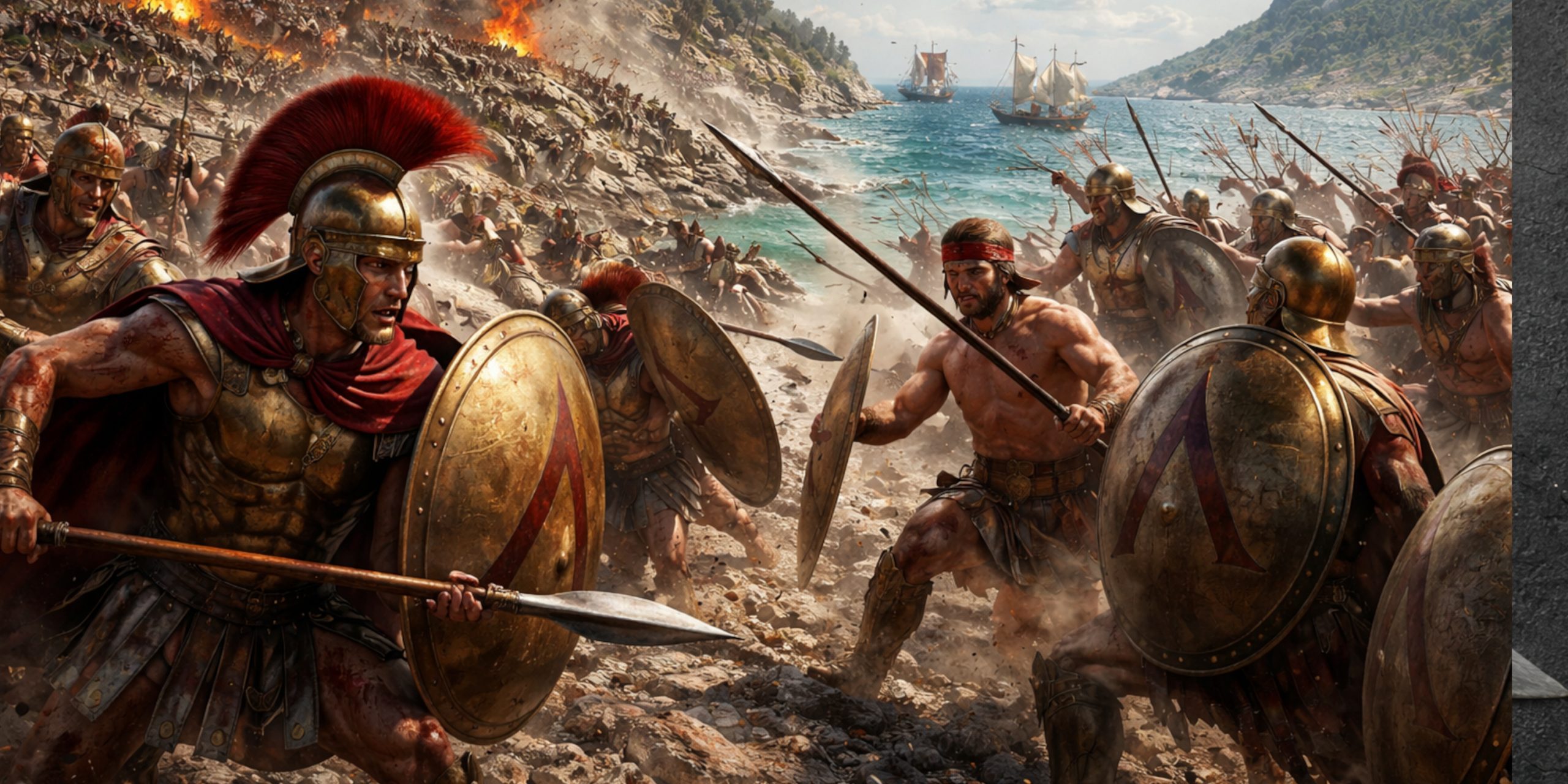
The Battle of Sphacteria in 425 BC sits strangely in the Peloponnesian War in the best possible way. A Spartan defeat that ends with surrender rather than annihilation was rare enough to feel almost improper. It happened not because Sparta forgot how to fight, but because terrain, improvisation, and a stubborn Athenian willingness to experiment all lined up at the same moment.
This clash unfolded during the wider Peloponnesian War, when Athens and Sparta were still feeling each other out for weaknesses. What Sphacteria exposed was not a single flaw, but several smaller ones that suddenly mattered far more than anyone expected.
Strategic Background
In 425 BC, an Athenian fleet operating near Pylos accidentally stumbled into opportunity. Fortifying the headland at Pylos, they provoked a Spartan response that went wrong almost immediately. A Spartan force became isolated on the nearby island of Sphacteria, cut off from support and surrounded by Athenian ships.
Sparta attempted a conventional relief operation and failed. The blockade held. For weeks, elite Spartan hoplites were stranded, running low on food and morale while the Greek world watched with interest. Athens suddenly had leverage it was not used to handling carefully.
Forces
Commanders
Athens
- Cleon, civilian leader with more confidence than caution
- Demosthenes, experienced commander and the quiet professional in the room
Sparta
- Brasidas, bold and aggressive, wounded earlier in the campaign
Troop Strength and Composition
| Side | Estimated Strength | Core Troops |
|---|---|---|
| Athens | c. 800 to 1,000 | Hoplites, peltasts, archers |
| Sparta | c. 420 | Spartan hoplites and allies |
Arms and Armour
Athenian Equipment
- Hoplites
Bronze helmet, linen or bronze cuirass, greaves, round hoplon shield
Primary weapon: Dory spear
Secondary weapon: Xiphos short sword - Light Infantry
Peltasts with wicker pelte shields, javelins
Archers with simple composite bows
Short blades including the kopis or makhaira for close work
Spartan Equipment
- Spartan Hoplites
Heavy hoplon shield with lambda marking
Bronze helmet, often Corinthian or modified types
Primary weapon: Dory spear
Secondary weapon: Xiphos, typically shorter than Athenian equivalents
The real imbalance was not equipment but flexibility. Spartan hoplites were unmatched in formation fighting. On broken ground under missile fire, that strength turned into a liability.
The Battle
The fighting unfolded in stages rather than a single dramatic clash. Athenian light troops harassed Spartan positions, withdrew, and returned again, refusing to stand still long enough for a decisive hoplite engagement.
A fire, likely accidental, stripped much of the island of cover. Smoke and heat wore down the Spartans. With no cavalry and little missile support, they were forced to endure punishment without the release of close combat.
Eventually, surrounded and exhausted, the Spartan force retreated to the northern tip of the island. When Athenian hoplites finally advanced, the outcome was no longer in doubt.
Then came the unthinkable. The Spartans surrendered.
Battle Timeline
- Early 425 BC
Athenians fortify Pylos after an unplanned landing - Spartan counterattack fails
Spartan troops become stranded on Sphacteria - Blockade established
Athenian naval dominance cuts off supply - Prolonged skirmishing
Light troops wear down Spartan resistance - Final assault
Athenian hoplites advance after the island fire - Surrender
Surviving Spartans lay down their arms
Archaeology and Landscape
No dramatic hoards of weapons have surfaced on Sphacteria, which is hardly surprising given the surrender rather than annihilation. What archaeology has confirmed is the rugged, uneven terrain of the island. Narrow paths, rocky slopes, and limited fresh water sources match the written accounts closely.
The topography alone explains much of the outcome. This was not the open plain Sparta trained for. It was a place where discipline mattered less than adaptability.
Contemporary Voices
The clearest account comes from Thucydides, who understood just how shocking the result was:
“The event was unexpected and contrary to all previous experience.”
Another passage drives the point home with typical restraint:
“It was the first time that Spartans had ever surrendered their arms.”
For a society built on martial reputation, that sentence carried more weight than a battlefield casualty list.
Takeaway
The surrender shattered the myth of Spartan invincibility. Not destroyed, not outmanoeuvred in a grand battle, but worn down and forced to concede by troops Sparta had long dismissed as inferior.
Athens gained hostages, diplomatic leverage, and something harder to measure: confidence. Sparta gained a lesson it would not forget, even if it took years to fully adapt.
For historians, Sphacteria is a reminder that wars are often decided by the unexpected. Planning matters. Training matters. But sometimes the ground under your feet matters more.