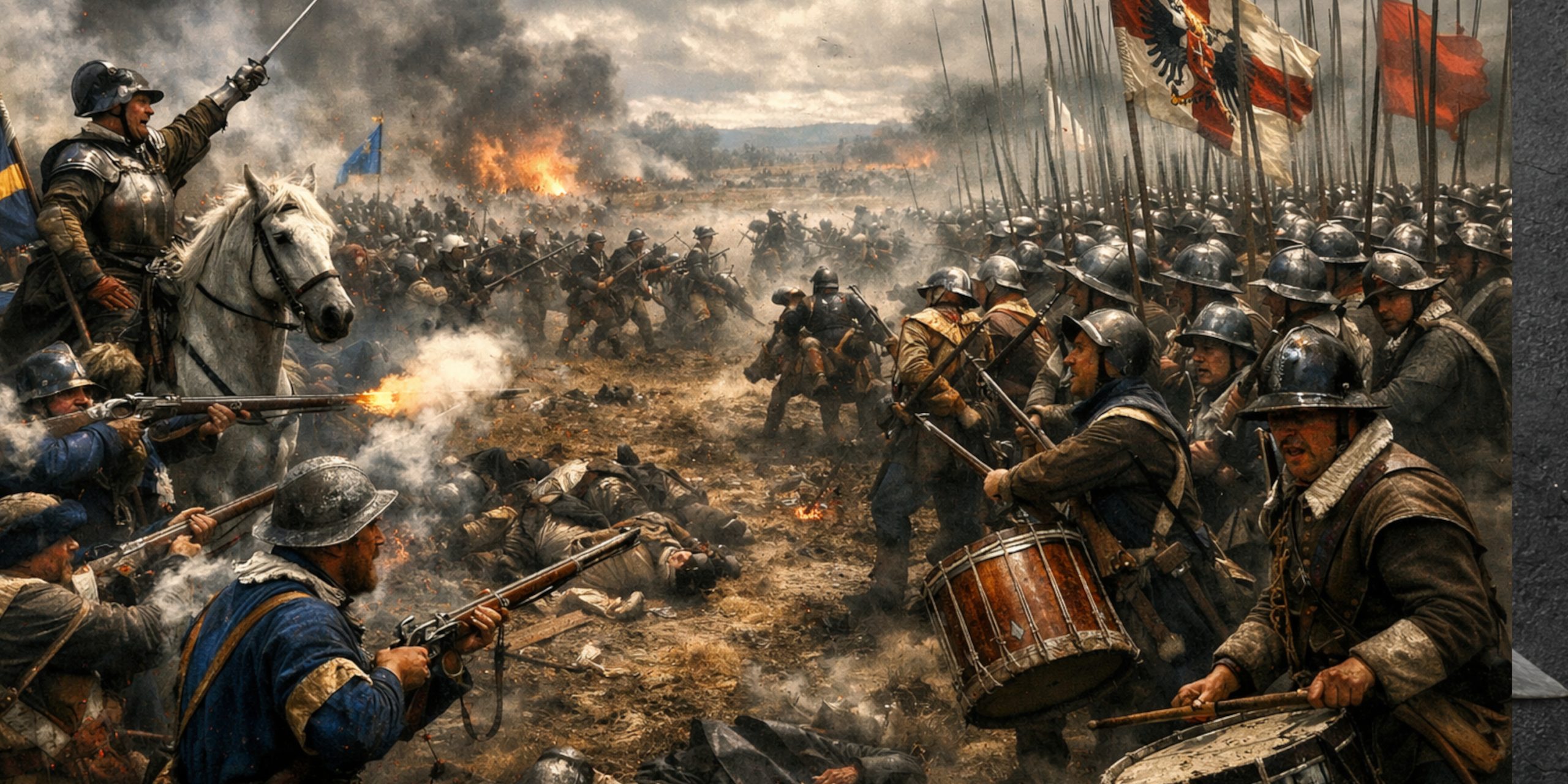
The Battle of Breitenfeld stands as one of those rare engagements where a single afternoon reshapes an entire war. Fought on 17 September 1631 near Leipzig, it marked the moment when Swedish intervention in the Thirty Years’ War stopped looking like a gamble and started looking inevitable. It was also a quiet demolition of the once feared Imperial infantry system. Quiet, at least, until the cannons opened.
Breitenfeld matters not because it was especially bloody by the standards of the age, though it was bloody enough, but because it proved that modern tactics could break the old pike and shot orthodoxy. Watching the Imperial line collapse, one suspects several generals mentally updated their notebooks and quietly crossed out “tercio”.
Strategic Background
By 1631 the war had already consumed much of Central Europe. Protestant forces were battered, disorganised, and short on confidence. The arrival of Sweden under Gustavus Adolphus changed the tone almost immediately. His army was smaller than the Imperial host but better trained, more flexible, and supported by aggressive artillery doctrine.
The Imperial and Catholic League army, commanded by Johann Tserclaes, Count of Tilly, sought a decisive engagement to crush the Swedes before their alliances hardened. Breitenfeld offered open ground and clear lines of sight. Tilly trusted experience. Gustavus trusted drill.
Both men believed they were choosing the battlefield. Only one was right.
Forces
Swedish–Saxon Army
| Component | Estimated Strength |
|---|---|
| Infantry | c. 23,000 |
| Cavalry | c. 13,000 |
| Artillery | 75+ guns |
| Total | c. 36,000 |
Leaders
- Gustavus Adolphus, King of Sweden
- Johann Georg I, Elector of Saxony
- Gustav Horn
- Johan Banér
Troop Composition
- Swedish brigades in flexible linear formations
- German Protestant auxiliaries
- Saxon infantry on the left flank, less experienced and shakier under fire
- Light, mobile artillery integrated with infantry units
Imperial and Catholic League Army
| Component | Estimated Strength |
|---|---|
| Infantry | c. 27,000 |
| Cavalry | c. 8,000 |
| Artillery | c. 25 guns |
| Total | c. 35,000 |
Leaders
- Johann Tserclaes, Count of Tilly
- Gottfried Heinrich Graf zu Pappenheim
Troop Composition
- Heavy infantry tercio formations
- Veteran cavalry, aggressive but poorly coordinated
- Artillery massed but slow to redeploy
Arms and Armour
Infantry Weapons
- Matchlock muskets with bandoliers and powder flasks
- Pike blocks armed with long ash pikes
- Sidearms including basket-hilted broadswords, German messers, and short arming swords
- Swedish infantry often carried lighter blades suited to close-order fighting
Cavalry Weapons
- Pistols used aggressively rather than for static caracole tactics
- Straight rapier-style swords among officers
- Heavy cavalry favoured backswords and proto-broadswords for cutting power
Defensive Equipment
- Breastplates and backplates common among cavalry
- Infantry armour increasingly minimal, with helmets more common than body protection
- Officers retained decorative armour, partly for morale, partly for vanity. Both worked.
The Battle Timeline
Morning
- Imperial artillery opens fire, advancing deliberately
- Saxon troops on the Swedish left begin to waver under pressure
Midday
- Pappenheim launches repeated cavalry assaults against the Swedish right
- Swedish infantry and artillery repel attacks through disciplined volley fire
Early Afternoon
- Saxon line collapses and flees, exposing the Swedish flank
- Gustavus redeploys units with alarming speed, refusing the flank rather than panicking
Late Afternoon
- Swedish brigades envelop Imperial infantry
- Tercio formations, unable to manoeuvre or respond to mobile artillery, break apart
Evening
- Imperial army retreats in disorder
- Swedish forces hold the field, exhausted but intact
Archaeology and the Battlefield
The Breitenfeld site itself offers few dramatic monuments, but archaeological surveys have recovered:
- Musket balls of varying calibres, indicating mixed formations and rapid firing
- Cannon shot consistent with light field artillery
- Personal items such as buckles, buttons, and fragments of sword hilts
The dispersal pattern supports contemporary accounts of Imperial collapse rather than orderly withdrawal. Archaeology, like eyewitnesses, tends to be unforgiving.
Contemporary Quotes
Gustavus Adolphus reportedly remarked after the battle that discipline, not numbers, had won the day. One suspects he knew this before the first shot.
A Catholic League observer lamented that “the old formations stood firm until they could not move, and then they died where they stood.” It is not a flattering epitaph for the tercio.
Another Protestant chronicler noted, with restrained satisfaction, that “the Emperor’s men learned today that courage without order is noise.”
Historical Significance
Breitenfeld shattered the myth of Imperial invincibility and confirmed Sweden as the dominant Protestant military power in Germany. It accelerated the decline of the tercio system and validated linear tactics, combined arms, and mobile artillery. In broader terms, it nudged European warfare closer to the modern battlefield.
For historians, it is also a reminder that innovation often looks risky right up until it works.