Few commanders loom as large over Late Antiquity as Belisarius. Serving Emperor Justinian I in the sixth century, he won improbable victories with small armies, toppled ancient kingdoms, and briefly restored Roman rule across much of the western Mediterranean. Yet his career is also threaded with frustration, court politics, and unfinished business. As a historian, I find Belisarius fascinating not because he always won, but because he so often succeeded despite being under-resourced, mistrusted, and recalled just as momentum built.
Early Life and Rise to Command
Belisarius was born around 500, probably in Thrace or Illyria, a region that still supplied tough soldiers to the eastern Roman state. He rose through the imperial guard, gaining Justinian’s trust early, and by his late twenties was already entrusted with independent command. That alone tells us how exceptional he appeared to contemporaries. Procopius, his secretary and chronicler, paints him as calm under pressure and unusually restrained for a general operating in a brutal age.
Arms and Armour
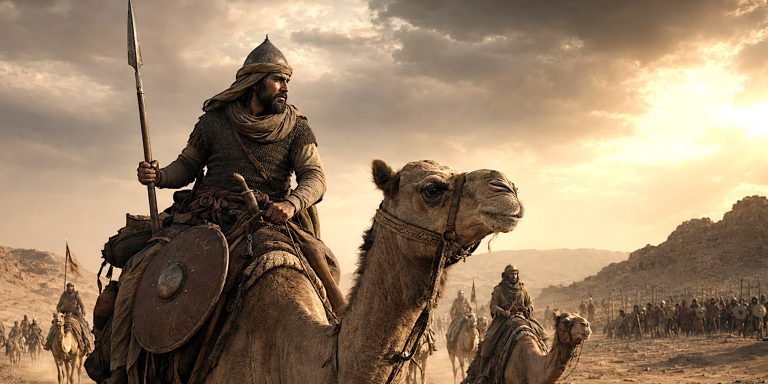
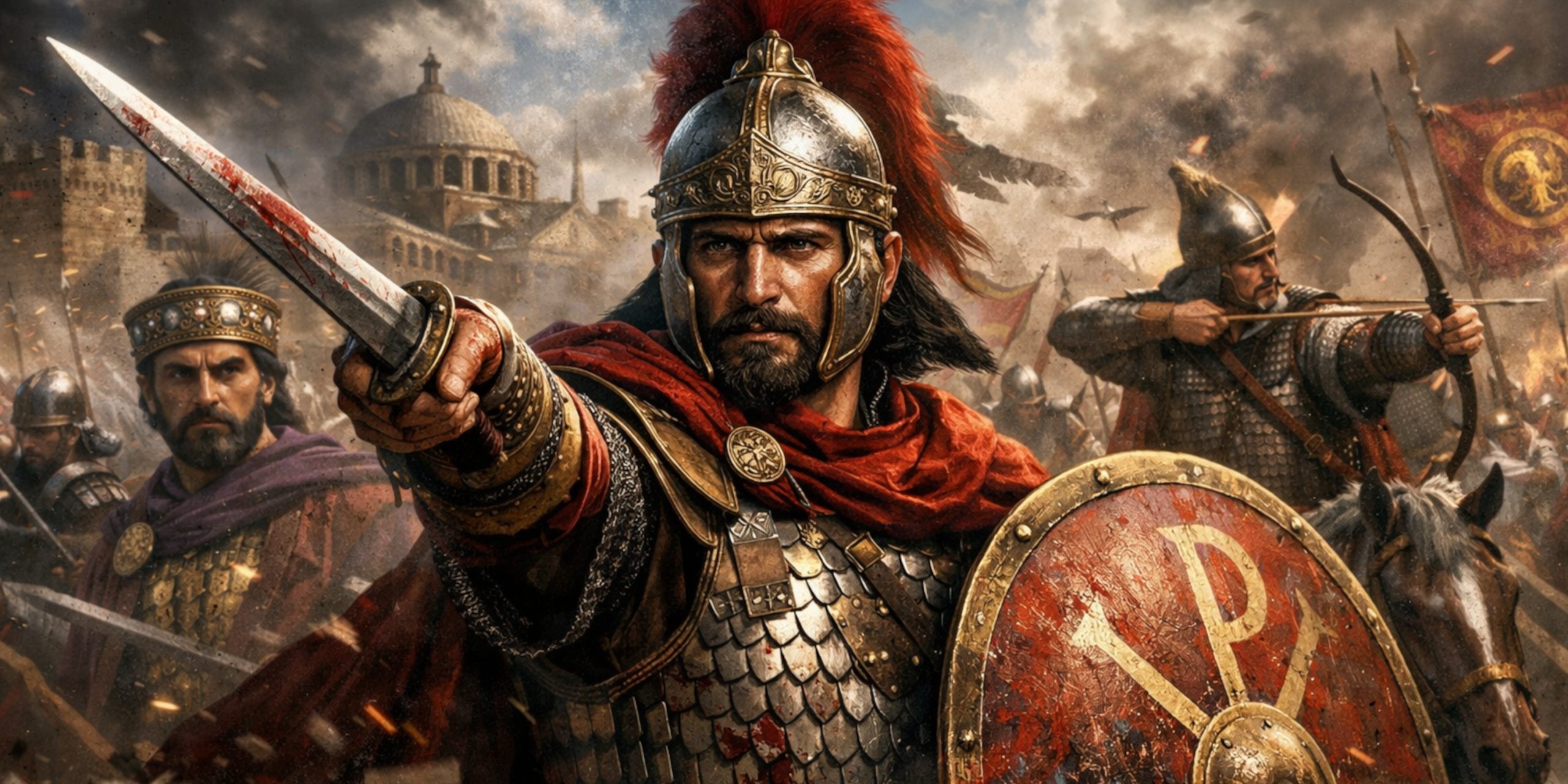
Belisarius fought at the intersection of Roman tradition and emerging medieval warfare. His armies were mixed forces, blending old imperial structures with new tactical realities.
Personal equipment
- Helmet of late Roman or early Byzantine type, likely ridge or segmented construction.
- Mail shirt or scale armour, offering flexibility rather than maximum protection.
- Oval or round shield, still bearing echoes of Roman iconography.
- Spatha-style sword, long and straight, suitable for cavalry combat.
- Lance or kontos when fighting mounted.
Troop composition under his command
- Heavy cavalry, including cataphract-style horsemen with lance and bow.
- Foederati troops, especially Huns, Heruli, and other allied contingents.
- Infantry armed with spear, shield, and sword, used defensively and in sieges.
- Mounted archers, a decisive arm in both eastern and western campaigns.
What stands out is how deliberately Belisarius used combined arms. Cavalry archers softened enemy formations, heavy horse delivered shock, and infantry held ground. This was not accidental. It reflects a commander who understood that flexibility mattered more than brute force.
Battles and Campaigns
Belisarius’ reputation rests on a series of campaigns that read like a catalogue of impossible assignments.
Against Persia
His early career was forged on the eastern frontier against the Sassanian Persians.
- At Dara in 530, he defeated a larger Persian army through careful positioning and disciplined reserves.
- At Callinicum, the outcome was less clear, yet Belisarius managed an orderly withdrawal that preserved his core forces.
These battles taught him caution. He learned when to stand and when to disengage, a lesson many Roman generals had forgotten.
The Vandal War
In 533, Belisarius sailed for North Africa with a force so small it bordered on reckless.
- He defeated the Vandals at Ad Decimum and Tricamarum.
- Carthage fell quickly, and the Vandal kingdom collapsed within months.
This campaign is a masterclass in speed, restraint, and psychological warfare. Belisarius forbade looting, presented himself as a restorer rather than a conqueror, and won over local populations who still thought of themselves as Roman.
The Gothic War in Italy
Italy proved far more stubborn.
- Rome was taken, lost, and besieged.
- Naples fell only after a gruelling siege.
- Ravenna surrendered in 540, when the Goths even offered Belisarius the western imperial title, which he refused.
Here his limitations were not tactical but political. Justinian repeatedly withheld reinforcements, suspicious of his own general’s popularity. Belisarius won battles but could not finish the war decisively.
Military Acumen
Belisarius was not a flashy commander. He did not seek decisive annihilation unless conditions favoured him. Instead, he excelled at:
- Defensive warfare and elastic responses.
- Using terrain and fortifications to offset numerical inferiority.
- Maintaining discipline among diverse and potentially unruly troops.
- Understanding the political dimension of warfare, especially in reconquered Roman provinces.
If I have a criticism, it is that Belisarius was perhaps too loyal. A more ruthless figure might have forced Justinian’s hand or secured lasting autonomy. Belisarius chose obedience, and history remembers him as noble, but constrained.
Relationship with Justinian and Court Politics
The relationship between Belisarius and Emperor Justinian was never simple. Justinian needed him, feared him, and occasionally humiliated him.
- Belisarius was recalled at critical moments.
- His wealth was confiscated and restored more than once.
- Later legends even claimed he was blinded and reduced to begging, though this is almost certainly fiction.
What is undeniable is that court suspicion blunted the impact of his victories. The Roman Empire came close to restoration, then stalled.
Where to See Artefacts from His World
No weapon or helmet can be securely identified as belonging to Belisarius himself, but the material culture of his era is well represented.
Key sites and collections
- Ravenna, Italy, especially the Church of San Vitale, whose mosaics depict Justinian, imperial guards, and the military elite of Belisarius’ world.
- Istanbul Archaeological Museums, holding sixth-century arms, armour, and inscriptions from the eastern empire.
- Carthage archaeological sites in Tunisia, where layers from the Byzantine reconquest remain visible.
- Rome and Naples, where siege works and late antique fortifications can still be traced.
These artefacts ground Belisarius in reality. They remind us that his campaigns were fought in cities that still stand, often beneath our feet.
Latest Archaeology and Research
Recent archaeology has refined rather than revolutionised our understanding.
- Excavations in North Africa continue to reveal Byzantine military installations tied to the reconquest.
- Italian urban archaeology has clarified the scale of destruction and rebuilding during the Gothic War.
- Advances in fortification studies show how sixth-century defences were adapted rapidly, often under Belisarius’ direction.
Scholars now emphasise continuity over collapse. Belisarius was not fighting in a dying world, but in one adapting fast to new pressures.
Legacy
Belisarius died in 565, the same year as Justinian. The timing feels symbolic. With both men gone, the dream of a restored Roman Mediterranean faded quickly. Lombards entered Italy within a few years, and the west slipped beyond imperial reach.
To me, Belisarius represents the last moment when Rome could still have gone another way. He proved that skill, discipline, and restraint could still win wars. What he could not overcome was the political fear of success itself.