French swords reflect a long shift from elite battlefield weapons to regulated civilian sidearms and finally to institutional symbols. Design followed social structure, military doctrine, and the growth of fencing culture rather than dramatic reinvention. French swords are connected to broader European Sword Type traditions.
Early Medieval France (8th to 10th Centuries)
- Frankish Spatha – Long straight cavalry sword derived from late Roman forms, used by mounted Frankish elites.
- Carolingian Sword – Pattern welded prestige weapon with broad fuller, associated with royal armies.
- Lobed Pommel Sword – Early medieval sword with multi lobed pommel improving balance and grip.
- Frankish Export Sword – High quality Frankish blades traded across northern Europe and Scandinavia.
- Frankish Cavalry Sword – Extended cutting sword designed for mounted shock combat.
- Royal Oath Sword – Ceremonial sword used in legal and dynastic rituals.
- Ecclesiastical Sword – Symbolic non combat sword carried by senior church officials.
- Short Guard Sword – Early crossguard sword offering minimal hand protection.
- Wide Fuller Sword – Weight reduced blade common in Frankish workshops.
- Frankish Chieftain Sword – Personal weapon of regional leaders, often richly decorated.
High Medieval France (11th to 13th Centuries)
- Romanesque Knight Sword – Broad cutting sword optimised for use against mail armour.
- Straight Guard Sword – Classic cruciform knightly sword widely used across feudal France.
- Capetian Knight Sword – Royal service sword associated with early French monarchy.
- Disc Pommel Sword – Improved balance and durability through circular pommel design.
- French Crusader Sword – Robust blades carried by French knights on eastern campaigns.
- Sergeant Sword – Plainer battlefield sword issued to professional foot soldiers.
- Early Long Sword – Transitional design with longer blade and grip.
- Almond Pommel Sword – Regional pommel style common in northern France.
- Lordly Justice Sword – Ceremonial sword representing feudal legal authority.
- Early Tournament Sword – Blunted sword designed for regulated knightly sport.
Late Medieval France (14th to 15th Centuries)
- French Bastard Sword – Versatile hand and a half sword for armoured combat.
- French Long Sword – Two handed battlefield sword used by men at arms.
- French Estoc – Rigid thrust focused blade for penetrating plate armour gaps.
- Ricasso Sword – Sword with unsharpened base allowing half sword techniques.
- Ordnance Infantry Sword – Issued sidearm under royal military reforms.
- Medieval Town Sword – Civilian sidearm carried by urban professionals.
- S Guard Sword – Curved guard sword offering improved hand coverage.
- Man at Arms Sword – Practical service sword for professional soldiers.
- Judicial Duel Sword – Weapon used in legally sanctioned trial by combat.
- Late Court Sword – Ceremonial sword bridging medieval and Renaissance styles.
Renaissance France (16th Century)
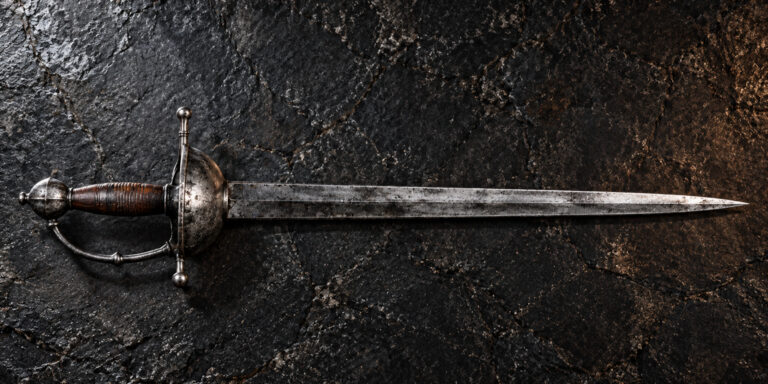
- French Rapier – Long narrow thrusting sword shaped by Italian fencing influence.
- Shell Guard Sword – Civilian sword with protective shell hilt.
- Gentleman’s Sword – Daily wear sword of the French nobility.
- Renaissance Duel Sword – Balanced civilian weapon for formalised duels.
- Light Cavalry Sword – Faster mounted sword for mobile cavalry units.
- Complex Hilt Sword – Elaborate hand protection reflecting fencing culture.
- Royal Infantry Sword – Sidearm for soldiers increasingly reliant on firearms.
- Fencing School Sword – Training weapon used in formal salles.
- Royal Court Sword – Decorative sword worn at court functions.
- Renaissance Justice Sword – Ceremonial symbol of royal legal authority.
Early Modern France (17th to 18th Centuries)
- Musketeer Sword – Officer sidearm balancing utility and fashion.
- French Smallsword – Light thrust focused weapon defining European fencing.
- Infantry Officer Sword – Combined service and dress sword.
- Naval Officer Sword – Compact sword adapted for shipboard use.
- Louis XV Court Sword – Highly decorative sword reflecting absolutist court culture.
- Academic Duel Sword – Regulated civilian fencing weapon.
- Guard Sword – Civic official sidearm denoting authority.
- Military Engineer Sword – Functional sword for technical officers.
- Noble Hunting Sword – Lightweight sidearm worn during hunts.
- Parade Sword – Purely ceremonial display weapon.
Napoleonic France (1799 to 1815)
- Line Officer Sword Model 1801 – Regulation officer sword of the Grande Armée.
- Light Cavalry Officer Sword – Straight bladed officer weapon for mounted troops.
- Napoleonic General Sword – Lavishly decorated symbol of imperial rank.
- Gendarmerie Sword – Service sword for internal security forces.
- Imperial Guard Officer Sword – Distinctive sword marking elite status.
- Artillery Officer Sword – Compact sword for technical branches.
- Imperial Naval Sword – Officer sword adapted for naval service.
- Logistics Officer Sword – Issued to transport and supply officers.
- Administrative Service Sword – Ceremonial sword for state officials.
- Imperial Parade Sword – Display weapon emphasising imperial symbolism.
19th to Early 20th Century France
- Officer Sword Model 1845 – Standardised thrust capable military sword.
- Officer Sword Model 1882 – Lightweight fencing oriented officer blade.
- Polytechnic Student Sword – Academic sword symbolising elite education.
- Academician Sword – Ceremonial weapon of learned institutions.
- Colonial Officer Sword – Issued for overseas service.
- National Gendarmerie Sword – Dress sword for policing roles.
- Republican Court Sword – Ceremonial sword reflecting republican authority.
- Sport Duel Sword – Civilian fencing weapon leading toward modern épée.
- Reserve Officer Sword – Regulation dress sword for reservists.
- Naval Officer Sword Model 1837 – Standard naval officer sidearm.
- Prefectural Sword – Administrative symbol of state authority.
- Municipal Parade Sword – Civic ceremonial sword.
- Modern Fencing Practice Sword – Training weapon used in salles.
- Late Civil Duel Sword – Regulated duelling sword of the late 19th century.
- Officer Sword Model 1902 – Final French regulation officer sword before the Great War.
France’s Legacy in European Sword Culture
France shaped the sword less through radical invention and more through discipline and theory. Its fencing schools formalised technique, its bureaucracy standardised military blades, and its civic institutions preserved the sword as a symbol of controlled authority. The French sword tradition is one of regulation, education, and continuity rather than spectacle.