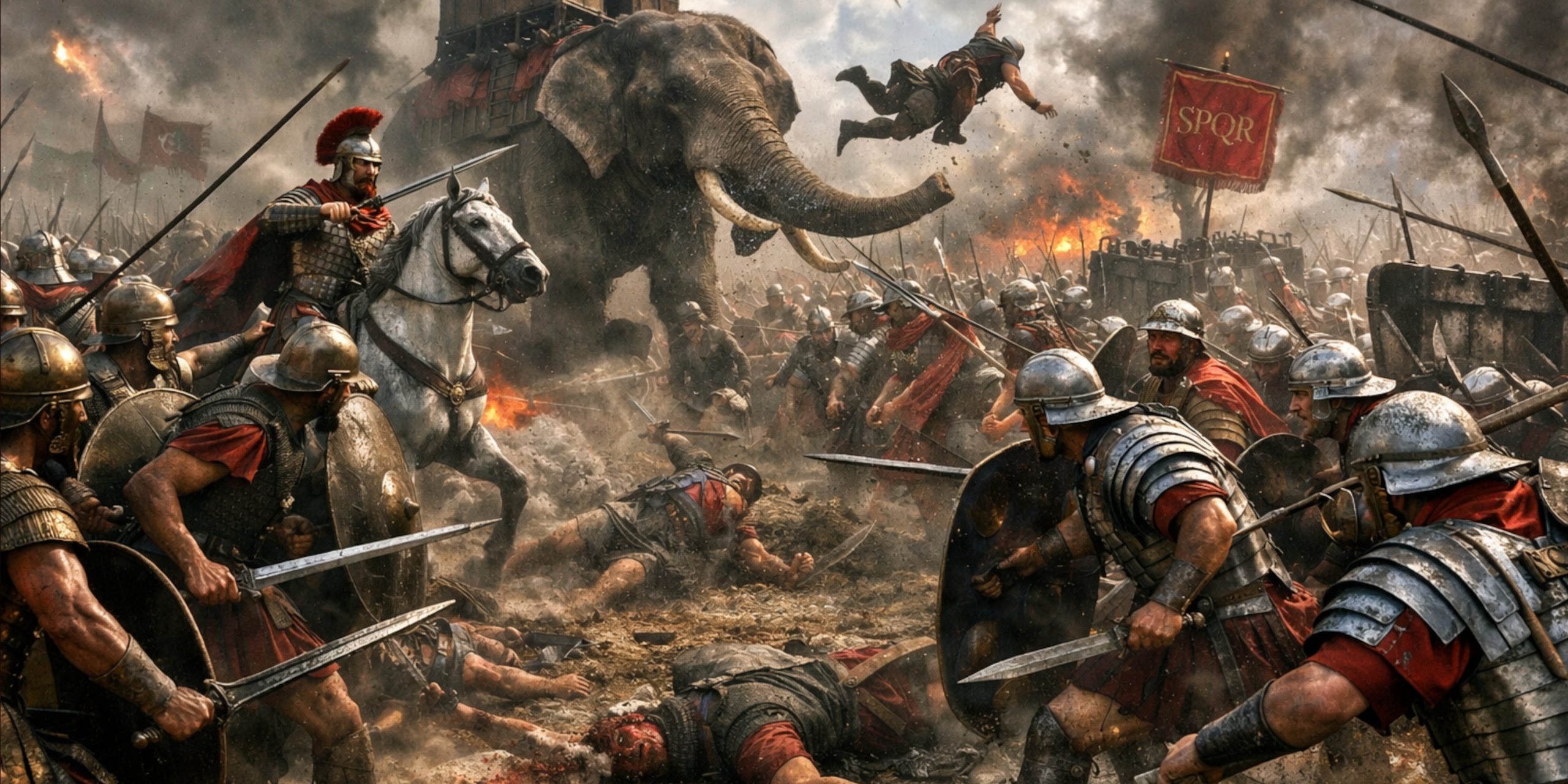
The Battle of Asculum in 279 BC sits in that awkward historical space where victory feels suspiciously like failure. King Pyrrhus of Epirus won the field against Rome, yet paid such a price that the word “Pyrrhic” has haunted commanders ever since. For a military historian, Asculum is fascinating precisely because it exposes the limits of brilliance, innovation, and even elephants when faced with Roman resilience.
Background and Strategic Context
Following his hard fought success at Heraclea, Pyrrhus of Epirus pressed deeper into Italy. Rome, stung but not shaken, refused negotiation and raised fresh legions. The clash at Asculum, probably near modern Ascoli Satriano in Apulia, became the moment where Hellenistic warfare met the industrial stamina of the Roman state. Neither side could afford to lose, which helps explain why both effectively did.
Forces Involved
The two armies reflected very different military cultures, one refined and professional, the other relentless and adaptive.
| Side | Estimated Strength | Core Components |
|---|---|---|
| Epirus and Allies | 40,000 to 45,000 | Macedonian phalanx, cavalry, elephants, Greek and Italic allies |
| Roman Republic | 40,000 to 50,000 | Roman legions, allied Italian infantry, cavalry, anti elephant units |
Rome fielded more men overall, but Pyrrhus had superior battlefield specialists. On paper, it looked like a fair contest. On the ground, it was a grinding two day ordeal.
Leaders and Command Structure
Epirote Coalition
- Pyrrhus of Epirus, supreme commander
- Thessalian and Epirote cavalry officers
- Greek allied generals from Tarentum and Samnium
Roman Republic
- Publius Decius Mus, consul and field commander
- Publius Sulpicius Saverrio, co consul
- Experienced legionary tribunes and allied Italian commanders
Rome’s leadership was collegiate and resilient. Pyrrhus’ command was unified and aggressive. Each had advantages, and blind spots.
Arms and Armour
The battlefield at Asculum was a catalogue of Mediterranean warfare in the early third century BC.
Epirote and Allied Equipment
- Sarissa pike, over five metres long, wielded by phalangites
- Xiphos sword, short double edged blade for close combat
- Kopis or machaira, curved cutting sword favoured by cavalry
- Bronze helmets of Phrygian and Corinthian styles
- Large round hoplite shields
- War elephants fitted with towers and escorting skirmishers
Roman Equipment
- Gladius Hispaniensis, early form of the thrusting sword that would dominate later warfare
- Hasta spear, still used by some Roman infantry at this stage
- Scutum, large rectangular shield offering excellent protection
- Montefortino helmets and bronze cuirasses
- Velites armed with javelins and anti elephant tactics
Rome’s equipment was less elegant but brutally practical. Pyrrhus brought the future of warfare. Rome quietly took notes.
The Battle Timeline
Day One
- Initial engagements hampered by broken terrain and woodland
- Roman flexibility frustrates the Macedonian phalanx
- Heavy casualties on both sides, fighting breaks off at dusk
Day Two
- Pyrrhus reorganises and commits elephants decisively
- Roman anti elephant wagons fail under pressure
- Epirote cavalry exploitation breaks Roman cohesion
- Romans withdraw in good order, leaving the field to Pyrrhus
Technically, Pyrrhus won. Practically, he bled.
Contemporary Voices
Plutarch, never one to resist a dramatic line, records Pyrrhus saying:
“If we are victorious in one more battle with the Romans, we shall be utterly ruined.”
Dionysius of Halicarnassus offers a Roman perspective:
“They were defeated, yet their spirit was unbroken, and they prepared for war as if they had prevailed.”
Both quotes tell you everything you need to know about Asculum.
Archaeology and Evidence
Archaeological confirmation of the exact battlefield remains debated, though the Apulian region continues to produce relevant finds.
- Coin hoards linked to Epirote and Italic forces
- Weapon fragments including spearheads and sword blades
- Defensive earthworks consistent with Roman temporary camps
No mass grave has been securely identified, which is unsurprising given later agricultural activity. As with many ancient battles, absence of evidence is not absence of slaughter.
Consequences and Legacy
Asculum broke Pyrrhus’ campaign in Italy. His army was exhausted, his officers dead or wounded, and his allies disillusioned. Rome replaced its losses with alarming ease. Within a few years, Pyrrhus was gone, the elephants were a memory, and Rome was learning how to fight phalanxes better than the men who invented them.
For historians, Asculum is a reminder that tactical brilliance means little without strategic depth. It is also proof that Rome’s greatest weapon was not the gladius, but an almost irritating refusal to stay beaten.