Bolesław I Chrobry stands at the point where early Poland stops being a regional experiment and starts behaving like a serious European power. Born in 967 and ruling from 992 until his death in 1025, he inherited a fragile state from his father Mieszko I and left behind a crowned kingdom that even the Holy Roman emperors had to reckon with. That alone tells you a great deal about his political nerve.
Sources are uneven and often partisan. Thietmar of Merseburg admired his energy while distrusting his ambition. Polish tradition later turned him into something close to a founding myth. Somewhere between those poles sits a ruler who understood power in its early medieval form, personal, martial, theatrical, and ruthlessly practical.
Early Life and Rise to Power
Bolesław was the son of Mieszko I and the Přemyslid princess Dobrawa of Bohemia. He grew up in a court that was still adjusting to Christianity and to the idea of permanent rule rather than seasonal dominance. When Mieszko died in 992, Bolesław moved quickly. Rival claimants and inconvenient stepmothers were removed with efficiency that suggests long preparation rather than sudden inspiration.
By the mid 990s he had consolidated Greater Poland, Pomerania, and Silesia. What matters here is not just expansion, but control. Bolesław replaced loose tribute relationships with direct administration, garrisons, and fortified centres. It is the difference between raiding influence and governing land.
Arms and Armour of Bolesław’s Poland
Early Piast warfare sat between Slavic tradition and emerging Western norms. Archaeology gives us more confidence than chronicles here.
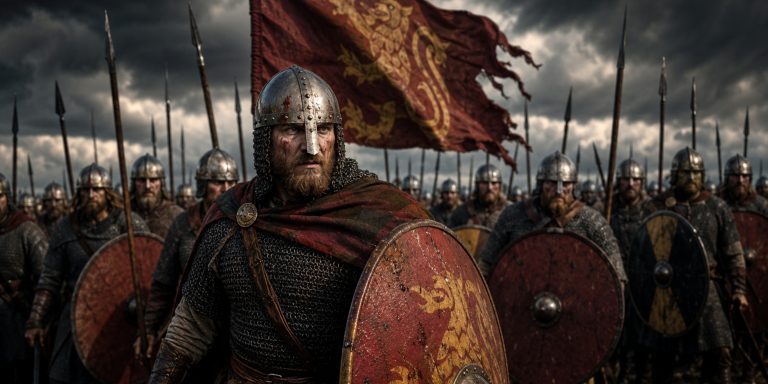
Typical equipment of elite warriors
- Pattern welded swords, often imported from the Rhineland or Scandinavia
- Broad bladed spearheads suited for both thrusting and throwing
- Round wooden shields with iron bosses
- Conical helmets, rare but increasingly present among retinues
- Mail shirts for the wealthiest warriors, not standard issue but known
Swords were prestige items. Many blades found in Poland from this period were forged elsewhere and hilted locally. That matters. It tells us Bolesław valued symbolic power. A sword that looked Frankish or Scandinavian carried political weight before it ever struck a blow.
For the bulk of his forces, spears and axes dominated. The Piast military system relied on a hardened core of mounted retainers supported by infantry levies. Not elegant, but effective.
Battles and Military Acumen
Bolesław’s reputation rests on action rather than theory. He fought Germans, Bohemians, Rus’, and Baltic pagans, often at the same time.
Key campaigns and conflicts
- Wars with Emperor Henry II from 1002 to 1018
- Conquest and brief rule of Bohemia from 1003 to 1004
- Expansion eastward culminating in the capture of Kyiv in 1018
- Continuous pressure on pagan tribes along the Baltic frontier
His genius lay in timing and audacity. He understood when to negotiate and when to strike. The Peace of Bautzen in 1018 is often overlooked, yet it shows him at his most effective. He forced the empire to recognise his control of Lusatia and Meissen, not as a vassal concession but as a negotiated settlement.
The Kyiv expedition deserves special mention. Marching east with Polish, German, and Hungarian troops, Bolesław installed his son-in-law Sviatopolk as prince. Whether the venture was sustainable is another question. Militarily, it demonstrated reach and confidence rare for a ruler on Europe’s eastern edge.
As a commander, he preferred decisive movement to cautious defence. He punished hesitation in allies and enemies alike. That made him feared, though not always loved.
Kingship and the Crown of 1025
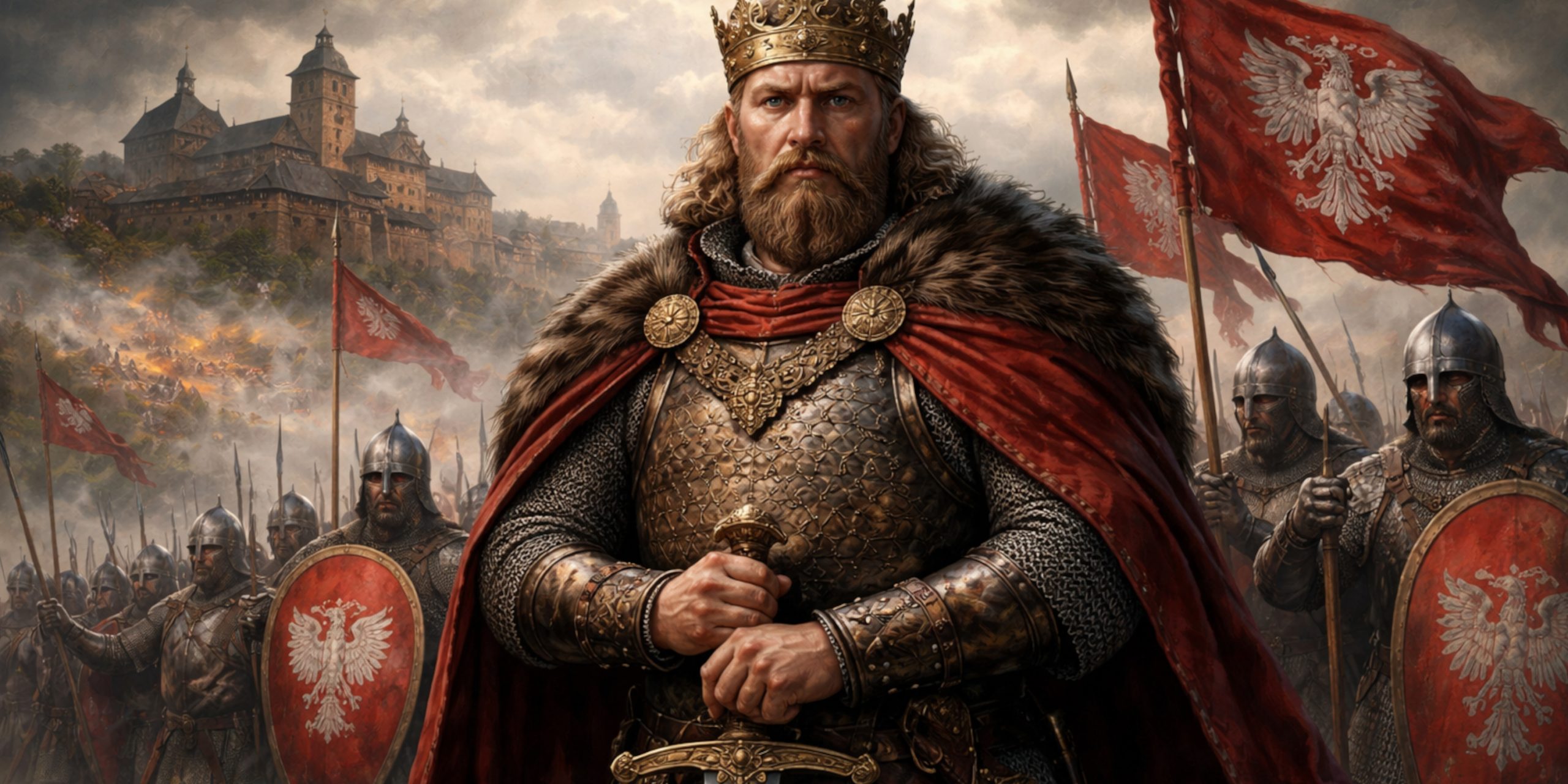
For decades Bolesław ruled as a duke in all but name. The coronation of 1025 was the final assertion of independence from imperial oversight. He was crowned king shortly before his death, a calculated move that ensured the title would survive him.
From a historian’s perspective, this feels less like ambition and more like closure. Bolesław knew the fragility of early states. A crowned kingdom had a better chance of survival than a strong man’s legacy.
Where to See Artefacts from His Reign
Very few objects can be linked to Bolesław personally, which is typical for the period. What we can see instead are the material traces of his world.
Key locations
- National Museum in Poznań, early Piast weaponry and regalia fragments
- Archaeological Museum in Gniezno, artefacts from Poland’s early capital
- Wawel Cathedral Treasury in Kraków, later regalia traditions rooted in Piast symbolism
- Regional museums in Ostrów Lednicki, displaying weapons, jewellery, and fortifications
Ostrów Lednicki is particularly evocative. Walking the island stronghold, you feel the physical reality of Piast rule. Timber, earth, iron, and water, not marble.
Latest Archaeology and Research
Recent excavations at Gniezno, Poznań, and Lednica have refined our understanding of Piast logistics and settlement density. The picture emerging is of a far more organised state than older scholarship allowed.
Finds include:
- Expanded fortification phases dated firmly to Bolesław’s reign
- Imported weapons and luxury goods indicating long distance trade
- Evidence of craft specialisation within strongholds
What excites me most is how these findings undermine the old stereotype of early Poland as a peripheral backwater. Bolesław ruled a connected, adaptable polity. Not a rough draft, but an early version of something durable.
Legacy and Historical Judgement
Bolesław the Brave was not gentle. He could be brutal, vindictive, and impatient. Yet early medieval kingship rewarded those traits. What sets him apart is how consistently his actions served long term goals.
He left Poland larger, stronger, and crowned. He forced emperors to negotiate, turned frontier wars into territorial gains, and embedded Christian kingship into Polish identity.
As a historian, I find him compelling because he feels recognisably human. Ambitious, calculating, sometimes reckless, but never passive. If Poland was an idea before him, Bolesław made it a fact.
Watch the documentary: