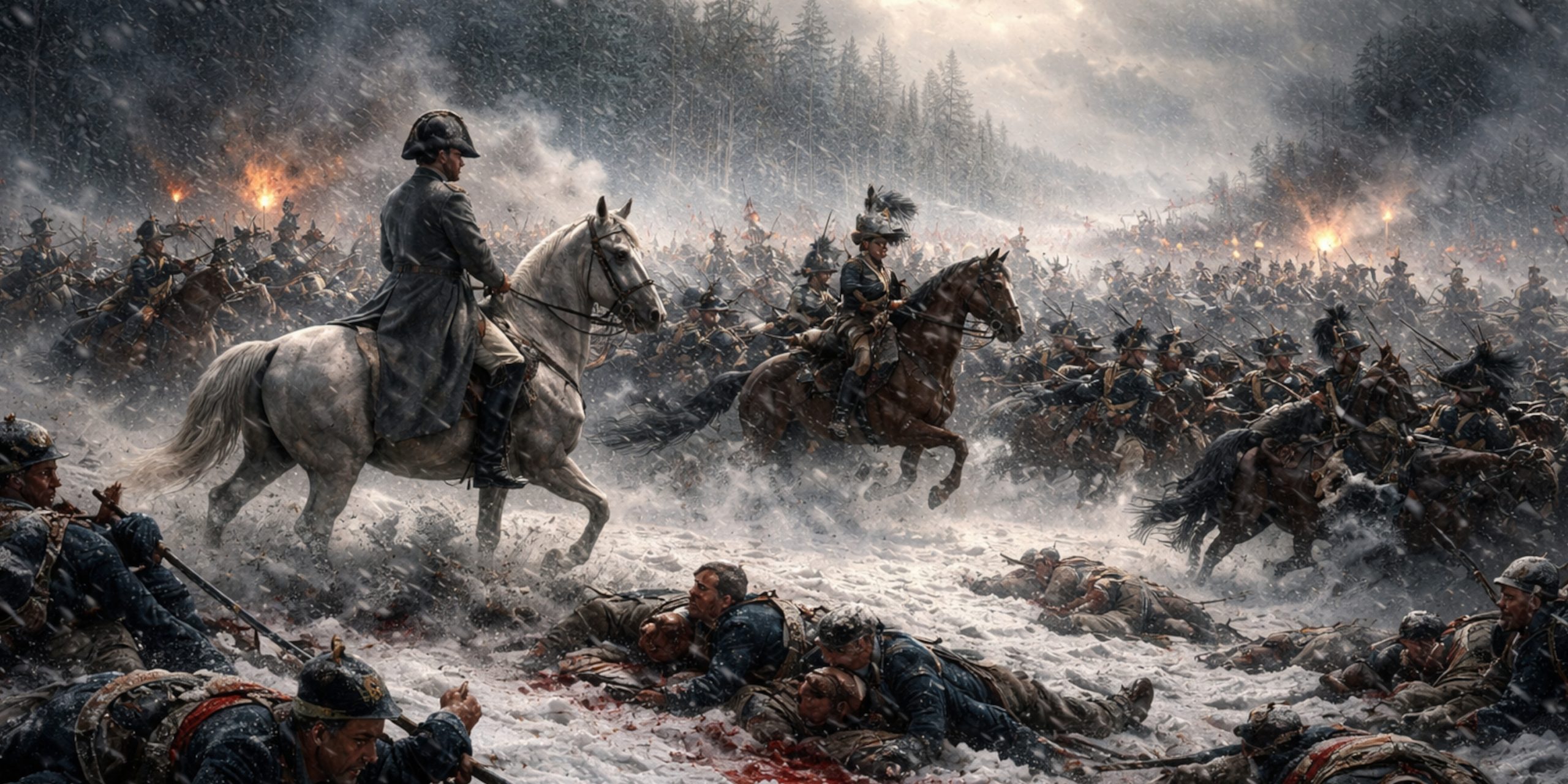
The Battle of Eylau, fought on 7 and 8 February 1807 in East Prussia, remains one of the most unsettling encounters of the Napoleonic Wars. It was not a clean victory, not even a convincing one. Instead, it was a frozen, chaotic struggle that ended with both armies shattered and the battlefield carpeted with casualties. Napoleon stayed on the field, which allowed him to claim success, but no one who stood among the snowbound dead would have called it triumphant.
If Austerlitz was chess played at speed, Eylau was more like two exhausted boxers swinging blindly in a blizzard.
Strategic Background
After the collapse of Prussia in 1806, the war shifted east. The Russian army under General Levin August von Bennigsen continued the fight, retreating into East Prussia while attempting to draw Napoleon away from his supply bases. Winter closed in, roads vanished under snow, and for once the Grande Armée found itself campaigning in conditions it did not control.
Eylau was not planned as a decisive battle. It happened because neither side could disengage cleanly. Both armies stumbled into each other, cold, hungry, and irritable.
Forces Engaged
Overall Strength
| Army | Estimated Strength | Casualties |
|---|---|---|
| French Empire | 65,000 to 75,000 | 18,000 to 25,000 |
| Russian Empire | 65,000 to 70,000 | 15,000 to 20,000 |
Casualty figures vary wildly, which tells its own story. Units dissolved, officers disappeared, and counts were made days later, often by men with frostbitten fingers and little enthusiasm for arithmetic.
Commanders and Leadership
French Command
- Napoleon Bonaparte, Emperor of the French
- Marshal Michel Ney
- Marshal Nicolas Soult
- Marshal Joachim Murat
- Marshal Pierre Augereau
Russian Command
- General Levin August von Bennigsen
- Prince Pyotr Bagration
- General Barclay de Tolly
Napoleon commanded personally, though illness and exhaustion reportedly dulled his usual sharpness. Bennigsen fought aggressively, perhaps sensing that this was a rare chance to stand toe to toe with the Emperor in conditions that neutralised French flexibility.
Arms and Armour
Infantry Weapons
- French Charleville Model 1777 musket with triangular bayonet
- Russian Model 1805 musket, often heavier and slower to reload
- Infantry short swords and hangers used by NCOs
Cavalry Weapons
- French AN IX heavy cavalry straight swords used by cuirassiers
- French light cavalry sabres for hussars and chasseurs
- Russian cavalry sabres with pronounced curvature, effective in close melee
Artillery
- French Gribeauval system field guns, 4, 8, and 12 pounders
- Russian artillery pieces heavier but less mobile
Armour had largely vanished from European battlefields by 1807, but French cuirassiers still wore steel breastplates. At Eylau, these gleamed briefly through falling snow before becoming just another target.
The Battle Timeline
7 February 1807
- French forces seize Eylau village after bitter street fighting
- Russians withdraw to high ground east of the town
- Night falls with both armies exposed in freezing conditions
8 February 1807
- Morning artillery duel begins in near whiteout conditions
- Augereau’s corps blunders off course in the snow and is shredded by Russian guns
- Murat leads a massive cavalry charge, over 10,000 horsemen, stabilising the French centre
- Ney arrives late, attacking the Russian right and preventing a French collapse
- Fighting dies away as both sides are too exhausted to continue
The snow did not stop until the killing did, which is a bleak but accurate way to remember Eylau.
Archaeology and the Battlefield Today
Modern Bagrationovsk, once Eylau, has yielded musket balls, uniform buttons, and artillery fragments through agricultural work and controlled archaeological surveys. Mass graves were recorded in the nineteenth century, though many were later disturbed or reburied.
The battlefield itself is difficult to read today. Roads have shifted, villages expanded, and the rolling terrain hides its scars well. Yet metal detector finds continue to confirm the sheer density of fire. Eylau was not a neat line battle. It was a grinding attritional mess, and the ground still remembers it.
Contemporary Accounts
Napoleon reportedly remarked:
“A spectacle so terrible makes one grow accustomed to war.”
Marshal Ney was less philosophical:
“What a massacre, and without result.”
A Russian officer wrote home:
“The snow was red for versts, and the dead lay as if asleep, their faces white as the ground beneath them.”
These are not the words of men celebrating victory.
Outcome and Historical Significance
Tactically, Eylau was a draw. Strategically, it mattered deeply. It shattered the myth of Napoleon’s invincibility and proved that the Russian army could fight the French to a standstill. The war would continue until Friedland later in 1807, where Napoleon regained the upper hand, but Eylau lingered in memory as a warning.
For historians, Eylau is a reminder that brilliance has limits. Weather, exhaustion, and chance can humble even the most gifted commanders. It is also a lesson in how battles are remembered. Napoleon held the field, so history long called it a victory. The bodies in the snow suggest a more honest verdict.
Legacy
Eylau entered Napoleonic lore as the battle that cost too much. Veterans remembered it with bitterness rather than pride. Painters later romanticised the suffering, but the reality was far colder and far less noble.
If Austerlitz crowned Napoleon, Eylau showed the cracks beneath it. Even emperors bleed, especially in February, in East Prussia, with the snow falling sideways.
Watch the documentary: