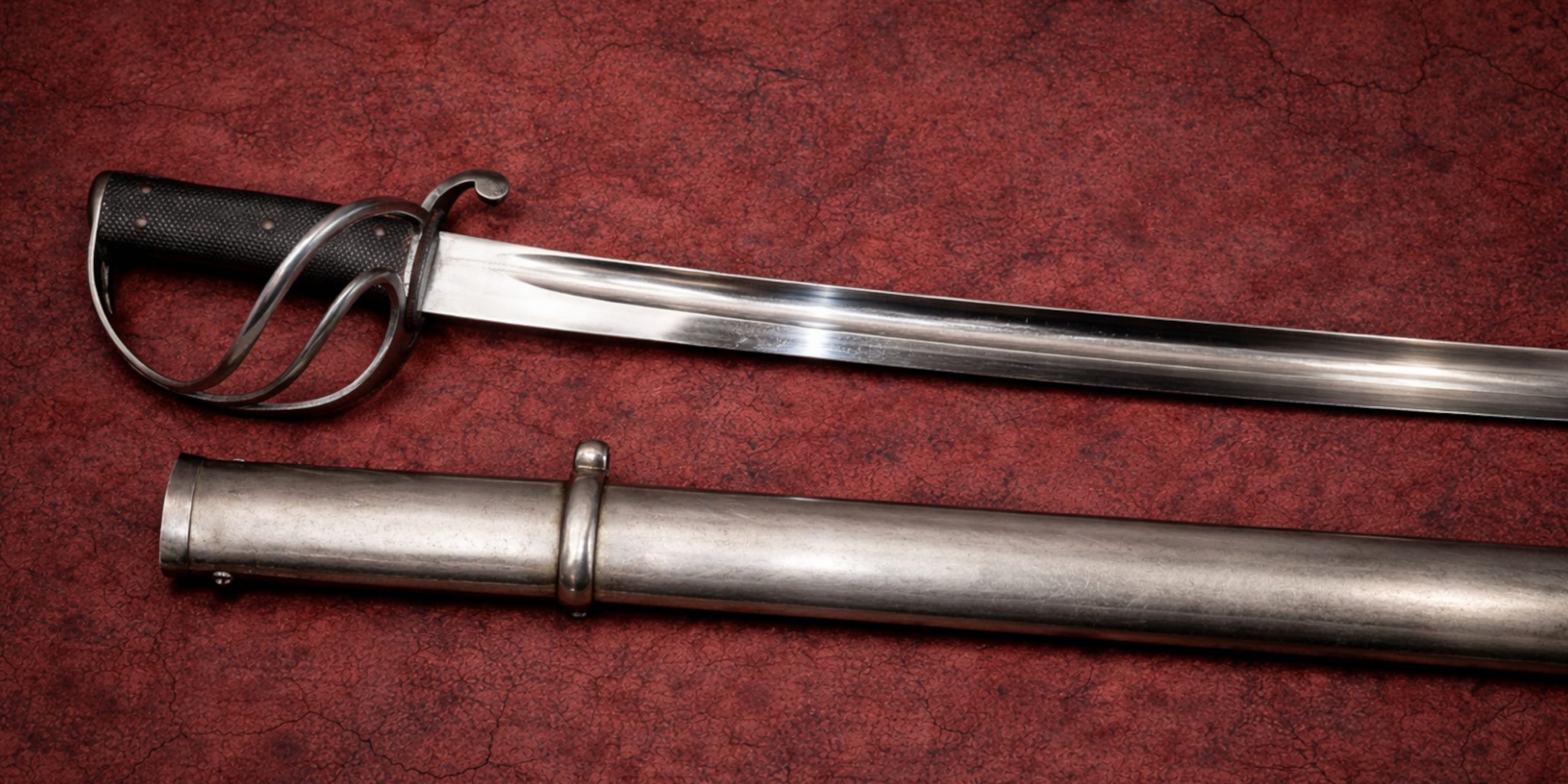
The British Pattern 1853 Cavalry Sword marks a turning point in Victorian military thinking. It reflects a period when the British Army began to reassess cavalry combat after hard lessons learned in the Napoleonic Wars and early colonial campaigns. Designed as a more versatile and controlled weapon, the 1853 pattern sought to balance cutting power with improved handling, while also addressing long standing complaints about poor blade quality and ineffective regulation swords.
Specifications
| Feature | Detail |
|---|---|
| Official designation | Pattern 1853 Cavalry Sword |
| Intended users | British heavy and light cavalry |
| Blade type | Single edged, curved |
| Blade length | Approx. 35 inches |
| Overall length | Approx. 40 inches |
| Blade width | Approx. 1.2 inches at forte |
| Weight | Around 2.5 to 2.8 lbs |
| Hilt material | Steel three bar guard |
| Grip | Leather covered wood, wire bound |
| Scabbard | Steel scabbard with two suspension rings |
History and Evolution
The Pattern 1853 emerged during a period of reform within the British Army, driven by criticism from officers and swordsmen such as John Latham and later influenced by the Wilkinson Sword Company.
Key historical context:
- Designed after extensive testing at the British Board of Ordnance
- Influenced by continental European cavalry sabres, particularly French models
- Adopted in the lead up to the Crimean War
- Intended to replace earlier patterns that suffered from inconsistent quality
Although introduced with good intentions, the sword quickly became controversial. Many officers felt it lacked cutting authority, while troopers complained about durability under field conditions. These criticisms directly influenced the development of the Pattern 1864 and later 1885 designs.
Advantages and Disadvantages
Advantages
- Improved balance compared to earlier heavy cavalry swords
- More consistent blade quality due to tighter manufacturing standards
- Safer hilt design with better hand protection
- Suitable for both thrusting and cutting in theory
Disadvantages
- Blade often considered too light for decisive cuts
- Curvature and edge geometry limited cutting effectiveness
- Did not fully satisfy heavy cavalry requirements
- Short service life before being superseded
Comparison with Similar Weapons
| Sword | Key Differences |
|---|---|
| Pattern 1821 Heavy Cavalry Sword | Heavier blade, more brutal cutting power but poor handling |
| Pattern 1821 Light Cavalry Sword | More curved and faster, better cutter but less controlled |
| French Model 1822 | Superior cutting geometry, strong influence on later British reforms |
| Pattern 1864 Cavalry Sword | Thicker blade, improved cutting, direct response to 1853 flaws |
In practical terms, the Pattern 1853 sits awkwardly between the heavy chopping swords of the early nineteenth century and the more refined later Victorian designs.
Legacy
The Pattern 1853 Cavalry Sword is remembered less for battlefield success and more for what it represented. It was an honest attempt at reform that exposed the gap between regulation theory and combat reality.
Its true legacy lies in:
- Highlighting the importance of blade geometry over weight alone
- Encouraging systematic testing of service swords
- Paving the way for Wilkinson’s dominance in British military sword manufacture
- Influencing later cavalry swords that achieved a better balance of form and function
Where to See One Today
Examples of the Pattern 1853 Cavalry Sword can be found in several major collections:
- Royal Armouries Museum, Leeds
- National Army Museum, London
- Imperial War Museum collections
- Regimental museums associated with Victorian cavalry units
Private collections also hold many surviving examples, often in better condition than those kept in active service.
Collector’s Guide and Auction Prices
The Pattern 1853 is popular among collectors of Victorian military swords, particularly transitional models.
What collectors should look for
- Clear maker marks, especially Wilkinson proof discs
- Intact leather grip and wire binding
- Matching scabbard with correct rings
- Absence of heavy edge damage or deep corrosion
Typical auction prices
| Condition | Approximate Price Range |
|---|---|
| Poor or incomplete | £350 to £600 |
| Good service condition | £700 to £1,200 |
| Excellent or near mint | £1,500 to £2,200 |
| Wilkinson proved examples | Can exceed £2,500 |
Prices vary significantly depending on provenance, regimental markings, and overall originality.