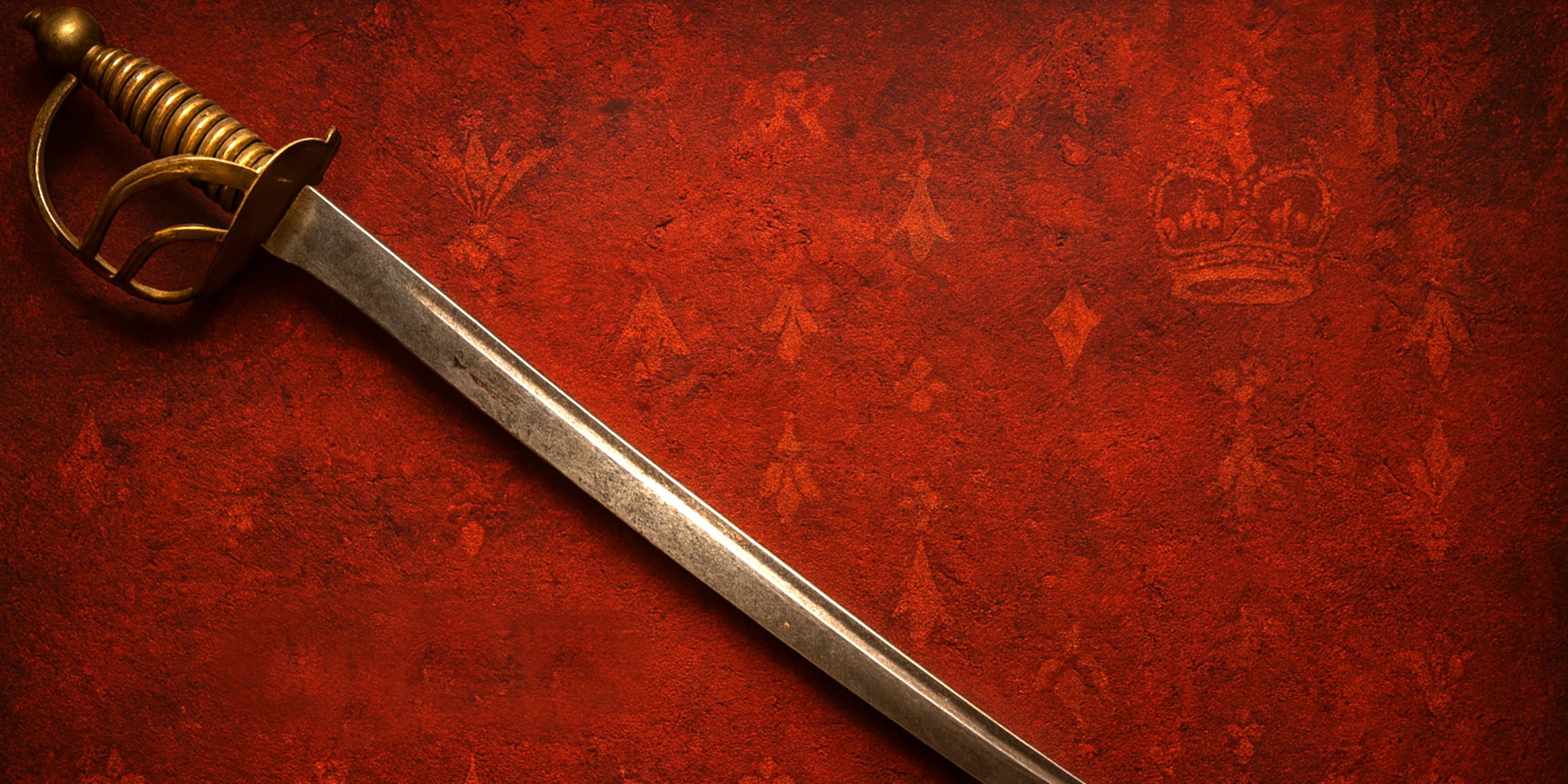
The British Pattern 1751 infantry hanger served as a simple workhorse of the eighteenth century British Army. It was not a weapon designed to stir romance or inspire artists. Instead it was built to cut brush, hack through rigging, steady a line in close quarters and occasionally settle matters when bayonets were not the right tool. Its short, curved profile gave it a straightforward utility that appealed to infantry and marines across the period. What it lacked in elegance it made up for in reliability, which is about as British as military design gets in the mid eighteenth century.
Specifications
| Feature | Details |
|---|---|
| Total length | Approx. 26 to 28 inches |
| Blade length | Approx. 22 to 24 inches |
| Blade type | Single edged, curved hanger blade |
| Blade width | Broad, heavy chopping profile |
| Grip | Ribbed wooden grip, usually leather covered |
| Guard | Simple brass shell guard with knucklebow |
| Weight | Moderate, suited to cutting not fencing |
| Intended users | Infantry, grenadiers, marines and some militia |
Key characteristics
- Robust chopping blade suited to brush clearing and close combat
- Curved profile similar to hunting hangers familiar to British officers
- Brass hardware that resisted corrosion at sea and in poor weather
History and Evolution
The Pattern 1751 emerged during a period when the British infantry sought reliability over experimentation. Earlier hangers varied wildly in shape and quality. The 1751 pattern gave the army a level of standardisation that simplified supply and training.
Its adoption aligned with British involvement in the War of Austrian Succession and the Seven Years’ War, where soldiers found themselves in dense woodland and rough terrain. The hanger acted as both tool and weapon. Marines liked it for working aboard ships. Grenadiers valued its practicality. By the late eighteenth century it was gradually replaced by the bayonet as infantry doctrine moved toward musket centred combat. The sword began to survive mainly in specialist roles and ceremonial contexts. Even so, the Pattern 1751 influenced later naval cutlasses and colonial sidearms right into the nineteenth century.
Advantages and Disadvantages
Advantages
- Very sturdy design that tolerated harsh use
- Effective cutting power at close range
- Easy to maintain thanks to simple brass and iron construction
- Versatile enough for camp and field tasks
Disadvantages
- Short reach compared with contemporary sabres
- Heavy chopping blade made fine fencing awkward
- Became functionally redundant once the bayonet dominated infantry doctrine
- No elaborate guard which left the hand exposed in dedicated combat
Comparison with Similar Weapons
| Weapon | Comparison Summary |
|---|---|
| British Naval Cutlass (early nineteenth century) | The cutlass is heavier and built for shipboard fighting. The 1751 is lighter and more general purpose. |
| French Briquet Sabre | The briquet is neater in appearance and slightly more refined. Cutting performance is broadly similar, but the briquet saw longer service. |
| German Hunting Hangers | Many German hangers were ornate civilian tools. The 1751 is a plainer military counterpart with simpler fittings. |
| American Revolutionary War short sabres | Colonial short sabres often copied European hangers. The British pattern is generally better finished and more standardised. |
Legacy
The Pattern 1751 infantry hanger represents the practical side of eighteenth century British arms. It demonstrates how armies balanced economy, supply, and battlefield utility. Although overshadowed by the bayonet in later tactical developments, its influence continued in naval cutlasses and militia swords into the nineteenth century. Collectors value it as a solid example of the transition between older hanger traditions and the professionalised weapon supply of later periods. It also features in museums covering the Seven Years’ War, early empire, and the American Revolution.
Where to See One
- National Army Museum, London. Examples with original scabbards and regimental markings.
- Royal Armouries, Leeds. Good examples that show blade profile variations.
- Musée de l’Armée, Paris. Foreign capture pieces illustrating cross channel influences.
- American museums such as the Museum of the American Revolution often display British hangers used in North America.
Collector’s Guide
What Collectors Look For
- Untouched brass shell guards with clear regimental stamps
- Full length blades with minimal edge shortening
- Original grips with intact leather wrapping
- Provenance linking the piece to a British regiment or colonial campaign
- Paired scabbards, which are rare and significantly increase value
Authentication Tips
- The blade should show forge marks and age related patina, not artificial staining
- Brass guards have a mellow tonality rather than bright polish
- Grip ribs should show wear but not modern tooling marks
- Beware of modern reproductions with overly bright brass and machine ground blades
Market Values and Auction Prices
| Condition | Typical Price Range | Notes |
|---|---|---|
| Poor (pitted blade, missing grip, no scabbard) | £150 to £250 | Usually for parts or restoration |
| Fair (complete but worn, no scabbard) | £300 to £450 | Common entry point for collectors |
| Good (solid blade, original grip, light patina) | £500 to £750 | Strong demand for authentic pieces |
| Very Good (clear markings, sound brass, minimal wear) | £800 to £1,200 | Often sells quickly, preferred for displays |
| Excellent with scabbard and provenance | £1,500 to £2,500 and above | Scarce. Top end prices seen at specialist military auctions |
The Seven Swords Takeaway
The British Pattern 1751 infantry hanger is not the most glamorous weapon in the catalogue of British arms, but it remains one of the most honest. It endured mud, oak forests, ship decks, colonial marches and the stubborn realities of eighteenth century warfare. For collectors today, it offers a direct connection to the practical craft of the period and serves as a reliable foundation in any collection of British edged weapons.