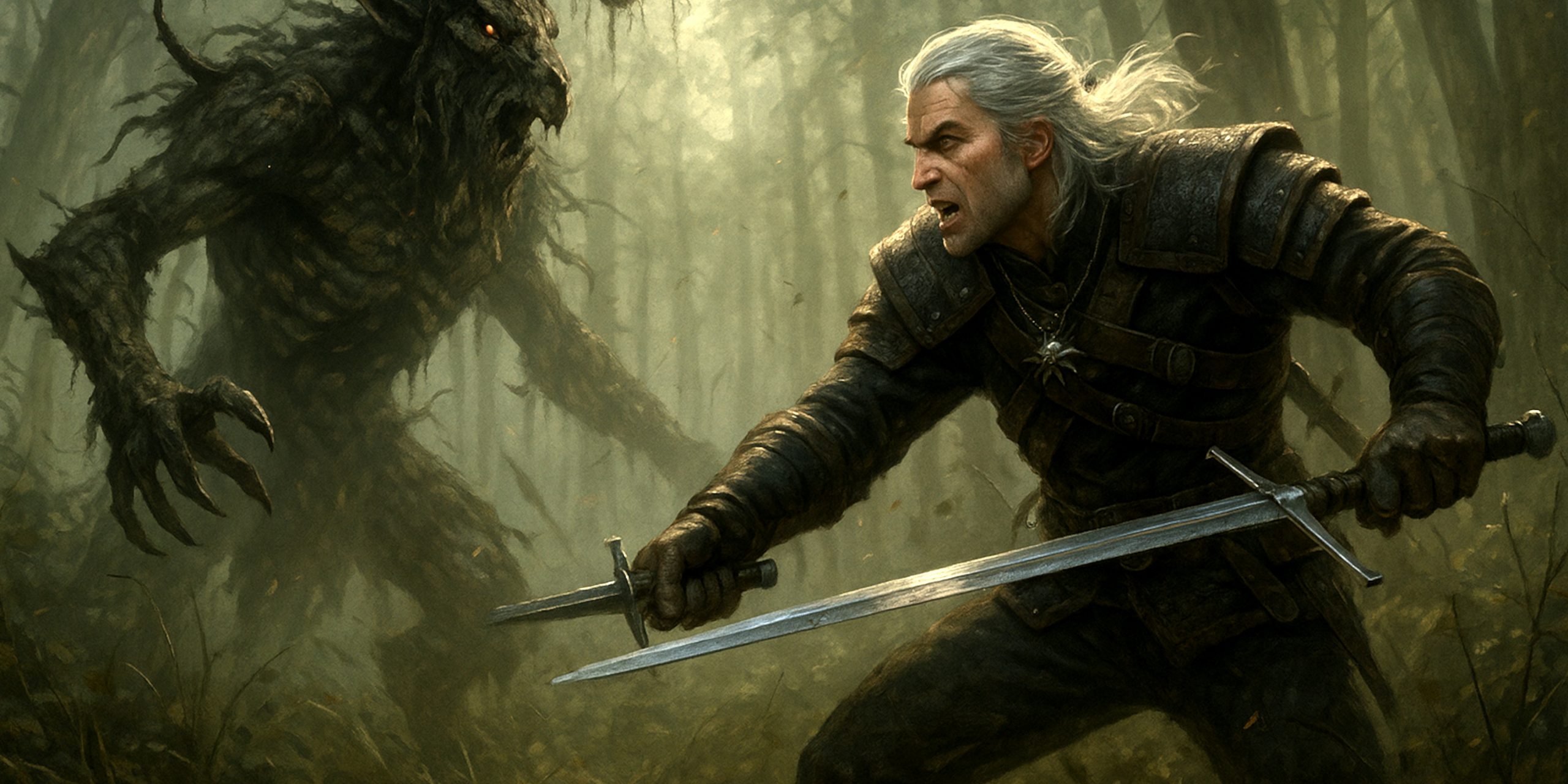
There is something oddly satisfying about watching a Witcher spin a blade like they were born holding one. I remember the first time I saw Geralt whirl around a drowner and thought, alright, that is unnecessarily cool. The more you look at it, the more you realise that his swordsmanship is built on a messy blend of real martial arts, fantasy flair, and hard survival instincts. It is never just about looking impressive. It is about getting out alive.
This guide breaks down how sword styles work across the books, games, and show, and why Witcher combat feels so different from most fantasy worlds.
The Two Sword System
Every Witcher carries two main weapons, although the exact rules can be a little slippery depending on which version of the story you are following.
Steel Sword
Used for humans, beasts, pretty much anything that is not magically cursed or technically undead. Steel is your everyday workhorse. It is the one Geralt reaches for when a bandit decides today is his final day on earth.
Silver Sword
This blade is for monsters that react badly to silver. It is not soft jewellery silver. It is an alloy reinforced to survive actual fighting. You get the sense that maintaining this thing is a full time job in itself. Silver is awkward, heavy, and absolutely necessary once something crawls out of the swamp with too many teeth.
What I love is that the games visualise this system cleanly. One sword over each shoulder, no fuss. Realistically, the weight would be brutal, but then again Witchers are walking mutations, so they get a pass.
Witcher Sword Styles and Technique
The books hint at named fighting styles but never go full martial arts manual. What we see instead is a set of habits that shape Witcher combat.
Fast, continuous motion
Geralt treats combat like a rhythm. No stopping, no posing. He strings attacks together so fluidly that it feels more like dance than warfare. It is all about not giving the creature a chance to rethink its life decisions.
Precision over power
A Witcher is strong, but their technique is built for accuracy. They target joints, tendons, weak spots, enchanted bindings. You rarely see Geralt just swing wildly. He hits the places that matter. It makes his fights feel surgical rather than chaotic.
Rotational movement
Those spins that some fans love and some love to mock serve a purpose. They generate momentum, help redirect weight, and keep enemies guessing. Spinning too much in real life is a good way to become one with the floor, but a Witcher has enhanced balance, so they get away with it while still looking dramatic enough for Netflix.
Guard and footwork
The real secret to the style is footwork. Geralt shifts constantly, keeping low and moving sideways to open angles. It is the kind of thing fencing coaches get excited about.
Signs in Sword Combat
The moment a Witcher mixes magic with blade work is when the fights get truly chaotic in the best way. Signs were never meant to replace martial skill. They are little power boosts that change the flow of a fight.
Aard
The push sign. Useful when you want someone to stay very far away for a moment.
Igni
Fire. It works as a quick burn, a panic button, and an intimidation tactic all in one.
Quen
A protective shield that lets a Witcher take a hit they really should not be taking. Probably the sign that keeps Geralt alive the most.
Yrden
A trap used for spectres and anything that refuses to stay solid. If you have ever fought a wraith in the games without Yrden up, I salute your bravery.
Axii
Mind control lite. Not ideal for combat, but helpful when someone needs to calm down fast.
Signs slot into the rhythm of the fight. Cast, step, strike, dodge, repeat. They allow Witchers to handle creatures that would flatten a normal swordsman.
Fighting Monsters vs Humans
Geralt always approaches monsters differently from humans because the rules of the fight do not match at all.
Against Humans
The goal is efficiency. Humans break, bleed, and fall like you expect. Geralt disarms, disables, or eliminates depending on how annoying they are. The choreography tends to stay grounded.
Against Monsters
Everything becomes a puzzle. Some creatures only fall to silver. Some need to be slowed, stunned, burned, trapped, or confused. A Witcher prepares oils, bombs, blades, and tactics around the thing’s biology. That preparation is basically half the fun of the lore. You get the sense that a Witcher earns their coin through homework as much as combat.
Real World Inspiration
The Witcher’s sword style takes inspiration from several martial traditions. There are touches of European longsword work, a bit of sabre technique, and even flourishes that feel lifted from Chinese and Japanese forms. It is not historically accurate, but it is grounded enough to feel believable.
Geralt fights like someone who has spent his entire life training to survive ambushes, claws, fangs, curses, and weather that is always terrible. It is practical fantasy. The kind that knows you need footwork before you need fancy twirls.
Why Witcher Combat Stands Out
Part of the charm is that Witchers are not heroic knights. They are tired contractors trying to get paid. The sword style reflects that mood. Efficient, weary, beautiful in motion, and occasionally violent enough to make you wince.
There is also personality in every fight. Geralt has this dry, almost bored confidence. Ciri fights with a faster, sharper edge, as if she is trying to outrun her own story. Vesemir brings old school weight to his movements. Watching them side by side is like watching three versions of the same language spoken with different accents.
Seven Swords Takeaway
Witcher swordplay lands in that sweet spot where fiction and technique meet. It looks cool, feels grounded, and has enough internal logic that fans can argue about it for years. I respect any fictional world that commits to its own combat rules and makes them feel lived in.
It also helps that Geralt swings a sword like someone who has had a long day and knows tomorrow will probably be worse.