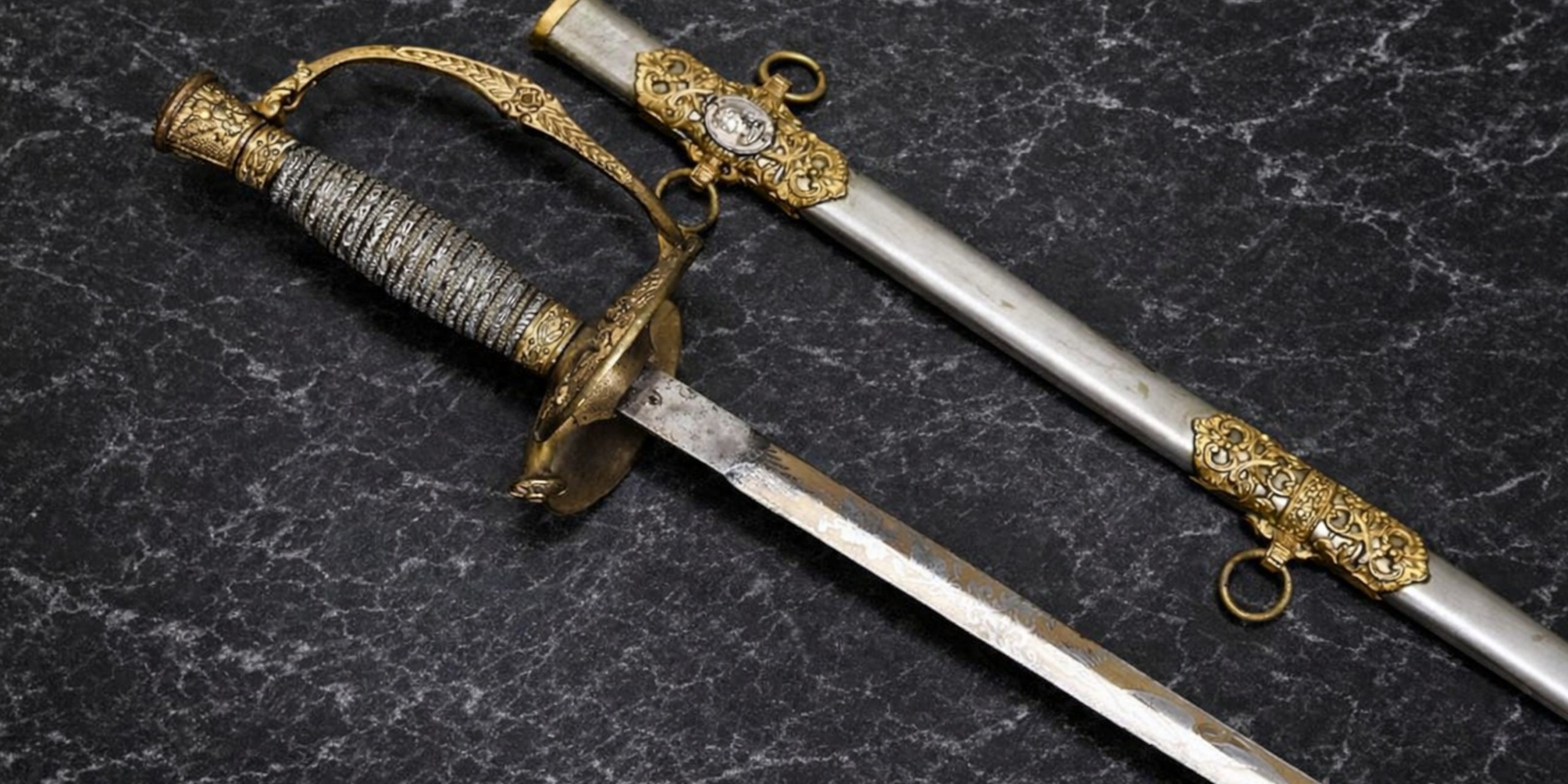
The US Model 1860 Foot Officer’s Sword is often misunderstood and mislabelled. Strictly speaking, the true regulation foot officer’s sword of the Civil War era is the Model 1850. The Model 1860 is more accurately described as the Staff Officer’s Sword, though it was worn by officers serving on foot and later absorbed into broader staff and line usage. This overlap in naming has created decades of confusion among collectors, dealers, and even auction houses.
What the Model 1860 represents is a shift in emphasis. It signals the move away from purely functional sidearms towards swords that balanced regulation compliance, visual authority, and ceremonial presence.
Specifications
Measurements vary by maker and production period, but most original examples fall within a narrow and recognisable range.
| Feature | Typical specification |
|---|---|
| Blade length | 30 to 32 inches |
| Overall length | Approximately 36 to 37 inches |
| Blade form | Straight, narrow, single fuller |
| Blade finish | Polished steel with etched decoration |
| Hilt | Gilt brass with patriotic motifs |
| Grip | Black horn or shagreen with twisted wire |
| Guard | Cast brass, usually with US eagle |
| Scabbard | Steel, later examples sometimes nickel plated |
Key identification traits:
- Noticeably lighter visual profile than earlier staff and field officer swords
- Decorative emphasis over cutting mass
- Consistent use of national symbolism rather than tactical features
History and evolution
Origins and regulation context
The Model 1860 emerged from mid century reforms intended to lighten the swords worn by staff officers. Earlier staff patterns were serviceable but heavy, and by 1860 there was a clear desire for a sword that projected rank without encumbering the wearer.
Civil War era use
During the American Civil War, the Model 1860 saw limited frontline use compared to older patterns. Many officers continued to favour the Model 1850 Staff and Field Officer’s Sword, which felt more substantial and martial. The 1860 pattern appears more frequently in photographs, parades, and formal settings than in documented combat accounts.
Post war expansion
After the war, the Model 1860 entered its most prolific period. From the 1870s onward it became a common officer’s sword across staff and line roles, with production continuing well into the late nineteenth century. This long lifespan explains why surviving examples are far more often post war than wartime.
Advantages and disadvantages
Advantages
- Strong visual identity associated with US officers
- Wide variety of makers, blade etches, and decorative styles
- Many examples survive in good condition due to limited field use
- Excellent representation of late nineteenth century military culture
Disadvantages
- Frequently misdated to the Civil War without evidence
- Less robust than earlier service oriented officer swords
- High incidence of restored or altered examples on the market
- Not ideal for collectors seeking a purely combat focused weapon
Comparison with similar weapons
| Sword pattern | Relationship to the Model 1860 |
|---|---|
| Model 1850 Foot Officer’s Sword | The true regulation foot officer sword, generally lighter and shorter |
| Model 1850 Staff and Field Officer’s Sword | Heavier, more field credible, and widely used during the Civil War |
| Post 1872 staff and line swords | Direct descendants in both form and function |
A sword that looks correct at first glance can still be decades later in manufacture. Provenance, maker details, and construction features matter far more than style alone.
Legacy
The Model 1860’s lasting impact lies in its symbolism. It helped establish the visual language of the American officer’s sword as an emblem of authority rather than a primary weapon. This influence carried forward into later regulation swords and shaped how officers presented themselves well into the twentieth century.
It is a sword of appearances, rank, and ceremony, and it succeeds completely on those terms.
Where to see original examples
Well documented examples are held in major public collections, where they are catalogued as staff or officer swords from the mid to late nineteenth century. These collections are valuable reference points for studying original finishes, blade etching styles, and construction details across different decades of production.
Collector’s guide
What affects value
- Maker marks and retailer names
- Degree of original gilt remaining on the hilt
- Condition of grip wire and integrity of the scabbard
- Clarity and depth of blade etching
- Named ownership or presentation inscriptions
Typical auction prices
Prices vary widely depending on condition and documentation, but realistic market ranges are well established.
| Category | Typical characteristics | Price range |
|---|---|---|
| Entry level | Later production, light wear, average etch | £250 to £550 |
| Mid range | Strong decoration, good condition, reputable maker | £550 to £1,000 |
| High end | Presentation grade, named officer, exceptional condition | £1,000 to £2,000 plus |
Buying advice
- Treat Civil War claims with caution unless supported by evidence
- Check that scabbard fittings match the sword in age and finish
- Be wary of overly bright gilt or modern looking wire wraps
- Ask for clear images of ricasso marks and blade etching
Care and storage
- Store in a dry environment with stable humidity
- Avoid long term contact between steel blades and scabbards
- Do not polish aggressively, original surface wear is part of the sword’s value
SEO meta
Title
US Model 1860 Foot Officer’s Sword Guide, History, Specs and Value
Meta description
An in depth guide to the US Model 1860 Foot Officer’s Sword, covering specifications, history, comparisons, legacy, and current collector prices.
URL slug
us-model-1860-foot-officers-sword
Keywords
US Model 1860 sword, Civil War officer sword, US staff officer sword, antique American officer sword, Model 1860 sword value, nineteenth century US military swords