Tyrfing sits among the most infamous weapons of Norse legend. It is not celebrated for heroism or righteous causes, but for inevitability. Once drawn, it must kill. Once forged, it ensures tragedy. In a mythic tradition already fond of grim outcomes, Tyrfing stands out as a sword that never fails its wielder yet always destroys them in the end.
The stories of Tyrfing survive mainly through later Icelandic sagas, where myth, heroic legend, and moral warning blend freely. What emerges is less a simple weapon and more a narrative engine for doom.
Origins and Forging
Tyrfing was forged by the dwarfs Dvalinn and Durinn, compelled under threat by King Svafrlami. The dwarfs were master smiths, but resentful ones. As punishment for their captivity, they laid a curse upon the blade.
The sword was said to be impossible to blunt, to cut through iron and stone, and to guarantee victory in battle. In return, it demanded blood whenever it was drawn and would ultimately bring about the deaths of three kings.
This bargain, power exchanged for catastrophe, is a familiar pattern in Norse myth. Tyrfing simply follows it with ruthless consistency.
Physical Description
Descriptions of Tyrfing vary slightly between sources, but the core details remain consistent.
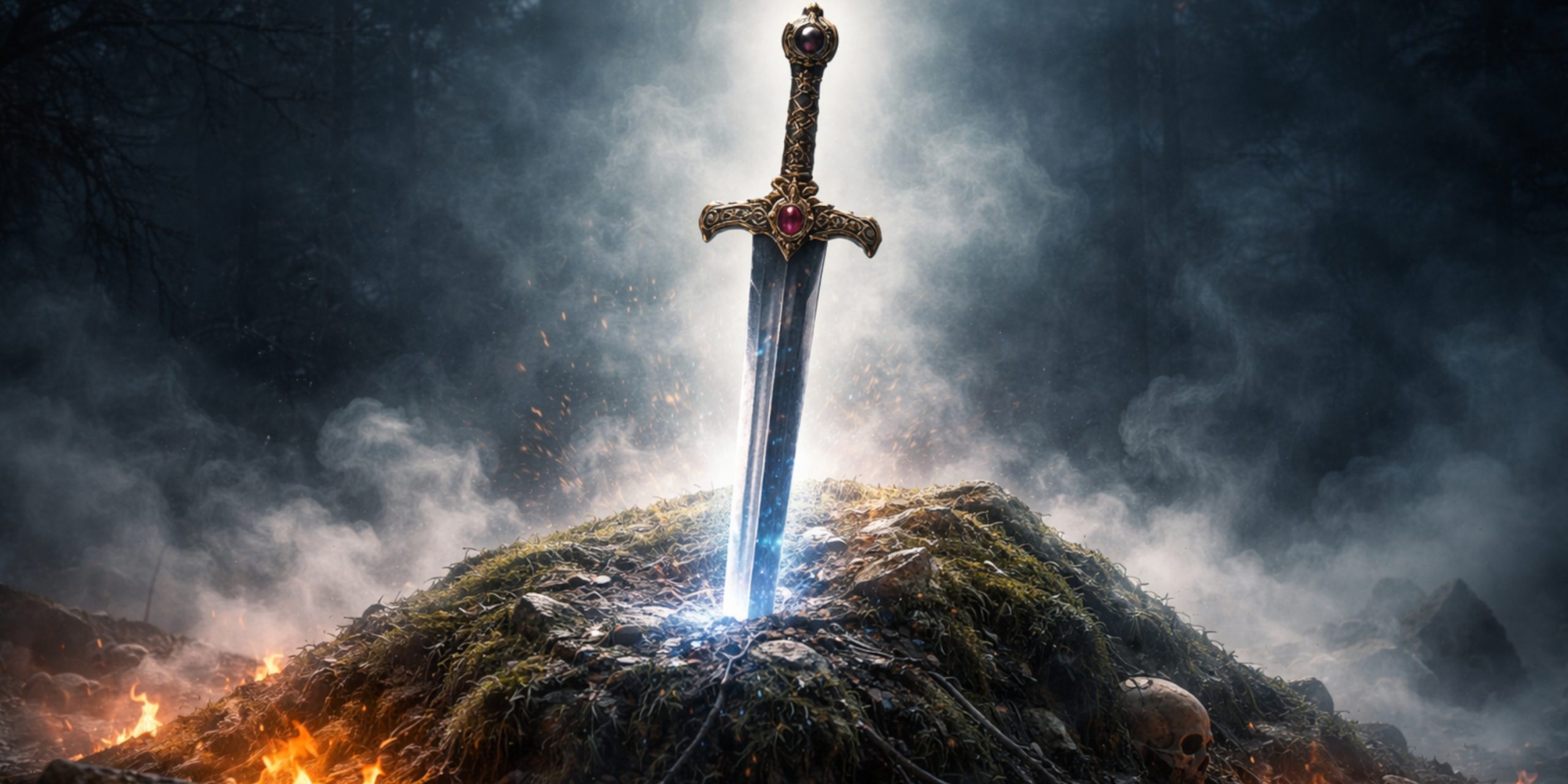
• A straight, double edged sword
• A golden hilt or inlaid grip
• A blade that glows or shines unnaturally when unsheathed
• Perfect balance and flawless sharpness
Unlike later medieval swords, Tyrfing belongs firmly to the heroic age of myth rather than historical typology. It is less a weapon you could catalogue and more a symbol sharpened into steel.
The Curse of Tyrfing
The curse is Tyrfing’s defining feature. Without it, the sword would be impressive but forgettable.
Its conditions are stark.
• It must kill a man every time it is drawn
• It will never fail to wound or kill its target
• It will cause great evils and betray its owner
• It will be responsible for the deaths of three kings
The curse transforms Tyrfing from a tool into an active force. The sword does not tempt its wielder with power. It coerces them through inevitability.
Tyrfing in the Sagas
Tyrfing appears most prominently in the Hervarar saga ok Heiðreks. The sword passes through generations, leaving violence in its wake.
King Svafrlami is eventually killed by the berserker Arngrim, who takes Tyrfing as spoil. Arngrim’s sons continue the cycle, using the blade in duels and feuds. Hervor, Arngrim’s daughter, famously retrieves Tyrfing from her father’s grave, confronting the undead to claim it.
Later, King Heidrek wields Tyrfing with great success before being murdered by his own thralls, fulfilling another part of the curse. Each owner gains power, reputation, and victory, but never peace.
The saga does not rush these events. It lets the reader watch the pattern repeat, as if daring anyone to believe it might end differently this time.
Symbolism and Meaning
Tyrfing reflects several core Norse ideas.
• Fate is unavoidable, even when known
• Power gained through coercion carries hidden costs
• Violence reproduces itself across generations
Unlike heroic weapons that reward virtue, Tyrfing punishes possession itself. The sword does not care who wields it or why. Once drawn, the story must continue.
In this sense, Tyrfing resembles a moral trap laid by the mythic imagination. Everyone sees it coming. Nobody escapes it.
Comparisons with Other Legendary Swords
Tyrfing belongs to a wider family of cursed or fated blades in European myth.
Compared to Gram, the sword of Sigurd, Tyrfing lacks heroic destiny and dragon slaying purpose. Compared to Excalibur, it offers no legitimacy or moral authority. Compared to Balmung, it offers power without redemption.
Tyrfing’s closest relatives are cautionary weapons, blades that reveal the price of domination rather than the glory of kingship.
Archaeology and Historical Influence
There is no archaeological sword that can be confidently identified as Tyrfing. This is expected. Tyrfing belongs to the mythic past rather than the material one.
That said, the legend likely drew inspiration from early Migration Period swords, which were rare, prestigious, and often named. Pattern welded blades with gold hilts would have appeared almost magical to early audiences, especially when inherited and reused across generations.
The idea that a sword could carry history, reputation, and doom is not far removed from how real early medieval weapons were perceived.
Legacy in Modern Culture
Tyrfing continues to appear in modern fantasy, gaming, and metal music, usually as shorthand for a blade that is both powerful and cursed.
Its appeal lies in clarity. Tyrfing does exactly what it promises, and that is precisely why it is dangerous. In a genre full of ambiguous magic systems, Tyrfing feels brutally honest.
Seven Swords Takeaway
Tyrfing is not a hero’s sword. It is a warning shaped like a weapon. Every figure who wields it believes they can manage the curse, bend fate slightly, or just survive long enough to make it worthwhile. None of them do.
That is why Tyrfing endures. It is a reminder that in Norse myth, knowing your fate does not mean you can change it. Sometimes it just means you understand exactly how sharp the blade will be.