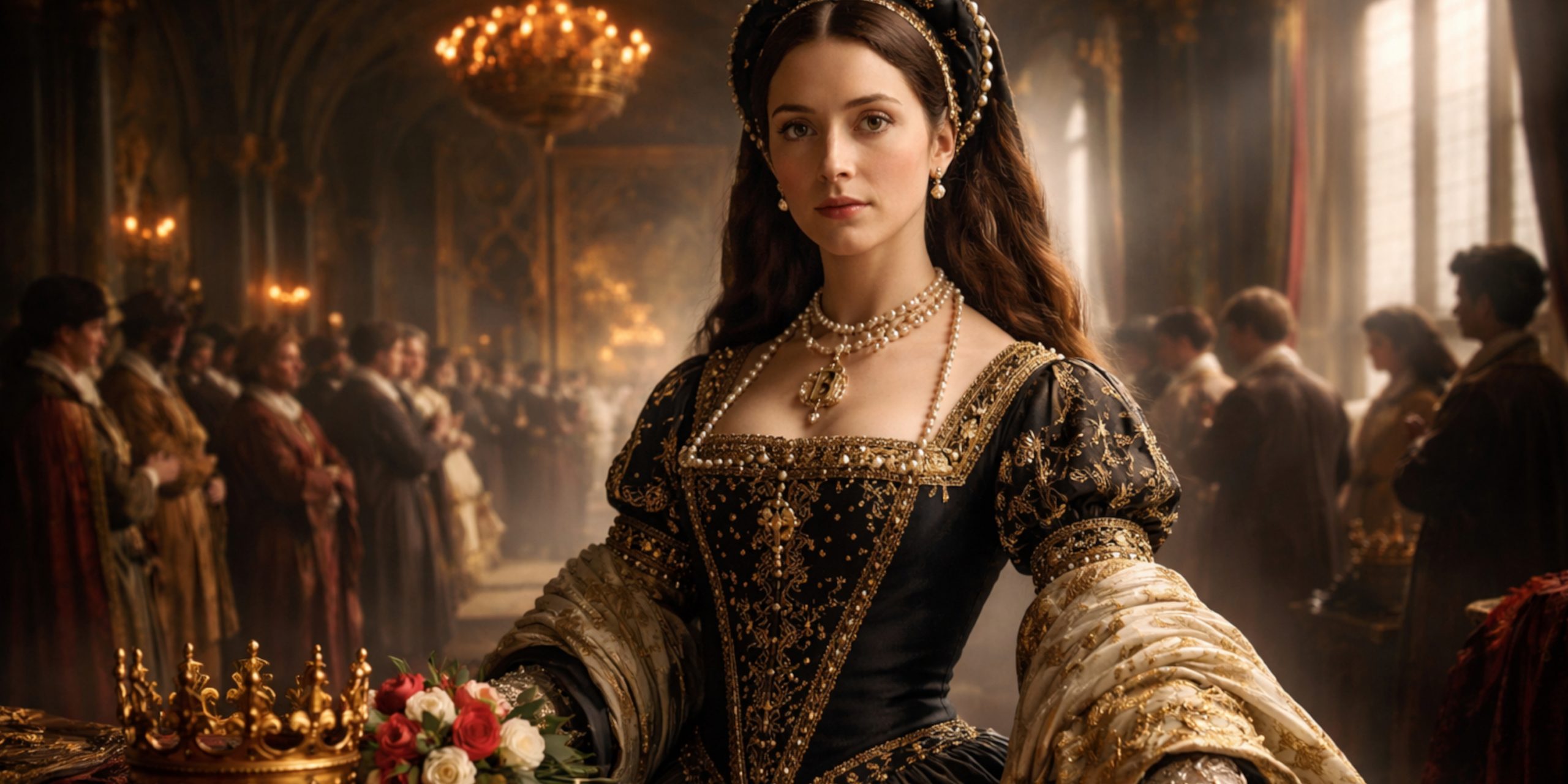
A closer look at the most talked-about queen of Tudor England
Anne Boleyn remains one of the most argued over figures in English history. Few queens have been admired, hated, romanticised, and blamed quite so thoroughly. For centuries she has been painted as a temptress, a reformer, a victim, or a schemer depending on who was telling the story.
The truth is less theatrical but far more interesting. Anne was intelligent, politically aware, and dangerously positioned at the centre of a royal court where favour could shift overnight. Her rise reshaped England’s religious and political landscape. Her fall revealed just how fragile royal power could be when the king changed his mind.
From the perspective of a historian who has spent far too many evenings buried in Tudor letters and ambassador reports, Anne Boleyn feels less like a villain or martyr and more like a sharp minded woman navigating a spectacularly unforgiving system.
Let us unpack what we actually know.
Origins and Early Life
Anne Boleyn was born around 1501, probably at Blickling Hall in Norfolk or Hever Castle in Kent. The exact date remains uncertain, which already tells you something about how little attention was paid to daughters compared with sons.
Her father, Thomas Boleyn, was a skilled diplomat who rose rapidly under Henry VIII. Her mother, Elizabeth Howard, belonged to one of England’s oldest noble families. Anne therefore grew up well connected but not royal.
What set her apart early was education.
As a young girl she was sent to the courts of Europe, first in the Netherlands under Margaret of Austria and later in France in the household of Queen Claude. These years shaped her completely.
At the French court she learned:
• fluent French
• music and dance
• literature and poetry
• courtly manners and political observation
French courts valued wit and conversation. Anne absorbed this environment and returned to England in 1522 noticeably more sophisticated than many women of the English court.
Contemporary observers later described her as lively, quick thinking, and socially confident. Not conventionally beautiful, according to most reports, but undeniably striking.
One Venetian diplomat wrote that she was “not one of the handsomest women in the world, but of middling stature, swarthy complexion, long neck, wide mouth”.
Hardly the description of a femme fatale. Yet clearly she had presence.
Anne at the Court of Henry VIII
Anne initially arrived at court as a lady in waiting to Queen Catherine of Aragon.
This meant she lived inside the royal household and witnessed the delicate dance of Tudor politics every day. She also observed the king closely.
Henry VIII had a reputation by the 1520s. Handsome, athletic, charming, and inclined to pursue women with considerable enthusiasm.
Anne’s sister Mary Boleyn had already been one of his mistresses. That detail would later become awkward.
Around 1526 Henry began courting Anne. At first this looked like a familiar royal pattern. A flirtation, perhaps a discreet affair.
Anne refused.
Whether from conviction or calculation remains debated, but she made it clear she would not become another royal mistress. She insisted on marriage.
For a king accustomed to getting his way, this was both frustrating and intriguing.
The King’s Great Matter
Henry VIII desperately wanted a male heir. His marriage to Catherine of Aragon had produced only one surviving child, Princess Mary.
By the late 1520s Henry convinced himself that the marriage was cursed because Catherine had previously been married to his brother Arthur.
Anne did not invent this crisis, despite later propaganda. Henry had already been worrying about succession and biblical legality.
What Anne did was become the catalyst.
The king began seeking an annulment from the Pope. What followed became known as the King’s Great Matter and dragged on for years.
Key events included:
• Cardinal Wolsey attempting to negotiate papal approval
• diplomatic pressure on Rome
• political tension with Emperor Charles V, Catherine’s nephew
• increasing frustration from Henry
When the Pope refused to grant the annulment, Henry gradually moved towards breaking from papal authority.
This decision would lead to the English Reformation.
It is difficult to overstate the scale of this change. A king pursuing one marriage helped sever England from the Catholic Church.
Anne was closely associated with reformist ideas and supported the circulation of religious texts. She was not a revolutionary theologian, but she was sympathetic to religious reform.
Marriage and Queenship
Henry VIII secretly married Anne Boleyn in January 1533.
By June she was crowned Queen of England in a lavish ceremony at Westminster Abbey. The scale of the celebrations shows how confident Henry felt at that moment.
Anne’s coronation procession through London included elaborate pageantry, theatrical displays, and enthusiastic crowds. For a brief period she stood at the very centre of the Tudor world.
Later that year she gave birth to a daughter.
The disappointment at court was immediate. Henry wanted a son. Anne expected more pregnancies and perhaps a male heir later, but the pressure intensified.
Despite this tension Anne proved an active queen.
She supported scholars, reformist clergy, and charitable causes. She also had strong opinions and occasionally involved herself in political discussions. This did not always endear her to the conservative factions at court.
Some courtiers admired her intelligence. Others considered her sharp tongue exhausting.
The Tudor court was not known for its tolerance of outspoken women.
Personality and Reputation
Anne’s personality has always divided historians.
Supporters describe her as:
• intelligent
• politically aware
• generous to scholars and reformers
• confident in conversation
Critics describe her as:
• proud
• impatient
• occasionally cutting in speech
• politically reckless
Both may be true.
She seems to have possessed a quick wit and little patience for fools, which in Tudor politics could be dangerous. Foreign ambassadors noted that she could be charming one moment and furious the next.
The court of Henry VIII thrived on factional rivalries. Anne’s rise created enemies who watched closely for any weakness.
The Fall of Anne Boleyn
By 1536 the atmosphere had changed dramatically.
Anne had suffered several miscarriages, including one in early 1536 that may have been a male child. At the same time Henry had begun showing interest in Jane Seymour.
Court factions moved quickly.
Thomas Cromwell, Henry’s chief minister, had begun clashing with Anne over religious policy and the distribution of monastic wealth. Their relationship deteriorated rapidly.
In May 1536 Anne was arrested.
The charges were astonishing:
• adultery with several men of the court
• incest with her brother George Boleyn
• plotting the king’s death
Five men were arrested alongside her.
Modern historians widely agree the accusations were fabricated or at least grossly exaggerated. The evidence presented during the trials was contradictory and often impossible according to known dates.
The real reason appears to be political convenience.
Henry wanted to remarry and secure a male heir. Anne had become a liability.
Trial and Execution
Anne was tried at the Tower of London by a jury that included several of her former allies.
The verdict was inevitable.
She was found guilty of adultery, incest, and treason. Under Tudor law this meant death.
On 19 May 1536 Anne Boleyn was executed within the Tower grounds.
Henry granted her the unusual mercy of a French swordsman rather than the traditional English axe. This was meant to ensure a swift death.
Contemporary accounts describe her final speech as calm and dignified. She avoided criticising the king and asked the crowd to pray for him.
Her composure impressed even hostile observers.
Nine days later Henry married Jane Seymour.
History rarely offers clearer examples of political ruthlessness.
Anne’s Daughter: Elizabeth I
Anne Boleyn did not live to see her greatest legacy.
Her daughter Elizabeth would become one of England’s most celebrated monarchs.
Elizabeth I ruled for forty four years and presided over a period of relative stability, cultural flourishing, and expanding global influence.
Ironically, the daughter whose birth disappointed Henry VIII became the monarch who defined the Tudor dynasty.
Elizabeth rarely spoke publicly about her mother. Yet portraits, personal emblems, and subtle court symbolism suggest she honoured Anne privately.
The Myths and Misconceptions
Anne Boleyn’s reputation was shaped heavily by propaganda after her death.
Catholic writers depicted her as a seductive villain responsible for England’s religious upheaval. Later romantic historians transformed her into a tragic heroine destroyed by an unstable king.
The truth sits somewhere between those extremes.
Anne did not single handedly cause the English Reformation. Henry’s political ambitions played the decisive role.
She also was not a helpless bystander. She participated actively in court politics and promoted reformist ideas.
What stands out most from the historical sources is her intelligence and determination. These qualities helped her rise astonishingly high. They also made her threatening once the political winds shifted.
How Historians View Anne Today
Modern historians tend to see Anne Boleyn as a complex political figure rather than a caricature.
She was:
• one of the most educated women at Henry VIII’s court
• an influential patron of reformist thinkers
• a catalyst for a constitutional crisis that reshaped England
Her downfall illustrates how precarious power could be in Tudor England. Even queens were not safe when royal favour disappeared.
As a historian, I find Anne both fascinating and slightly exasperating. She seems to have possessed enormous intelligence but perhaps underestimated how dangerous the Tudor court truly was.
Then again, if one insists on marrying Henry VIII, optimism may already be in short supply.
Takeaway
Anne Boleyn’s story continues to grip historians and readers alike because it sits at the intersection of power, religion, ambition, and personal tragedy.
Her rise transformed England’s relationship with Rome. Her death revealed the brutal mechanics of Tudor politics.
Most importantly, her legacy lived on through Elizabeth I, whose reign reshaped England’s identity.
For a woman who ruled for only three years, that is quite an afterlife.