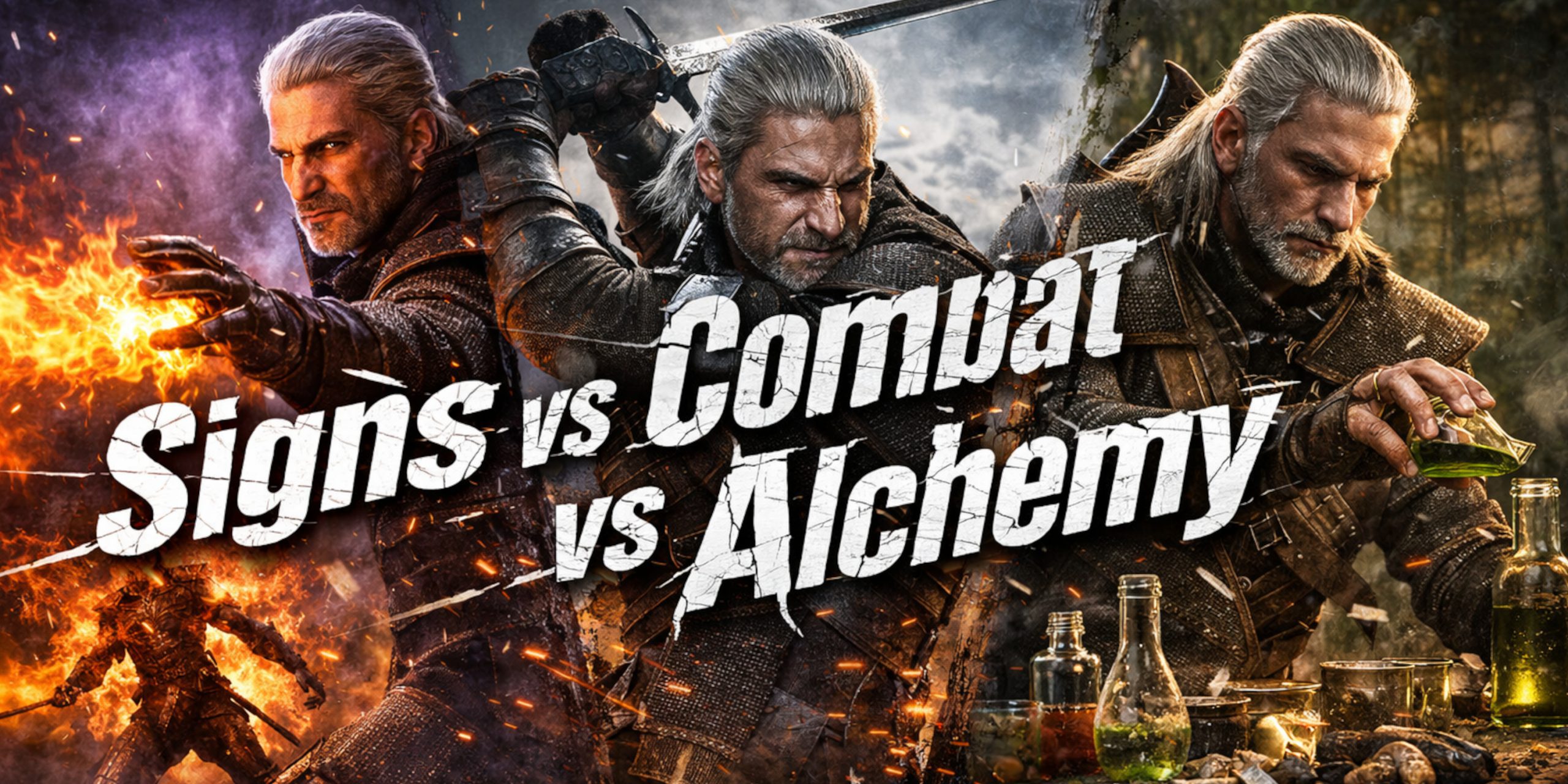
Few RPGs give you as much freedom in shaping your character as The Witcher 3: Wild Hunt. Geralt can be a whirling swordmaster, a potion-fuelled monster scientist, or a walking magical artillery platform that casually sets entire battlefields on fire.
The game never really tells you which path is best. It quietly hands you skill points and lets you figure it out while a griffin attempts to remove your spine.
So the big question arrives sooner or later. Should you focus on Combat, Signs, or Alchemy?
Each approach changes the rhythm of the game in noticeable ways. Fights feel different, preparation matters more or less, and some builds shine in the late game while others dominate early. After several playthroughs and a fair bit of trial and error, the three main archetypes reveal their personalities.
Let’s break them down properly.
Combat Builds: The Classic Witcher Approach
A Combat build is the most straightforward way to play The Witcher 3. If you imagine Geralt as a fast, precise monster hunter who relies on sword skill above all else, this is the path.
It focuses on increasing damage, critical hits, and attack speed while improving survivability through defensive talents.
Core Strengths
Combat builds deliver extremely reliable damage. Strong attacks become devastating against large enemies, while fast attacks carve through humans and smaller monsters. Once you unlock higher level abilities, Geralt begins to feel like a spinning blender made of steel.
The style also works well in nearly every encounter. You rarely need to worry about oils, potions, or magical tricks to win fights.
Another advantage is how early it becomes effective. Many Combat skills are strong from the moment you unlock them.
Key Skills to Prioritise
Several skills form the backbone of a strong Combat build.
Fast attack talents increase attack speed and critical chance, which makes sword combat feel noticeably smoother.
Strong attack talents dramatically increase damage against large targets.
Defensive abilities such as damage reduction or adrenaline generation add survivability.
Adrenaline mechanics become particularly valuable later in the game. When fully developed, Geralt begins stacking damage bonuses that turn boss fights into short, decisive duels.
Weaknesses
Combat builds can feel a little one dimensional if you ignore other skill trees entirely. Without support from Signs or Alchemy, fights against tougher enemies can take longer.
You also lose some of the tactical depth that comes from potion management or magical utility.
Still, if you want Geralt to feel like a legendary swordsman first and everything else second, Combat builds deliver exactly that.
Sign Builds: Turning Geralt into a Battlefield Mage
A Sign build takes Geralt’s limited magical abilities and turns them into the centrepiece of combat.
Normally Signs act as helpful tools. With the right upgrades they become the main event.
Suddenly enemies burn, freeze, stagger, and explode with alarming regularity.
Core Strengths
The biggest advantage of Sign builds is control. Enemies spend far more time stunned, burning, or knocked down, which gives you breathing room in fights.
Igni becomes particularly satisfying once upgraded. Instead of a small flame burst, it starts behaving like a short range flamethrower that can ignite entire groups.
Yrden also becomes incredibly powerful against spectres and fast enemies, slowing them down and making them vulnerable.
Meanwhile Quen, when properly enhanced, can keep Geralt alive through fights that would normally be far too dangerous.
Key Skills to Prioritise
Several abilities turn Signs from minor tricks into devastating tools.
Upgrades that increase Sign intensity dramatically raise damage and status effects.
Igni enhancements allow the spell to burn enemies for long periods.
Quen improvements create protective shields and healing effects.
Many players also invest in stamina regeneration so Signs can be cast far more frequently.
Once the build comes together, Geralt begins controlling fights instead of reacting to them.
Weaknesses
Sign builds rely heavily on stamina management. Without it, your magical arsenal shuts down quickly.
They can also struggle in the early game before enough upgrades are unlocked. At low levels the damage can feel underwhelming.
However, once the build matures, it becomes one of the most entertaining ways to play.
There is something deeply satisfying about defeating a monster primarily by setting it on fire.
Alchemy Builds: The Witcher Scientist
Alchemy builds represent Geralt at his most professional. This approach leans into potions, oils, toxicity management, and mutagens to produce some of the most powerful builds in the entire game.
It requires preparation and knowledge of the systems. In return it can produce absurd results.
Core Strengths
Alchemy builds generate massive damage bonuses through potions and oils. When properly prepared, Geralt can enter fights with several stacked buffs active at once.
Toxicity based talents increase damage as potion effects accumulate. This creates a strange but effective strategy where drinking more potions actually makes you stronger.
Mutagen bonuses also scale extremely well. When combined with combat abilities, the damage output becomes impressive.
Alchemy builds also provide strong survivability. Certain talents allow healing through potion effects or increase resistance to incoming damage.
Key Skills to Prioritise
The most effective Alchemy builds usually focus on:
Potion duration increases
Toxicity threshold improvements
Oil effectiveness against monsters
Mutagen bonuses that enhance damage
Once these systems start working together, Geralt becomes a carefully engineered monster killing machine.
Weaknesses
Preparation becomes essential. Forget to apply the correct oil or drink the right potions and the build loses some of its edge.
It also takes time to gather ingredients and recipes, which means the build shines most in the mid to late game.
Still, players who enjoy preparation and experimentation tend to love Alchemy builds.
Which Build Is Actually Best?
There is no single answer because The Witcher 3 rewards hybrid builds.
Many experienced players combine elements from multiple trees. A Combat base supported by Alchemy buffs is extremely popular. Sign builds paired with Quen upgrades can also become surprisingly durable.
The most effective approach often looks something like this.
Combat skills provide consistent sword damage.
Alchemy boosts that damage through potions and mutagens.
Signs add control and survivability when needed.
In other words, Geralt ends up doing what Witchers are supposed to do. Using every trick available.
Seven Swords Takeaway
Each build represents a different interpretation of Geralt.
Combat builds feel like a legendary duelist who defeats monsters through pure skill.
Sign builds lean into the magical side of the Witcher profession.
Alchemy builds transform Geralt into a carefully prepared hunter who wins fights before they even begin.
Personally, the most fun comes from blending them. A sword master who occasionally lights enemies on fire while running on a cocktail of suspicious potions feels very on brand for Geralt.
And if a few drowners explode along the way, that is simply good Witcher work.