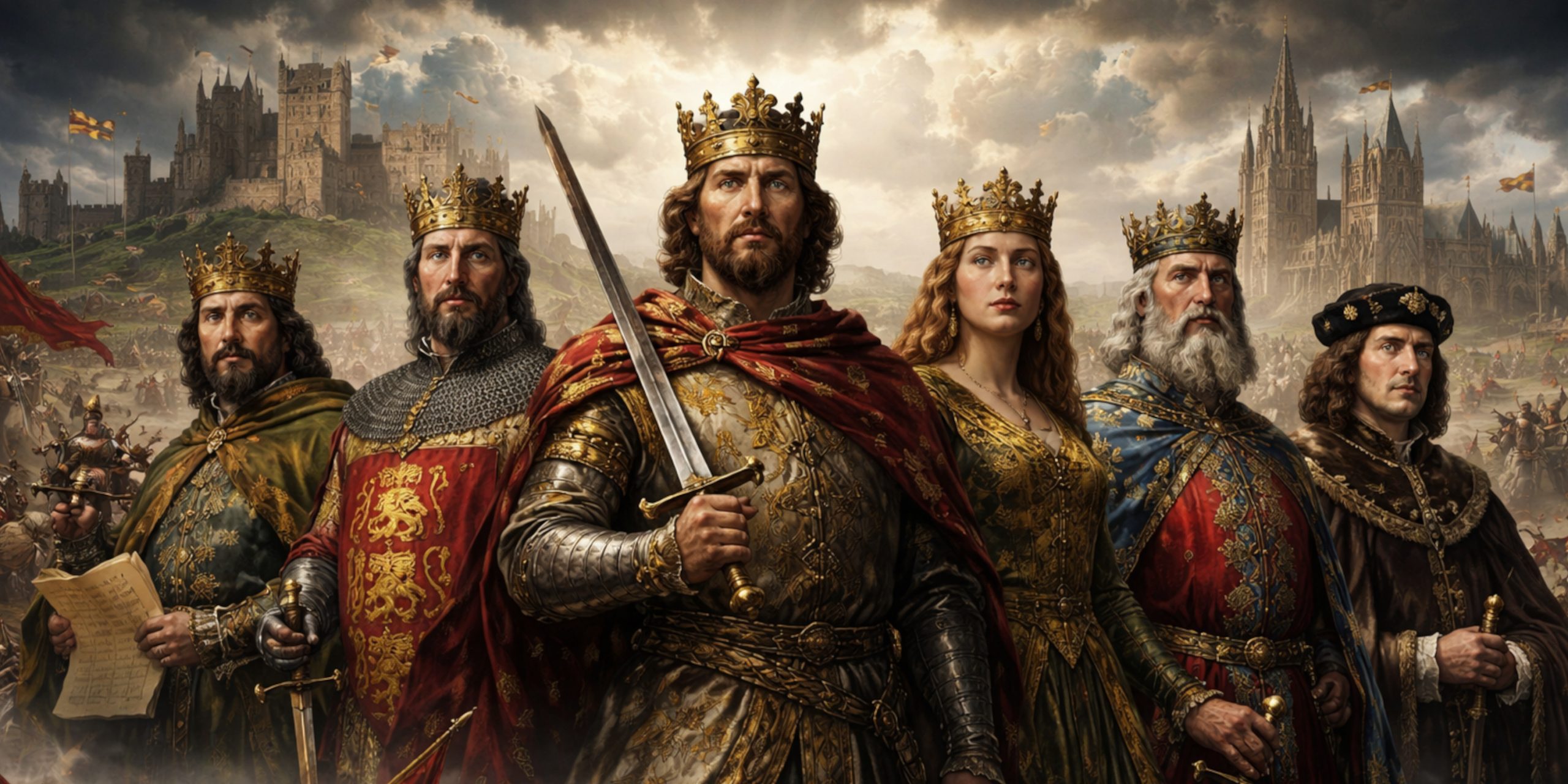
Few royal houses have shaped England as deeply, or as dramatically, as the Plantagenets. Their reign was long, turbulent, often brilliant and occasionally catastrophic. From crusading kings to child monarchs, from reformers to tyrants, they governed for more than three centuries and left behind a political and cultural legacy that still frames the British monarchy today.
Origins: From Anjou to the English Throne
The dynasty takes its name from Geoffrey of Anjou, known for wearing a sprig of broom, planta genista, in his cap. His son, Henry II of England, became king in 1154, founding what historians call the Angevin Empire.
Henry inherited a realm exhausted by civil war during the reign of Stephen of England. What he built instead was formidable. At its height, his dominions stretched from the Scottish border to the Pyrenees.
His marriage to Eleanor of Aquitaine was politically transformative. Aquitaine alone made the English crown a continental superpower. Their sons, however, would ensure that domestic drama remained a family tradition.
Timeline of Plantagenet Rulers
Before diving further into personalities and crises, it helps to see the full arc of the dynasty laid out clearly. Three centuries can blur without structure.
Angevin and Early Plantagenets
- Henry II – 1154 to 1189
- Richard I – 1189 to 1199
- John – 1199 to 1216
- Henry III – 1216 to 1272
- Edward I – 1272 to 1307
- Edward II – 1307 to 1327
- Edward III – 1327 to 1377
- Richard II – 1377 to 1399
Richard II’s deposition in 1399 ended the senior line descending directly from Edward III.
House of Lancaster
House of York
- Edward IV – 1461 to 1470, restored 1471 to 1483
- Edward V – 1483
- Richard III – 1483 to 1485
In 1485, Richard III was killed at Bosworth. With him the Plantagenet dynasty ended and the Tudors began.
When teaching this period, I sometimes tell students that longevity does not equal stability. The Plantagenets endured for 331 years. They rarely enjoyed calm.
The High Plantagenets: Conflict and Consolidation
Henry II was followed by Richard I of England, remembered for crusading more than governing. He spent little time in England and an impressive amount of money defending it. Charismatic and capable in war, he left administration to others.
His brother, John of England, was less fortunate. Military defeat in France and heavy taxation alienated his barons. In 1215, he sealed the Magna Carta at Runnymede. It was not intended as a grand constitutional statement, yet it became precisely that. Medieval politics can be unexpectedly ironic.
John’s son, Henry III of England, ruled for over fifty years. His reign saw growing tensions between crown and parliament, including the reform movement led by Simon de Montfort. Here we see the gradual emergence of parliamentary representation as a political force.
Edwardian Ambition: War and Law
Edward I of England was a formidable ruler. His campaigns in Wales led to the construction of castles such as Caernarfon, still standing as monumental statements of conquest. His attempt to dominate Scotland ended less triumphantly, particularly after Bannockburn.
His son, Edward II of England, struggled with factional politics and military defeat. His deposition in 1327 marked a dangerous precedent. English kings could be removed.
Edward III of England restored prestige through war with France, launching what became the Hundred Years’ War. Chivalric culture flourished, alongside administrative sophistication. It is tempting to romanticise this era. I resist the temptation, though not always successfully.
The Later Plantagenets: Crisis and Civil War
Richard II of England believed deeply in royal authority. His nobles believed in limiting it. He was deposed by his cousin, who became Henry IV of England, inaugurating the Lancastrian branch.
Henry V of England revived martial prestige with victory at Agincourt. His early death altered the course of English history. His son, Henry VI of England, inherited a fragile realm and a protracted war.
The fifteenth century descended into the Wars of the Roses, a dynastic struggle between Lancaster and York. It culminated in the defeat of Richard III of England at Bosworth in 1485. With him ended the Plantagenet line and began the Tudors.
Governance, Law and Cultural Impact
The Plantagenets refined royal justice, expanded administrative record keeping and strengthened the concept of the common law. Institutions such as Parliament developed in this period not as abstract theory but as practical responses to taxation and war.
Architecturally, the era gave us Gothic cathedrals, royal castles and the rebuilding of Westminster Abbey. Culturally, it was the age of chivalric literature, courtly love and, later, the works of Chaucer.
It is easy to forget that these developments were born from crisis as often as confidence. War financed reform. Rebellion prompted negotiation. Even incompetence occasionally produced constitutional progress.
The Dynasty in Perspective
The Plantagenets ruled from 1154 to 1485, spanning the High Middle Ages to the cusp of the Renaissance. They presided over territorial expansion, legal innovation, economic growth and repeated civil war. They lost most of their French possessions, fought Scotland and Wales, endured plague and famine, and still managed to leave behind one of the most recognisable royal lineages in European history.
I admire their administrative resilience and question their appetite for war. Their story reminds us that monarchy in medieval England was never static. It was negotiated, contested and sometimes violently corrected.
For a family that began with a sprig of broom tucked into a cap, they altered the constitutional and political landscape of Britain in ways that still echo. Not bad for three centuries of near perpetual argument.
Watch the documentary: