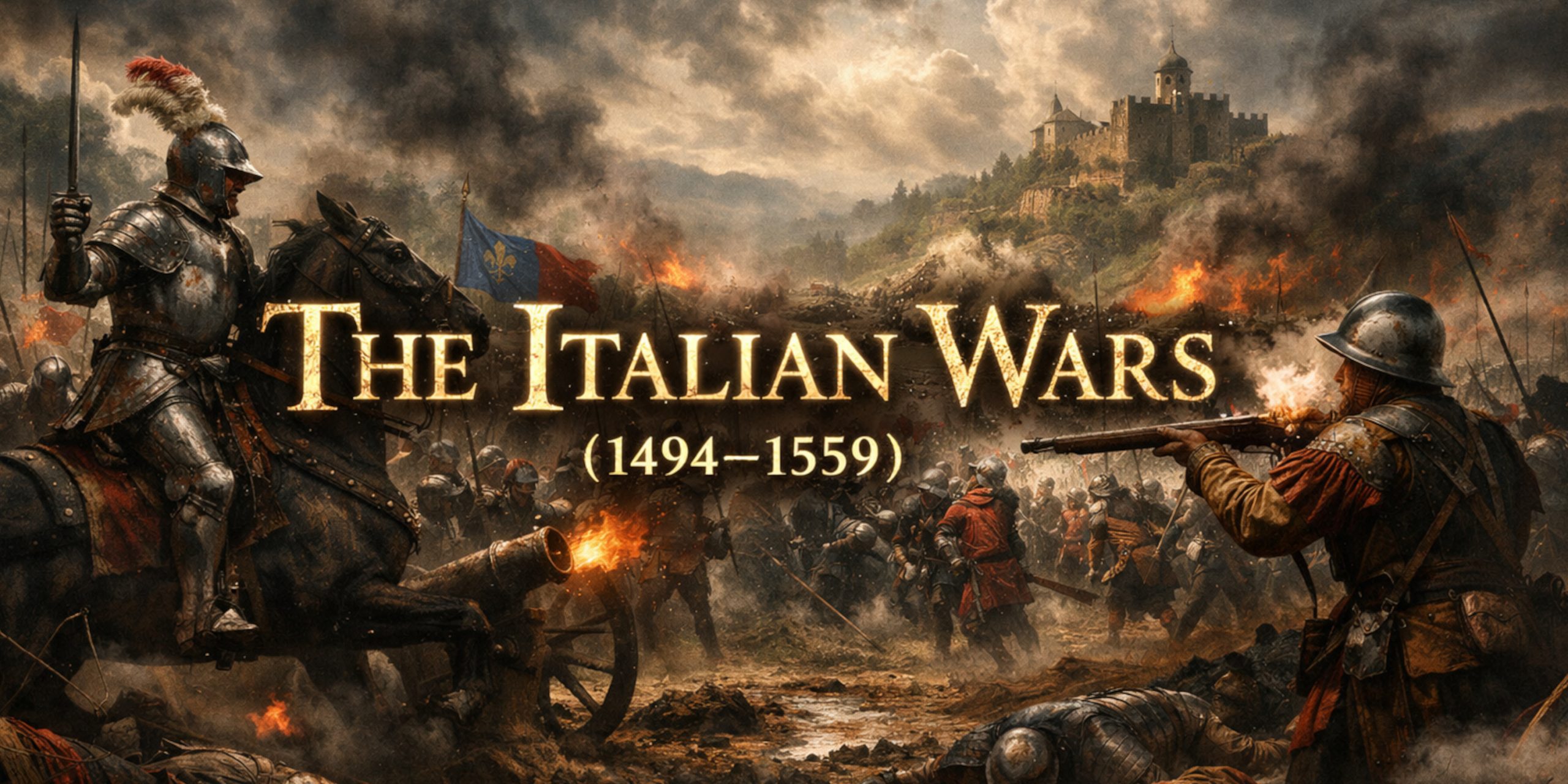
The Italian Wars begin, as many European disasters do, with a confident monarch and a map that looks deceptively simple.
In 1494, Charles VIII of France marched into Italy with a claim to Naples and a sense of optimism that history would quickly punish. What followed was not a single war but a rolling series of conflicts stretching over six decades, drawing in France, Spain, the Holy Roman Empire, the Papacy, and a cast of Italian states who alternated between ambition, survival, and opportunism.
Italy, wealthy and politically fragmented, became the testing ground for a new kind of warfare. Gunpowder weapons, professional armies, and shifting alliances turned the peninsula into Europe’s proving ground. If medieval warfare had been a matter of honour and banners, the Italian Wars were about logistics, artillery, and whoever could pay their troops on time.
Background and Causes
Italy in the late fifteenth century was a collection of powerful but vulnerable states. Milan, Venice, Florence, Naples, and the Papal States all possessed wealth and influence, but none could dominate the peninsula outright.
France saw opportunity. The Angevin claim to Naples gave Charles VIII a legal excuse, though the real motivation was prestige and expansion. Spain, under Ferdinand and Isabella, had no intention of letting France establish a foothold so close to its own Mediterranean interests. The Holy Roman Empire, meanwhile, had its own claims and anxieties.
Italian rulers themselves played a dangerous game. Alliances shifted quickly, sometimes within the same campaign. It is tempting to see this as chaos. In truth, it was a calculated attempt to maintain balance. Unfortunately, inviting foreign armies into Italy proved rather like opening the door to a storm and hoping it would behave politely.
The Course of the Wars
The wars are best understood as a sequence of phases rather than a single continuous conflict.
Charles VIII’s invasion in 1494 met surprisingly little resistance. His army, equipped with modern artillery, moved rapidly and captured Naples. The reaction was swift. The League of Venice formed to drive the French out, and by 1495 Charles was retreating.
Louis XII returned to Italy in 1499 with greater success, taking Milan and again pressing south. Spain entered more directly, leading to prolonged conflict over Naples. By the early sixteenth century, the wars had widened into a broader European struggle.
The campaigns of Francis I of France and Charles V, Holy Roman Emperor, marked the height of the conflict. Italy became the centrepiece of their rivalry, with battles fought not only for territory but for dominance in Europe.
By 1559, after decades of shifting fortunes, Spain emerged as the dominant power in Italy, confirmed by the Treaty of Cateau-Cambrésis. France withdrew, and the peninsula settled into a new political order, though “settled” may be too generous a word.
Key Battles
Battle of Fornovo (1495)
A chaotic engagement during Charles VIII’s retreat. The French fought their way through League forces, technically a victory, though one achieved while running for the border. A useful reminder that winning and escaping are sometimes the same thing.
Battle of Agnadello (1509)
France delivered a crushing defeat to Venice. The Venetian Republic, usually resilient, found itself suddenly exposed. It recovered, but the shock lingered.
Battle of Marignano (1515)
Francis I secured a dramatic victory over Swiss mercenaries. The battle demonstrated the growing importance of combined arms, with artillery and cavalry working alongside infantry. It also gave Francis a reputation he was rather fond of repeating.
Battle of Pavia (1525)
One of the most decisive engagements of the wars. Spanish and Imperial forces defeated the French, and Francis I was captured. The dominance of gunpowder infantry over traditional heavy cavalry was unmistakable.
Francis himself reportedly wrote, “All is lost save honour,” which is a line that sounds noble until one considers the scale of what had just been lost.
Sack of Rome (1527)
Not a battle in the conventional sense, but impossible to ignore. Imperial troops, unpaid and increasingly mutinous, stormed Rome. The city was looted, its population brutalised, and the Papacy humiliated.
If there is a moment that captures the darker reality of the Italian Wars, this is it.
Arms and Warfare
The Italian Wars mark a turning point in European military practice.
Artillery became central. French armies in particular used mobile cannon to devastating effect, reducing medieval fortifications with alarming speed. This led to the development of new defensive designs, most notably the trace italienne, low angled bastions built to absorb and deflect cannon fire.
Infantry evolved as well. Pike formations remained important, but they were increasingly supported by arquebusiers. The Spanish tercio became the dominant infantry system, combining pikes and firearms in a flexible formation.
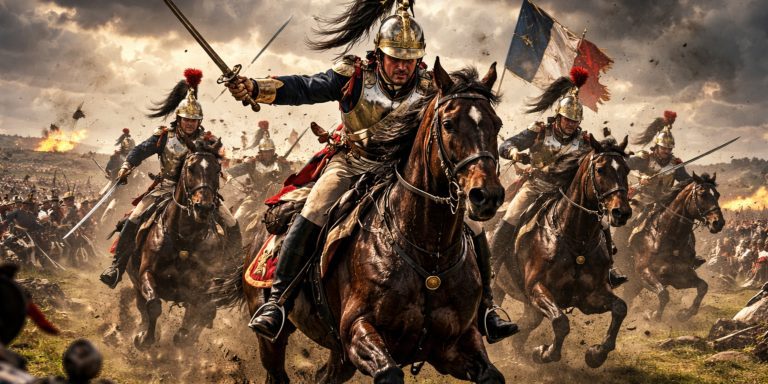
Cavalry did not disappear, but its role changed. Heavy knights charging in isolation found themselves outmatched by disciplined infantry and gunpowder weapons. Adaptation was necessary, and not always immediate.
There is a certain irony in watching centuries of chivalric tradition adjusted, rather hurriedly, to the realities of shot and powder.
Archaeology and Material Evidence
Archaeological work has shed valuable light on the realities of these campaigns.
Excavations at sites such as Pavia have uncovered concentrations of lead shot, fragments of armour, and weapon remains that confirm contemporary accounts of intense firearm use. These finds reinforce the idea that battles were increasingly decided by disciplined volleys rather than individual combat.
Fortifications across Italy tell their own story. Star forts, with their angular bastions and thick earthworks, still dominate many landscapes. They are physical evidence of a rapid architectural response to artillery warfare.
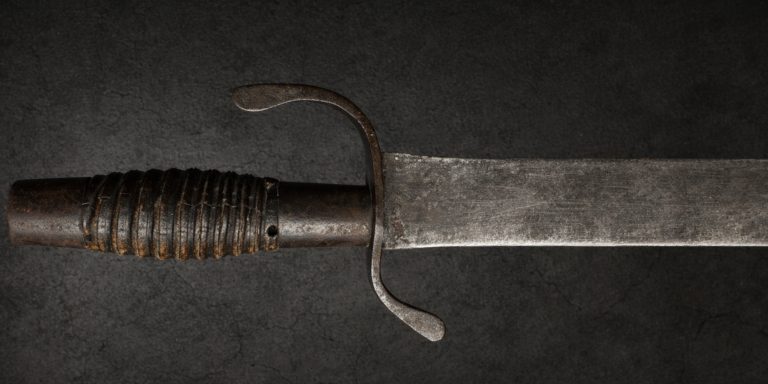
Even smaller finds, buckles, coins, pieces of equipment, reveal the scale of these armies and the logistical effort required to sustain them. War, it turns out, leaves behind a great deal of debris, much of it surprisingly mundane.
Contemporary Voices
The Italian Wars were well documented, and their participants left vivid impressions.
Niccolò Machiavelli, observing the instability of Italian politics, wrote, “Mercenaries and auxiliaries are useless and dangerous.” Given how often unpaid troops turned on their employers, it is difficult to argue with him.
Francesco Guicciardini offered a more sombre reflection on the devastation of Italy, noting the repeated suffering of its cities as foreign armies marched back and forth.
From the battlefield, the words of Francis I after Pavia remain among the most quoted. They capture both the pride and the frustration of a ruler caught in a conflict that rarely rewarded either for long.
Legacy
By 1559, the Italian Wars had reshaped Europe.
Spain emerged as the dominant power in Italy, controlling key territories and exerting influence across the peninsula. France, though still powerful, had been checked.
More importantly, warfare itself had changed. The dominance of gunpowder weapons, the rise of professional armies, and the importance of logistics became defining features of early modern conflict.
Italy, for all its cultural brilliance, paid a heavy price. Its cities were repeatedly occupied, looted, and drawn into conflicts not entirely of their making.
One is left with the sense that the Italian Wars were less a single catastrophe and more a long lesson, one that Europe would continue to study, and occasionally forget, for centuries.
Takeaway
The Italian Wars are often overshadowed by later conflicts, yet they sit at a crucial turning point in history.
They mark the end of medieval warfare and the emergence of something recognisably modern. They reveal the dangers of fragmented politics in the face of larger powers. And they demonstrate, with uncomfortable clarity, that war has a habit of lingering long after its original causes have been forgotten.
If nothing else, they remind us that inviting foreign armies onto your soil is rarely a tidy solution. History, in this case, was quite clear on the matter.