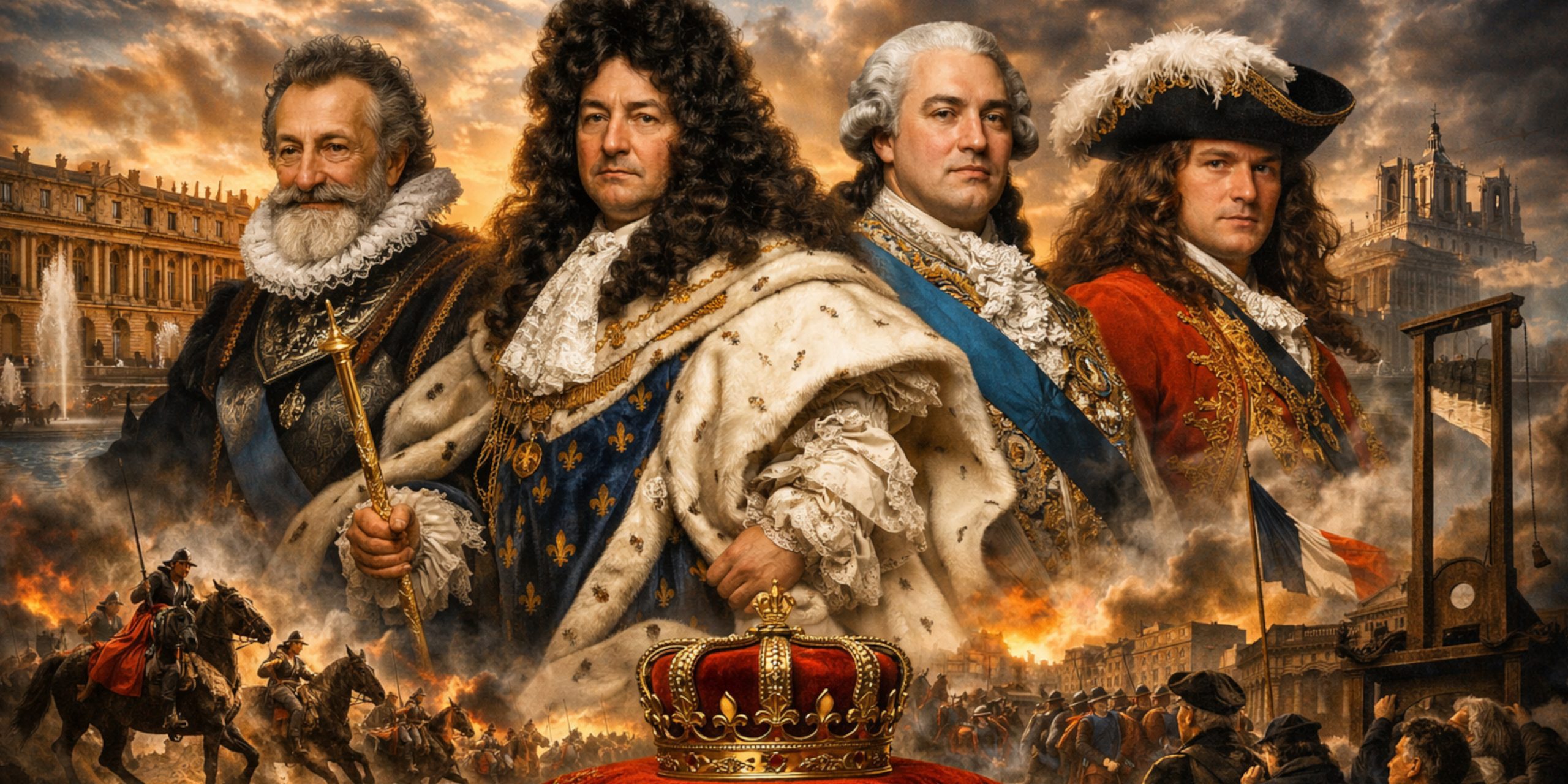
Few royal families have shaped European politics for as long, or as dramatically, as the House of Bourbon. Emerging from medieval France, the dynasty would eventually rule vast territories across Europe and the Americas. Their story includes wars of religion, imperial ambitions, revolutions, restorations, and more than one awkward moment involving guillotines.
From a historian’s desk the Bourbons feel almost stubbornly persistent. Remove them from one throne and, sooner or later, another Bourbon seems to appear somewhere else wearing a crown. If monarchy were a long chess match, the Bourbons were the sort of players who refused to leave the board.
Origins of the Bourbon Line
The Bourbon dynasty began as a cadet branch of the Capetian royal house of France. Their ancestral seat lay in the region of Bourbonnais in central France, centred on the town of Bourbon-l’Archambault.
The family rose gradually through marriage, inheritance, and careful political positioning. Medieval aristocracy was rarely a game of dramatic leaps. It was more like a patient accumulation of titles and lands over generations.
Key early figures include:
| Figure | Lifespan | Significance |
|---|---|---|
| Robert, Count of Clermont | 1256–1317 | Youngest son of King Louis IX of France, founder of the Bourbon line |
| Louis I, Duke of Bourbon | 1279–1342 | First Duke of Bourbon, established the family as major French nobles |
| Charles, Duke of Bourbon | 1489–1527 | A powerful noble whose rebellion against the French crown nearly destroyed the family |
By the late Middle Ages the Bourbons were among the most influential noble families in France, though still some distance from the throne itself.
History often turns on unlikely circumstances. In this case, the collapse of other royal lines opened the door.
The Bourbons Take the French Throne
The dynasty’s great breakthrough came during the Wars of Religion in the sixteenth century.
When the Valois royal line collapsed in 1589, the closest legitimate heir was Henry of Navarre, a Bourbon prince. There was only one problem. Henry was Protestant, and France was overwhelmingly Catholic.
Henry solved the dilemma with a piece of political pragmatism that still makes historians smile.
Paris, he reportedly remarked, was worth a mass.
After converting to Catholicism, Henry became King Henry IV of France, founding the Bourbon monarchy.
His reign stabilised a fractured kingdom. The Edict of Nantes granted limited rights to Protestants and helped end decades of civil conflict.
Henry IV also acquired a reputation as a practical ruler who cared about ordinary subjects. His famous wish that every peasant might have a chicken in the pot on Sundays reveals both political awareness and an understanding that content peasants rarely rebel.
Bourbon France at its Height
The Bourbon monarchy reached its zenith under Louis XIV, the Sun King.
His reign from 1643 to 1715 transformed France into the dominant power in Europe. He centralised authority, weakened the nobility, and turned the royal court at Versailles into a theatre of power.
Notable Bourbon rulers of France included:
| Monarch | Reign | Key Achievements |
|---|---|---|
| Henry IV | 1589–1610 | Restored stability after the Wars of Religion |
| Louis XIII | 1610–1643 | Strengthened royal authority with Cardinal Richelieu |
| Louis XIV | 1643–1715 | Expansion of French power, construction of Versailles |
| Louis XV | 1715–1774 | Long but increasingly troubled reign |
| Louis XVI | 1774–1792 | Last Bourbon king before the French Revolution |
The Bourbon court became the model for European monarchy. Courts across the continent copied French fashion, etiquette, and architecture.
Versailles itself was less a palace than a carefully choreographed display of political control. Keep the nobles busy attending ceremonies and they have less time plotting rebellions. One suspects Louis XIV understood human vanity extremely well.
The Bourbon Expansion Across Europe
While France remained the core of Bourbon power, the dynasty spread across Europe through inheritance and diplomacy.
The most significant expansion came with the War of the Spanish Succession.
When the Spanish Habsburg line died out in 1700, the throne passed to Philip V, a grandson of Louis XIV. This created the Spanish Bourbon branch, which continues to rule Spain today.
Other Bourbon branches appeared across the continent.
Major Bourbon monarchies included:
| Kingdom | Bourbon Ruler | Period |
|---|---|---|
| Spain | Philip V and successors | From 1700 |
| Kingdom of the Two Sicilies | Bourbon-Sicily branch | 1734–1861 |
| Duchy of Parma | Bourbon-Parma line | Various periods |
| France | Main Bourbon line | 1589–1792, restored 1814–1830 |
By the eighteenth century Bourbons sat on several European thrones simultaneously. Dynastic politics became a complex web of cousins ruling neighbouring states, occasionally declaring war on each other.
Family gatherings must have been interesting.
The French Revolution and the Fall of the Monarchy
The late eighteenth century brought the Bourbon monarchy face to face with the forces of revolution.
Financial crisis, social inequality, and Enlightenment political thought combined into a volatile mixture. Louis XVI struggled to manage the growing unrest.
The French Revolution erupted in 1789. Within three years the monarchy collapsed.
Louis XVI was executed in 1793. His queen, Marie Antoinette, followed shortly afterwards.
For the Bourbons it was a catastrophic moment. The royal family scattered across Europe, while France entered a period of radical political change.
Yet the dynasty was not finished.
Restoration and Final Loss of the French Throne
After the fall of Napoleon in 1814, the Bourbon monarchy returned to France.
Louis XVIII, brother of the executed king, took the throne. His reign attempted to balance royal authority with the constitutional realities created by the revolution.
The final Bourbon king of France was Charles X.
His deeply conservative policies alienated large sections of French society. In 1830 the July Revolution forced him into exile.
The French crown passed to the Orléans branch of the royal family, ending the Bourbon line on the French throne.
The Bourbons had ruled France for more than two centuries, though not without interruptions.
The Spanish Bourbons
While the French monarchy ended, the Spanish branch of the dynasty survived.
The Spanish Bourbons ruled through periods of upheaval that included:
- The Napoleonic occupation of Spain
- Nineteenth century civil wars
- Temporary republican governments
- The dictatorship of Francisco Franco
In 1975 the monarchy was restored under King Juan Carlos I, a Bourbon descendant.
Today the Spanish throne is held by King Felipe VI, continuing the Bourbon lineage into the twenty first century.
For a dynasty that began in medieval France, the longevity is impressive.
Bourbon Legacy
The influence of the Bourbon dynasty reaches well beyond individual rulers.
Their legacy includes:
- The development of modern centralised monarchy in France
- The cultural influence of the Versailles court
- Dynastic politics that shaped European diplomacy for centuries
- Continued royal rule in Spain
They also left a significant architectural and cultural imprint. Palaces, archives, and royal collections from Bourbon reigns remain central to European heritage.
From a historian’s perspective the Bourbons represent a fascinating case of dynastic endurance. Their power rose gradually, reached spectacular heights, collapsed dramatically, and yet somehow continued elsewhere.
If history teaches anything, it is that royal families are remarkably difficult to remove entirely. The Bourbons demonstrate this point rather neatly. Remove them from Paris and they simply reappear in Madrid, still wearing crowns and still navigating the endlessly complicated business of ruling nations.