There are figures in history who arrive with a quiet certainty and then leave with a continent altered. Tariq ibn Ziyad belongs in that category. His name is forever tied to a single act that feels almost mythic, the crossing into Iberia in 711. From that moment, the political and cultural trajectory of Spain shifted in ways that still echo today.
What makes Tariq particularly intriguing is how little we can say with absolute certainty. The outlines are clear, the details often blurred. He stands somewhere between a documented commander and a figure shaped by later storytelling. That tension is part of his appeal.
Origins and Early Life
Tariq was likely of Berber origin, probably from the Zenata tribes of North Africa. This alone is significant. It reminds us that the early Islamic expansions were not simply Arab enterprises but complex coalitions in which Berber forces played a decisive role.
He rose under the authority of Musa ibn Nusayr, the Umayyad governor of Ifriqiya. By the time Iberia entered the picture, Tariq was already a trusted military commander, which suggests experience, discipline, and political reliability. These were not small qualities in a frontier region where loyalties could shift quickly.
The Crossing into Iberia
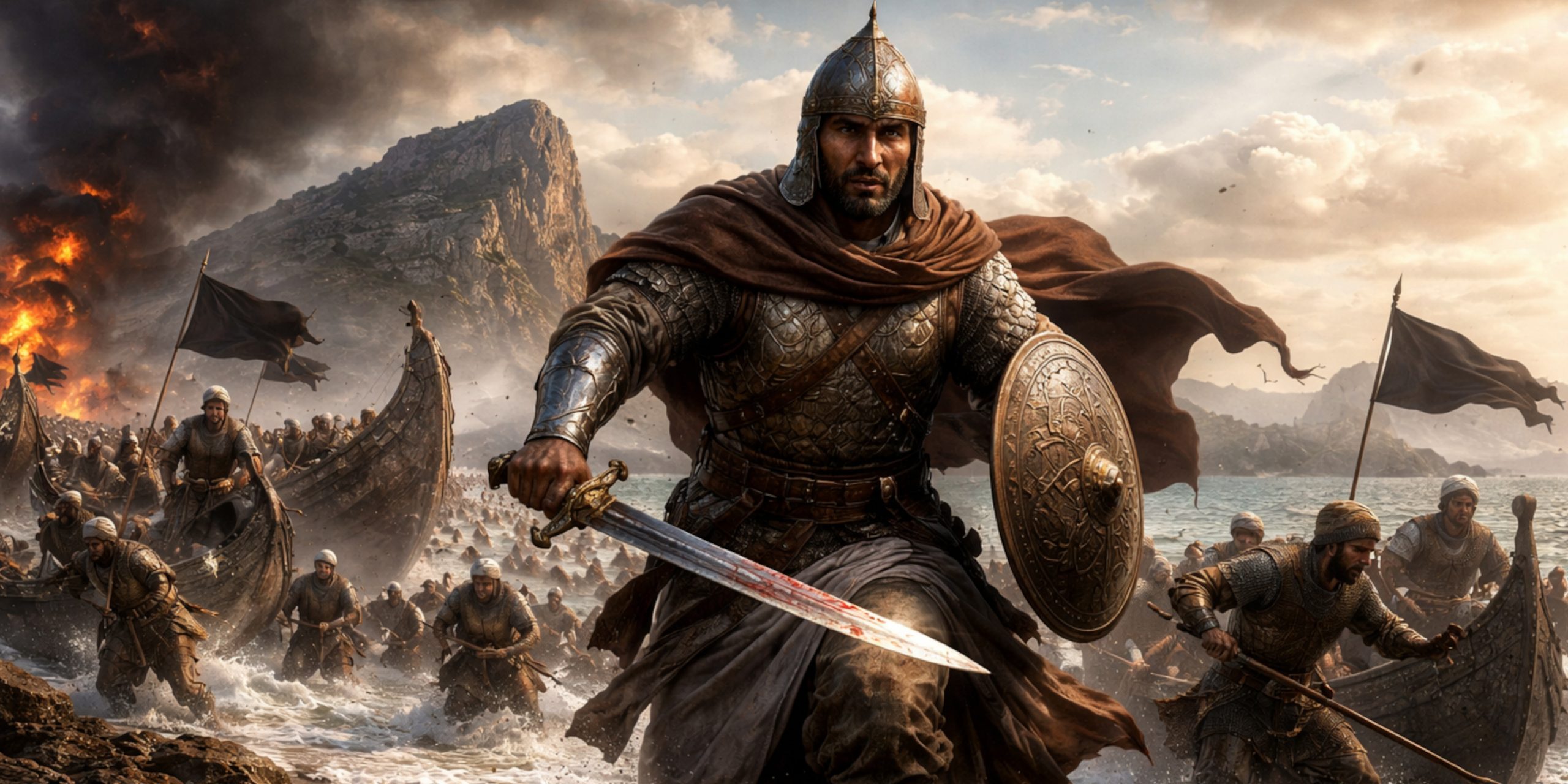
In 711, Tariq led a force across the narrow strait separating North Africa from Iberia. The landing point would later bear his name, Jabal Tariq, the mountain of Tariq, now Gibraltar.
The oft-repeated story that he burned his ships after landing is almost certainly apocryphal. It is a good story, perhaps too good. Still, even stripped of embellishment, the reality remains bold. A relatively small force, largely Berber, entered a Visigothic kingdom already strained by internal division.
Timing, as ever, was everything.
Key Battles and Campaigns
The Battle of Guadalete
The defining moment came at Guadalete in 711.
Opponents
- Tariq ibn Ziyad’s army, estimated 7,000 to 12,000 troops
- Visigothic forces under King Roderic
Outcome
- Decisive victory for Tariq
- Collapse of central Visigothic authority
Accounts suggest that internal dissent within the Visigothic ranks played a role. Some factions may have withdrawn or defected. Tariq did not create that weakness, but he exploited it with precision.
From there, the campaign unfolded with remarkable speed.
Advance Through Iberia
After Guadalete, Tariq pushed north.
Key Movements
- Capture of Córdoba
- March on Toledo, the Visigothic capital
- Securing major urban centres with minimal prolonged sieges
This was not a slow grinding conquest. It was a rapid dislocation of an already fragile political system. The speed alone suggests effective leadership and disciplined troops.
Military Acumen
Tariq’s success rests on several identifiable strengths.
Operational Flexibility
- He adapted quickly to unfamiliar terrain
- Maintained momentum rather than consolidating too early
Use of Light Forces
- Berber troops excelled in mobility
- Skirmishing and rapid strikes disrupted heavier Visigothic formations
Psychological Impact
- Early victories created a sense of inevitability
- Local resistance often fractured before full engagement
He appears to have understood that momentum can be more decisive than numbers. Once the Visigothic command structure faltered, he pressed forward relentlessly.
Arms and Armour
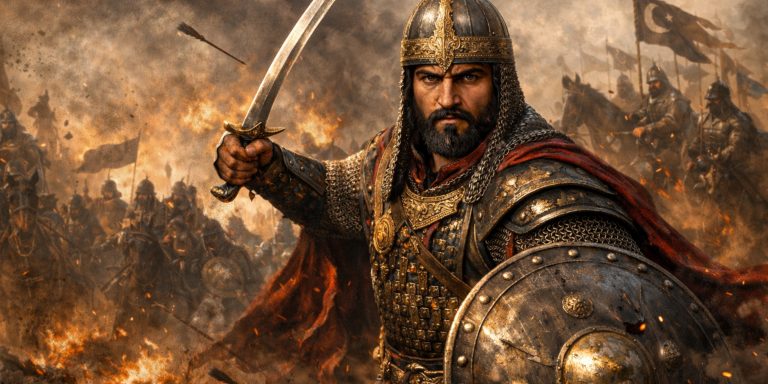
The forces under Tariq were not uniform, but certain elements are consistent with early 8th century North African and Umayyad military practice.
Weapons
- Straight double-edged swords, often referred to as saif
- Spears and lances for both infantry and cavalry
- Javelins for light troops
- Simple bows used for skirmishing
Armour
- Leather or textile armour for many Berber troops
- Mail shirts among higher-status warriors
- Conical helmets, sometimes with nasal protection
- Round shields made of wood and leather
Tactical Implications
- Light equipment allowed speed and endurance
- Cavalry mobility played a key role in pursuit and disruption
- Flexibility mattered more than heavy protection
This was not an army built for static warfare. It was built to move, and that shaped the campaign.
Relationship with Musa ibn Nusayr
Success tends to complicate relationships.
Musa ibn Nusayr later crossed into Iberia with reinforcements. The relationship between Musa and Tariq is debated. Some sources suggest tension, perhaps even rivalry. Others present a more cooperative picture.
Both were eventually summoned to Damascus. Their achievements were recognised, but neither remained in Iberia long enough to shape its long-term governance. That task fell to others.
Archaeology and Evidence
Material evidence from Tariq’s campaign is limited, which is not unusual for rapid early medieval conquests.
What We Have
- Early Islamic coinage in Iberia from shortly after the conquest
- Urban layers showing transition from Visigothic to Islamic control
- Mosque foundations in cities such as Córdoba
What We Lack
- Direct artefacts tied specifically to Tariq himself
- Clear battlefield archaeology for Guadalete
This leaves historians reliant on later chronicles, many written decades or even centuries after the events. As ever, one reads them with care.
Artefacts and Where to See Them
There are no confirmed personal artefacts of Tariq ibn Ziyad. Still, the world he helped shape can be explored through surviving material culture.
Notable Locations
- The Great Mosque of Córdoba, later developments but rooted in the early Islamic presence
- National Archaeological Museum in Madrid, early Al-Andalus artefacts and coinage
- Gibraltar Museum, contextual material linked to the landing region
- Toledo collections, artefacts from the transition between Visigothic and Islamic rule
These sites do not give us Tariq the man, but they show the consequences of his campaign.
Legacy
Tariq ibn Ziyad’s legacy is immense, even if the man himself remains partly obscured.
- He initiated the Islamic presence in Iberia that would last for centuries
- His campaign reshaped the political and cultural map of Western Europe
- Gibraltar bears his name, a rare geographical memorial that has endured
There is a temptation to turn him into a symbol of inevitability. That is rarely how history works. His success relied on timing, leadership, and the weaknesses of his opponents.
Still, one cannot ignore the scale of what followed.
A Historian’s Reflection
Tariq is one of those figures who resists neat conclusions. The sources are thin, the later narratives often embellished, and yet the impact is undeniable.
If anything, the lack of detail sharpens the outline. You see the decisions rather than the personality. A landing, a battle, a rapid advance. No unnecessary flourishes.
There is something almost austere about it.
And perhaps that is fitting. History often preserves noise. Occasionally, it leaves us with silence and consequence instead.