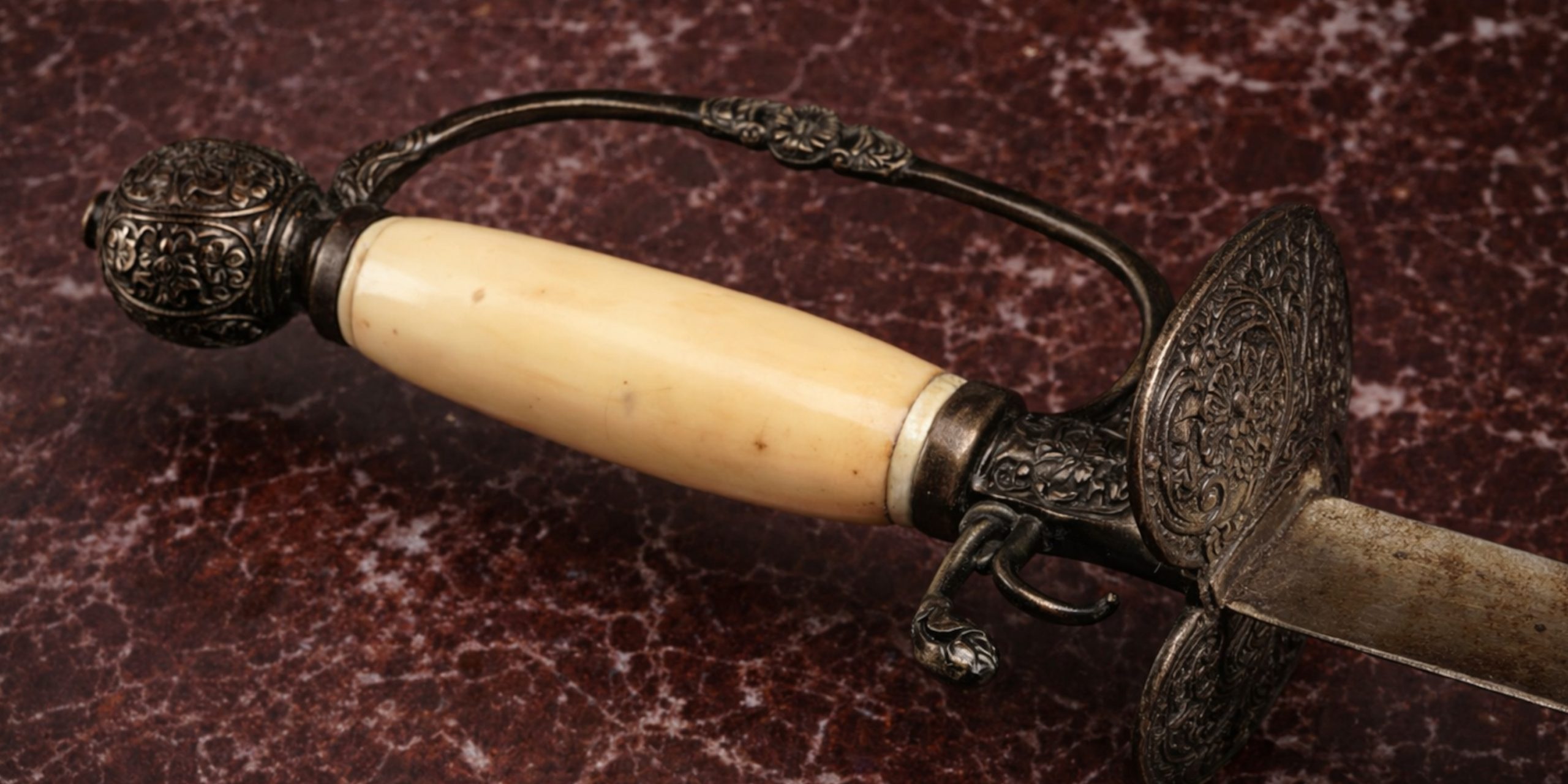
The smallsword was the quiet badge of authority in late eighteenth century America. Slim, elegant, and rarely intended for battlefield hacking, it sat at the hip of lawyers, merchants, militia officers, and politicians who wanted to signal refinement as much as readiness. An ivory gripped example sits at the upper end of that social ladder. During the American Revolution, such swords were worn by men who moved between council chambers, courts, and camp life, often trained in fencing but fully aware that the sword’s power lay as much in symbolism as steel.
Specifications
| Feature | Typical Characteristics |
|---|---|
| Overall length | 85 to 95 cm |
| Blade length | 75 to 85 cm |
| Blade type | Triangular or hollow ground smallsword blade |
| Blade material | High carbon steel, often imported from France or Solingen |
| Hilt material | Ivory grip with brass or gilt bronze mounts |
| Guard | Small shell guard or double shell |
| Pommel | Urn, globular, or faceted |
| Weight | 700 to 1,000 g |
| Scabbard | Leather or shagreen with brass fittings |
History and Evolution
The smallsword evolved in Europe during the late seventeenth century as rapiers fell out of fashion. By the mid eighteenth century it had become the dominant civilian sidearm among elites on both sides of the Atlantic. In colonial America, wealthy professionals imported finished swords from France or England, or purchased blades mounted locally by colonial cutlers.
Ivory grips gained popularity among the American elite during the Revolutionary period for several reasons. Ivory was durable, took fine carving well, and carried connotations of wealth and worldliness. While military sabres and hangers were common among enlisted men and cavalry, the smallsword remained the choice of officers off parade and gentlemen who wished to present themselves as cultured rather than brutal.
By the early nineteenth century, the smallsword faded as pistols and military sabres became more practical and fashionable. Its legacy survived in ceremonial swords and formal court dress.
Advantages and Disadvantages
Advantages
- Excellent balance and point control for thrust based fencing
- Lightweight and comfortable for daily wear
- Strong social signalling of education, rank, and refinement
- Ivory provides a secure grip and visual distinction
Disadvantages
- Limited cutting ability
- Fragile compared to heavier military swords
- Ivory is sensitive to humidity and temperature changes
- Ineffective against armoured or heavily clothed opponents
Comparison with Similar Weapons
| Weapon | Key Differences |
|---|---|
| French smallsword | Often finer finishing and lighter guards |
| English court sword | More conservative styling, plainer hilts |
| Military hanger | Shorter, heavier, designed for cutting |
| Spadroon | Transitional weapon with both cut and thrust capability |
Compared to a spadroon or hanger, the ivory gripped smallsword is clearly a civilian weapon. Its blade geometry and balance prioritise precision over force. Against continental European smallswords, American owned examples are often simpler in decoration but identical in function.
Legacy
The smallsword with ivory grip represents the intellectual face of the American Revolution. It is the sword of debates, duels of honour, and political theatre rather than massed charges. Many Founding Era portraits show leaders wearing such swords, not because they expected to fight with them daily, but because they communicated legitimacy and authority in a world that still read status through dress.
Its influence continues in modern dress swords, Masonic regalia, and diplomatic uniforms, where the silhouette remains largely unchanged.
Where to See Examples
Notable examples can be viewed in major museum collections:
- Metropolitan Museum of Art, New York
- Smithsonian National Museum of American History
- Philadelphia Museum of Art
These institutions hold late eighteenth century smallswords with ivory or bone grips, often attributed to American or Franco American ownership.
Collector’s Guide and Auction Prices
What collectors look for
- Original ivory grip with visible age patina
- Tight hilt with no modern repairs
- Period blade with correct triangular section
- Provenance linking the sword to American ownership
- Undamaged shells and pommel
Condition concerns
- Cracks or shrinkage in the ivory
- Replaced blades or later scabbards
- Over polishing that removes tool marks
Typical auction prices
| Condition and Provenance | Price Range |
|---|---|
| Plain ivory grip, no provenance | £2,000 to £4,000 |
| Decorated hilt, good condition | £4,000 to £7,000 |
| Attributed Revolutionary era owner | £8,000 to £15,000+ |
Major sales are regularly handled by auction houses such as Sotheby’s and Christie’s, where documented examples command strong interest.
Collectors should note modern restrictions on ivory sales. Documentation proving pre twentieth century origin is essential for legal ownership and resale in the UK and EU.