Few figures in early medieval legend are as compelling as Wayland the Smith. He stands at the crossroads of myth and material culture, a shadowy craftsman whose blades were said to cut through armour, fate, and occasionally their owners’ moral restraint. The so-called Seven Swords of Wayland occupy a curious place in British and wider Germanic folklore. They are not preserved as a neat medieval inventory. Instead, they emerge from poetry, saga, antiquarian enthusiasm, and modern storytelling.
As a historian, I find Wayland fascinating because he embodies a truth about the early Middle Ages. Iron was power. The man who mastered it commanded respect that bordered on fear. The swords attributed to him reflect that awe.
Who Was Wayland?
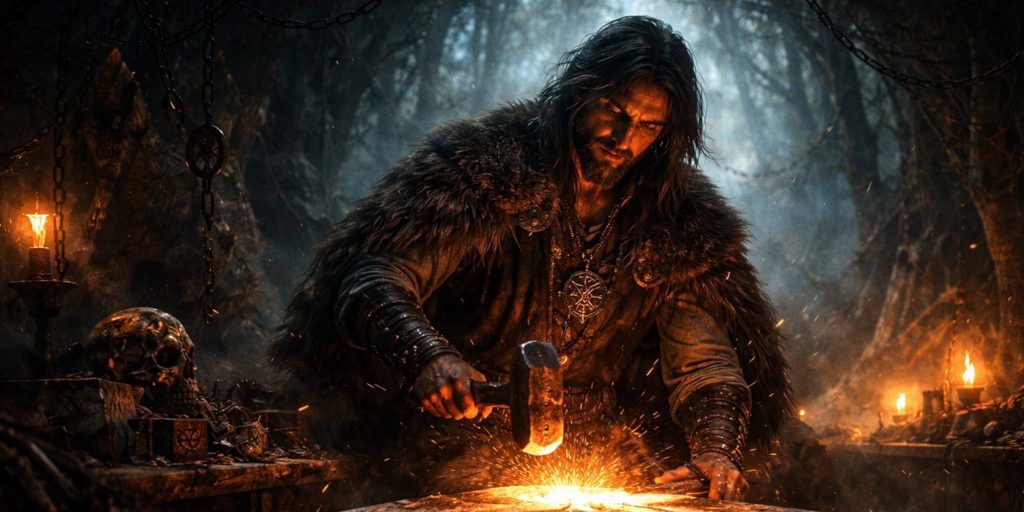
Wayland, known in Old Norse as Völundr and in Old English as Wēland, appears in the Old Norse poem Völundarkviða and in the Old English poem Deor. He is also depicted on the eighth century Franks Casket, now in the British Museum, where scenes from his legend are carved in whalebone relief.
In these accounts, Wayland is the greatest of smiths. He forges weapons and treasures of extraordinary quality. Betrayed and hamstrung by a king who seeks to control his skill, he exacts a ruthless revenge before escaping through craftsmanship of his own devising.
The legend is dark, but it preserves something valuable. The early medieval smith was not a mere tradesman. He was a figure of mystery. The ability to extract usable steel from earth and flame felt close to sorcery.
The Concept of the Seven Swords
There is no surviving early medieval manuscript listing precisely seven swords of Wayland. The concept is a later synthesis drawn from swords across Germanic heroic tradition that were attributed to his forge. Eighteenth and nineteenth century antiquarians, keen to tie folklore to landscape and epic poetry, helped shape the idea into a recognisable grouping.
Blades often linked to Wayland include weapons forged for:
- Sigmund and Sigurd in the Völsunga cycle
- Heroes of later German epics
- Kings whose swords were retrospectively granted mythic origins
What unites them is reputation. These swords are peerless in sharpness and resilience. They are sometimes broken in battle and reforged stronger. That detail is telling. It echoes real early medieval pattern welded blades, which could be repaired and reforged, and it symbolises heroic endurance.
Seven, as a number, carries symbolic weight. It suggests completeness. Whether medieval audiences thought in those terms is uncertain, but later tradition certainly did.
Wayland’s Craft in Historical Context
Between the fifth and ninth centuries, northern European sword making relied heavily on pattern welding. Iron and steel strips were twisted and forge welded together to produce blades that balanced flexibility with cutting strength.
Archaeological finds such as those from Sutton Hoo reveal blades of remarkable sophistication. Some bear inlaid inscriptions. Others show carefully constructed cores with hardened edges. These were expensive objects. A sword could be worth a small fortune and passed down through generations.
I have always thought that the myth of Wayland gains credibility when one studies these artefacts. Even corroded, they show a careful geometry and balance. A blade that held its edge and did not snap under stress would have seemed almost enchanted.
The legend of a master smith is not an embellishment of nothing. It is a cultural memory of real technological achievement.
Legendary Swords Attributed to Wayland
Among the most famous is Gram, the sword of Sigmund and later Sigurd. In the Völsunga saga it is shattered and later reforged, after which it cleaves an anvil. The image is extravagant, but it underscores the blade’s rebirth and superior temper.
Mimung, associated with later German heroic tradition, is another sword credited to Wayland. It is described as unmatched in sharpness.
In some strands of legend, royal Frankish or Lombard swords are retrospectively attributed to Wayland. This reflects a common medieval instinct. The finest weapons must have had a legendary maker.
In effect, Wayland’s name became a mark of quality.
Wayland in the English Landscape
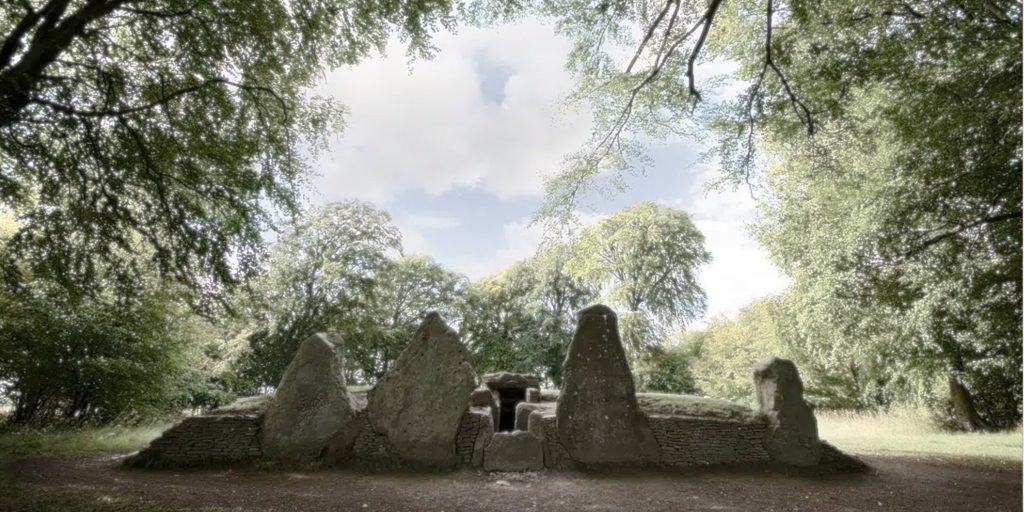
Wayland’s Smithy in Oxfordshire, a Neolithic long barrow, became associated with the legendary smith in later folklore. Travellers believed that if a horse was left there with a coin, it would be shod by morning.
The monument itself predates the Anglo Saxon period by millennia. Its association with Wayland shows how early medieval communities reinterpreted ancient sites through their own mythic lens.
Old stones invited stories. Wayland provided one.
Robin of Sherwood and the Seven Swords

The idea of the Seven Swords of Wayland reached a wide modern audience through the television series Robin of Sherwood. Broadcast in the 1980s, the series wove pagan mysticism into the Robin Hood legend and placed the swords at the centre of its mythic framework.
In the show, the swords are imbued with spiritual significance. They represent fragments of a greater whole, forged by Wayland and scattered across the land. Their recovery becomes tied to destiny and the balance between Saxon and Norman England.
This interpretation is imaginative rather than historical, yet it draws convincingly on older motifs. The series recognises Wayland as a liminal figure, rooted in pre Christian myth and connected to the land itself. It also taps into the long English tradition of associating ancient monuments, hidden blades, and lost kings with sacred geography.
As someone who studies early medieval belief systems, I appreciate the series for one reason in particular. It understands that legend is not tidy. It blends Saxon myth, Christian symbolism, and romantic nationalism in a way that feels closer to medieval storytelling than one might expect from late twentieth century television.
The Seven Swords in this adaptation are less about metallurgy and more about identity. They represent inheritance, legitimacy, and the endurance of older traditions beneath imposed authority.
The Swords in Robin of Sherwood
Flauros: A demon known for destruction and chaos.Note: The TV series borrows names from The Lesser Key of Solomon, a demonological grimoire, infusing the swords with occult gravitas.
Morax: A demon associated with wisdom and knowledge.
Solas: A spirit linked to the sun and light.
Orias: A demon connected to divination and astrology.
Albion: A name with deep roots in British mythology, symbolizing the ancient identity of England.
Elidor: A spirit tied to hidden knowledge and secrets.
Beleth: A powerful demon associated with love and passion.
The Modern Legacy
Today, Wayland’s name continues to resonate among historical enthusiasts and bladesmiths. Pattern welding has been revived by modern craftsmen seeking to recreate Migration Period techniques. The figure of Wayland appears in fantasy literature, music, and reenactment culture.
Collectors of early medieval swords occasionally invoke his name with a knowing smile. No serious historian believes a specific excavated blade was forged by a mythic smith. Yet the desire to connect an object to a legendary maker remains powerful.
It reminds us that weapons were never purely functional. They carried stories.
Takeaway
The Seven Swords of Wayland are not a fixed catalogue preserved in a single medieval source. They are a constellation of legends shaped by saga, landscape, antiquarian imagination, and modern reinterpretation.
They reflect societies that valued skill, reputation, and memory. The smith who could master iron stood close to the sacred. Wayland embodies that reverence.
Steel corrodes. Myths endure. Between the two stands the enduring image of a craftsman whose hammer still echoes in story.