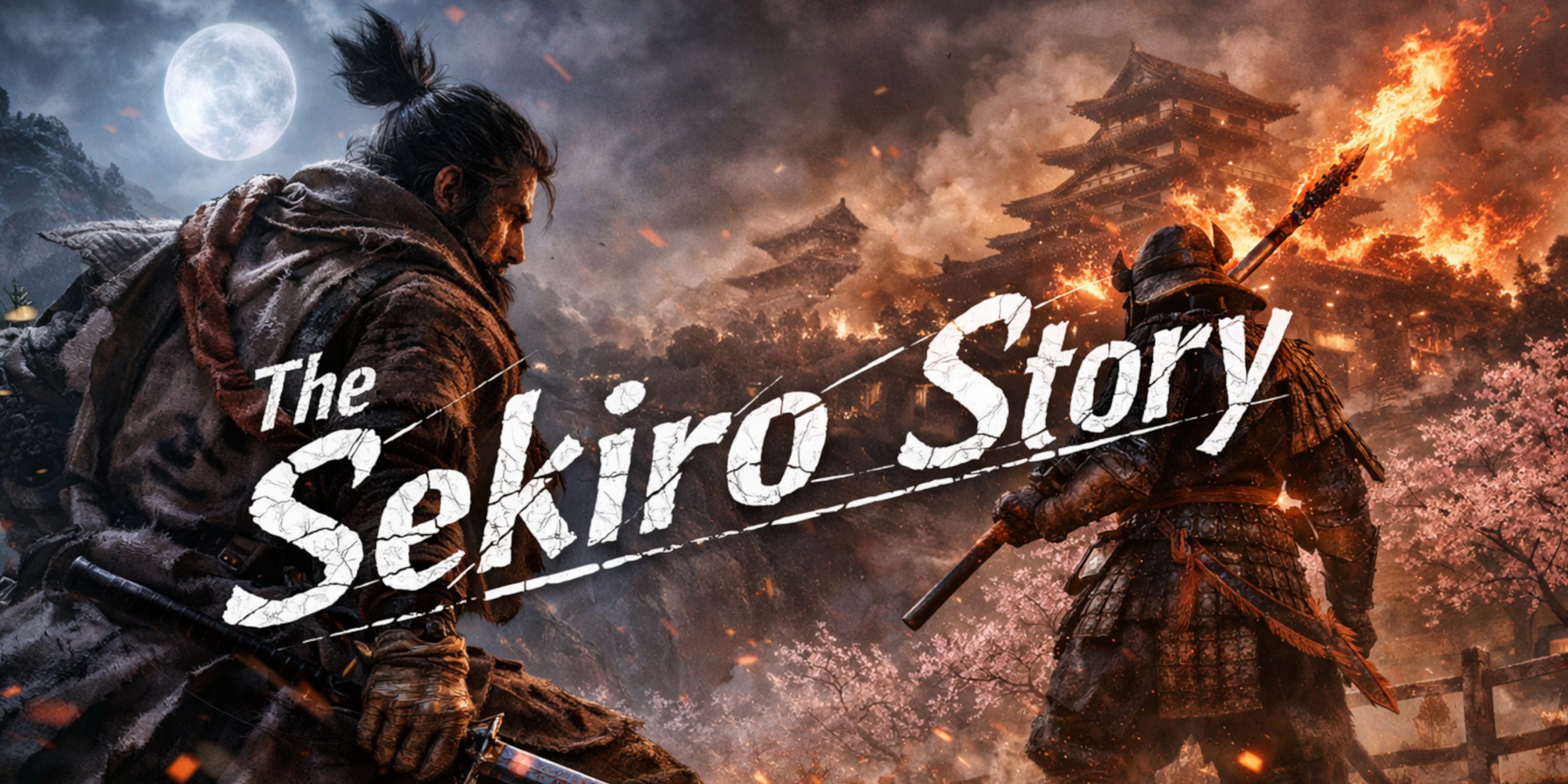
Sekiro: Shadows Die Twice throws you into a world full of giant snakes, immortal monks, angry grandpas with spears and one man so committed to ruining your day that he climbs out of his own grandson. It is brilliant, but it is also confusing.
Like most FromSoftware games, Sekiro does not hand you a tidy little plot and a cup of tea. Instead, it tosses scraps of dialogue, item descriptions and traumatised old men at you until your brain slowly assembles the story like a cursed jigsaw.
So here is the full thing, laid out clearly. No cryptic nonsense. No pretending the lore is obvious. Because frankly, after being killed by Genichiro for the seventh time, most of us were in no mood to interpret symbolism.
What Is Sekiro Actually About?
At its core, Sekiro is about loyalty.
You play as Wolf, a shinobi who serves a young lord named Kuro, known as the Divine Heir. Kuro possesses the Dragon Heritage, a mysterious power that grants immortality.
That sounds great until you realise everyone in Japan immediately decides they would quite like that power for themselves.
The game begins after Wolf has already failed. Kuro has been captured by the Ashina clan, Wolf has been left for dead, and the land of Ashina is collapsing under the weight of war, disease and desperation.
The central conflict is simple:
- Kuro wants to end the Dragon Heritage and stop immortality from spreading.
- Wolf wants to protect Kuro.
- Nearly everyone else wants to use Kuro’s power for themselves.
That includes Genichiro Ashina, Owl, the monks of Senpou Temple and, in a more complicated way, Isshin Ashina.
The Fall of Ashina
Before the events of the game, the land of Ashina was seized by Isshin Ashina during a violent rebellion.
Isshin built Ashina into a powerful state, but by the time Sekiro begins, he is old and dying. The Ministry, essentially the Japanese central government, is preparing to invade and wipe Ashina off the map.
Genichiro, Isshin’s adopted grandson, is desperate to save Ashina. He believes the only way to do that is through immortality.
That is why he kidnaps Kuro.
Genichiro is not evil in the moustache-twirling sense. He is tragic. He sees Ashina collapsing around him and thinks immortality is the only answer. Unfortunately, his solution is roughly the fantasy equivalent of setting your house on fire because the heating bill is too high.
Wolf and Kuro
Wolf was rescued as a child by Owl, a shinobi master. Owl raised him according to the Iron Code, a strict set of rules that places obedience above everything else.
One of those rules is simple:
The parent is absolute.
Wolf eventually becomes the sworn protector of Kuro.
Unlike Owl, Kuro treats Wolf with kindness and genuine trust. Their relationship becomes the emotional centre of the game.
Kuro does not want immortality. He sees what it has done to Ashina. People are becoming obsessed, corrupted and twisted by the desire to live forever.
By the middle of the story, Kuro decides the Dragon Heritage must be severed permanently.
Wolf agrees, even though doing so may cost both of them everything.
What Is the Dragon Heritage?
The Dragon Heritage comes from the Divine Dragon, a supernatural being that originated in the West and eventually came to Ashina.
Its blood grants immortality to certain people, particularly Kuro.
Anyone bound to the Divine Heir can return from death. That is why Wolf keeps resurrecting every time a boss turns him into a shinobi-shaped smear on the floor.
There is a catch.
Repeated resurrection spreads Dragonrot, a disease that weakens and eventually kills other people. Every time Wolf cheats death, someone else suffers.
It is a classic FromSoftware bit of storytelling. You get an amazing power, but it quietly ruins everyone around you. Very relatable, honestly.
Genichiro’s Role in the Story
Genichiro is the first major antagonist and probably the most misunderstood character in Sekiro.
He is trying to protect Ashina from destruction. He genuinely believes that Kuro’s immortality can save his homeland.
After defeating Wolf at the start of the game, Genichiro cuts off Wolf’s arm and imprisons Kuro. Wolf later escapes, gains the prosthetic arm from the Sculptor, and returns to rescue him.
When Wolf finally defeats Genichiro atop Ashina Castle, Genichiro still refuses to give up.
He drinks the Rejuvenating Waters, another twisted form of immortality created in Ashina. Unlike the Dragon Heritage, these waters corrupt people, turning them into monstrous and unstable versions of themselves.
Genichiro spends the rest of the game chasing power more and more desperately, until he finally sacrifices himself to bring Isshin back from the dead.
Which is perhaps the most dramatic way possible of saying, “Grandad, please sort this out.”
The Sculptor and the Demon of Hatred
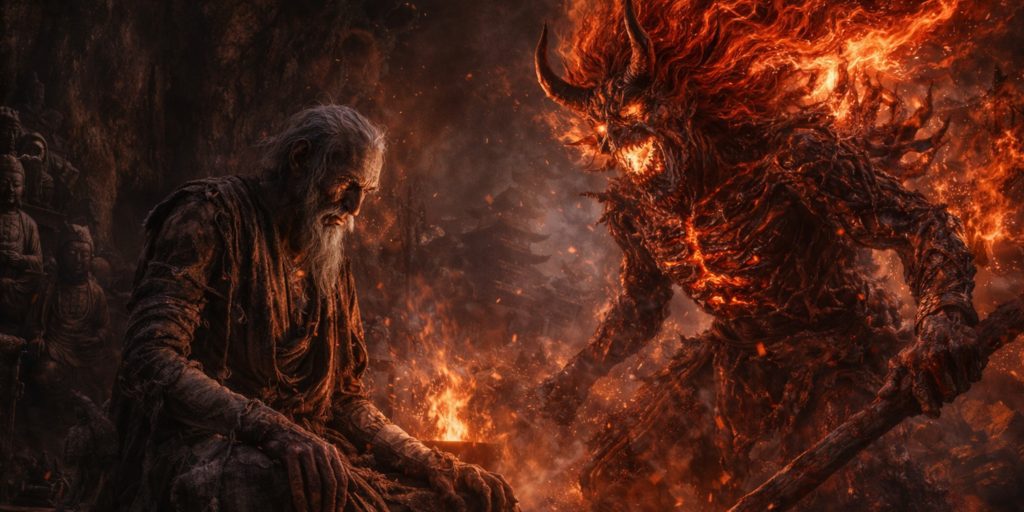
The Sculptor seems like a quiet, slightly grumpy old man who carves Buddha statues and gives you useful advice.
Naturally, this being a FromSoftware game, he is hiding several layers of misery.
The Sculptor was once a shinobi known as Orangutan. Like Wolf, he was consumed by violence and killing. Eventually he came close to becoming a Shura.
A Shura is someone who becomes so addicted to slaughter that they lose their humanity entirely.
Isshin stopped the Sculptor years ago by cutting off his arm.
Throughout the game, the Sculptor fears he will become a monster again. If you complete certain story events, he eventually transforms into the Demon of Hatred.
The Demon is not just another boss. It is the result of all the anger, regret and violence that Sekiro’s world creates.
It also happens to be one of the few bosses in the game that seems personally offended by your existence.
Owl’s Betrayal
Halfway through the story, Wolf returns to Ashina Castle and finds Owl waiting for him.
Owl reveals he never cared about Wolf or Kuro. He only wants the Dragon Heritage for himself.
He orders Wolf to obey the Iron Code and abandon Kuro.
This is the biggest decision in the game.
You can:
- Obey Owl and betray Kuro.
- Reject Owl and remain loyal to Kuro.
If you obey Owl, you enter the Shura ending.
If you reject him, the rest of the game continues.
This choice matters because it is really the moment Wolf stops being a weapon and becomes his own person.
For most of the game, Wolf follows orders because that is all he has ever known. Rejecting Owl is the first truly human decision he makes.
The Shura Ending Explained
If Wolf sides with Owl, he kills Emma and Isshin.
Then he becomes Shura.
The ending implies Wolf goes on a rampage and becomes a monster consumed by endless violence.
It is the darkest ending in the game.
The whole thing feels less like a victory and more like watching somebody throw away the last bit of themselves they had left. Also, if you pick this ending accidentally because you were not paying attention, the game has absolutely no sympathy for you.
The Three Main Endings
If you stay loyal to Kuro, there are three possible endings.
Immortal Severance Ending
This is the standard ending.
Wolf defeats Genichiro and then fights Isshin, who has been resurrected in his prime.
After defeating Isshin, Wolf uses the Mortal Blade to sever Kuro’s immortality.
Kuro dies peacefully.
Wolf survives, but becomes the new Sculptor, living alone in the ruined temple.
It is a melancholy ending. The cycle ends, but the cost is heavy.
Purification Ending
In this ending, Wolf learns that he can save Kuro by sacrificing himself instead.
After defeating Isshin, Wolf uses the Mortal Blade on himself and dies.
Kuro survives.
This is arguably the most emotional ending because Wolf finally chooses his own path completely. He is no longer following Owl’s code or simply obeying orders. He gives his life willingly to protect the one person who treated him like more than a tool.
Return Ending
The Return ending is the most hopeful and also the most complicated.
By working with the Divine Child of Rejuvenation, Wolf discovers that the Dragon Heritage came from the West and can perhaps be returned to where it belongs.
Instead of simply destroying the Dragon Heritage, Wolf and the Divine Child set out on a journey to return it.
Kuro survives inside the Divine Child, and Wolf accompanies her westward.
This ending feels like the beginning of a new story. It leaves the door open for a sequel, although FromSoftware being FromSoftware, they would probably make that sequel even stranger.
Why Does Isshin Fight You?
This is one of the most common questions.
Isshin actually respects Wolf and does not really want Kuro’s power.
When Genichiro resurrects Isshin, he does so using a ritual tied to his final wish. Isshin is effectively forced to fight Wolf.
At the same time, Isshin is a warrior to his core. He sees Wolf as the strongest opponent he could possibly face.
So even though he understands Wolf’s mission, he still fights him.
Honestly, if you spent your entire life becoming the greatest swordsman in Japan and then somebody gave you one final duel at the end of your life, you would probably at least consider it.
Who Is the Divine Dragon?
The Divine Dragon is one of the strangest and most important figures in Sekiro.
It is the original source of the Dragon Heritage.
The dragon appears in the Fountainhead Palace, a beautiful but deeply unsettling place where immortality has warped everything.
The nobles there have become pale, twisted creatures obsessed with preserving themselves forever.
The palace is essentially the game showing you what happens when people cling to immortality for too long. Nobody is happy. Everyone looks damp and haunted.
Wolf defeats the Divine Dragon, not to kill it, but to obtain its tears.
Those tears are needed to end the Dragon Heritage.
Sekiro’s Story Themes
Sekiro is really about three things:
- Loyalty
- Identity
- Letting go
Nearly every character fails because they cannot let go.
- Genichiro cannot let go of Ashina.
- Owl cannot let go of power.
- The Sculptor cannot let go of violence.
- The monks cannot let go of immortality.
Wolf is different because, depending on the ending, he learns to choose something for himself.
That is why the story works so well. Beneath all the sword fights and screaming monkeys, it is surprisingly personal.
Wolf starts the game as a weapon. By the end, he becomes a person.
Seven Swords Takeaway
Sekiro’s story can seem confusing at first because it is told in fragments. But once you put those fragments together, it becomes one of FromSoftware’s strongest stories.
It is smaller and more emotional than Dark Souls or Elden Ring. The focus stays tightly on Wolf, Kuro and the people around them.
Underneath all the monsters and myth, it is really a story about someone learning that loyalty is not the same thing as obedience.
Also, it is a story where an old man climbs out of another man and immediately challenges you to a sword fight in a thunderstorm.
Which, somehow, makes perfect sense by the end.