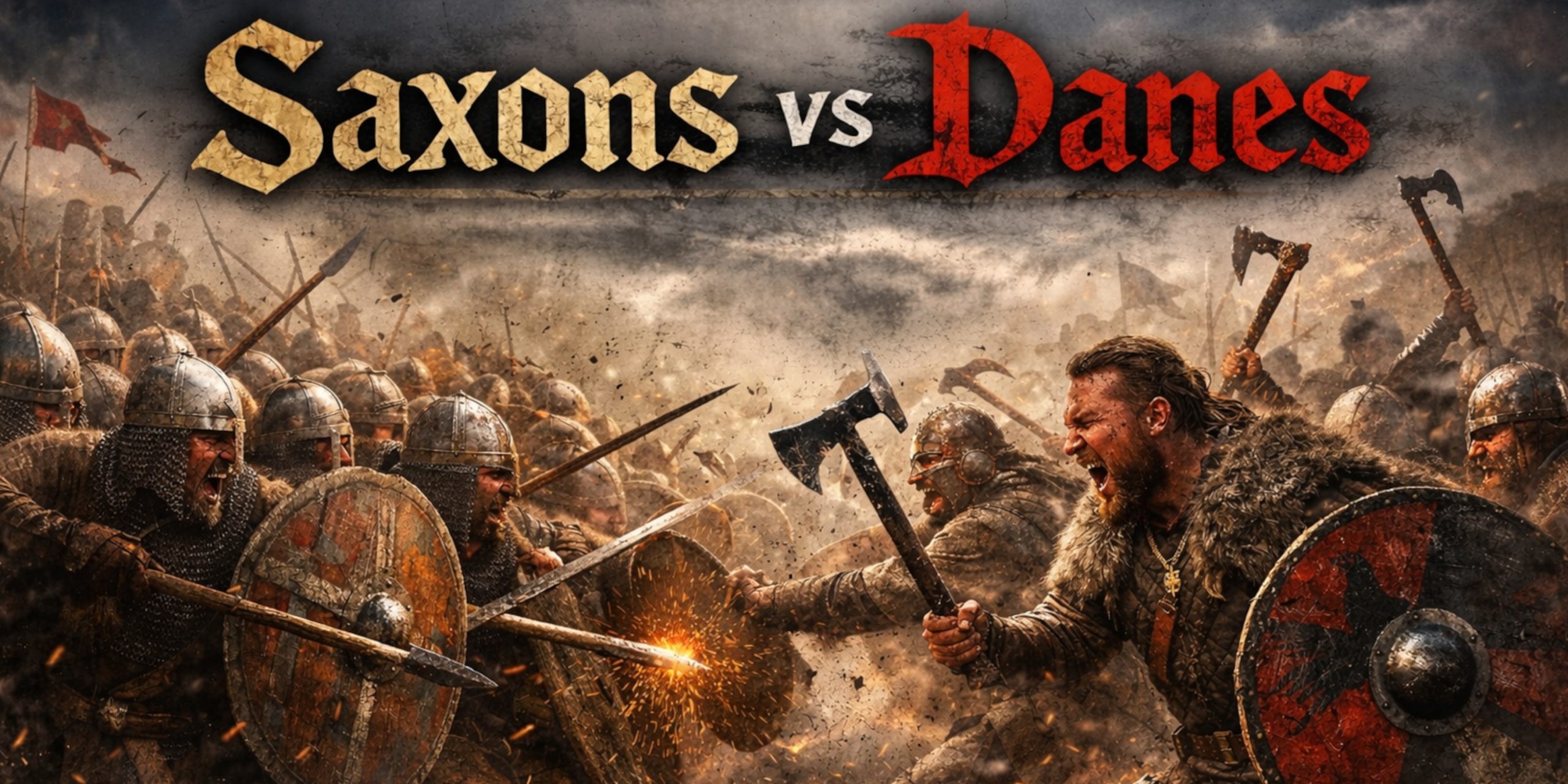
Few rivalries in historical drama feel as raw and personal as the clash between Saxons and Danes in The Last Kingdom. It is not just armies colliding. It is belief systems, family loyalties, and entire ways of life grinding against each other in mud, blood, and ambition.
The series paints both sides with sympathy and steel. But when it comes down to power, momentum, and long term survival, who really held the advantage?
Let us break it down properly.
Political Stability: Wessex vs the Great Heathen Army
On paper, the Saxons should have been overwhelmed. The Danes arrived as hardened warriors from Scandinavia, driven by plunder, land hunger, and a refusal to be told no. The so called Great Heathen Army was aggressive, mobile, and ruthless.
But then there was Alfred the Great.
In the show, Alfred is frustrating, calculating, sometimes exhausting to watch. Yet he understands something the Danes struggle with. Stability wins wars. Not always quickly. Not always cleanly. But eventually.
The Saxons, especially Wessex, operate with:
- Centralised leadership
- Administrative structure
- A vision of a unified England
- Defensive depth
The Danes, by contrast, are powerful but fragmented. Leaders rise and fall quickly. Alliances shift. Ambition often overrides strategy.
Edge here goes to the Saxons, narrowly. Long term thinking beats constant internal rivalry.
Battlefield Tactics and Combat Style
Both sides rely heavily on the shield wall. It is brutal, claustrophobic warfare. No cinematic spinning here. Just pushing, stabbing, and hoping the man beside you does not panic.
The Danes often appear more ferocious in close combat. They fight with raw aggression and personal bravado. Leaders like Ragnar Ragnarsson and Ubba embody that physical dominance.
The Saxons, however, improve as the series progresses. They become more disciplined. They learn from defeat. Under Alfred’s influence, they build fortified burhs and choose defensive engagements wisely.
If you judge purely on individual warrior ferocity, the Danes probably take it. If you judge on sustained military development, the Saxons adapt faster.
That adaptability matters.
Cultural Cohesion and Identity
This is where things get interesting.
The Danes in the series feel alive. Their halls are loud. Their loyalties are personal. Honour is immediate and visceral. Watching their culture unfold is compelling. It feels bold and unfiltered.
The Saxons, meanwhile, are rigid, devout, and politically cautious. Faith dominates their worldview. Christianity shapes law, marriage, and kingship.
Yet cohesion is not about excitement. It is about endurance.
Alfred’s dream of a single England creates a unifying myth. It gives people something larger than clan or loot. Over time, that shared idea becomes stronger than any individual warlord.
So culturally, the Danes feel freer. Strategically, the Saxons feel more sustainable.
Leadership: Charisma vs Calculation
The Danes are stacked with magnetic figures. Ubba is terrifying. Ragnar is noble and intense. Later, characters like Cnut bring cunning into the mix.
But the Saxons have Alfred. And Alfred is a headache in human form, yet also a visionary. He sees England before it exists.
Leadership in the series is not about who shouts loudest. It is about who survives long enough to reshape the map.
By that measure, the Saxons win again.
The Uhtred Factor
You cannot discuss this rivalry without Uhtred of Bebbanburg.
Uhtred is the living embodiment of the conflict. Saxon by birth, Dane by upbringing. He exposes the strengths and weaknesses of both worlds.
Through him, the series quietly suggests something important. The edge does not belong fully to either side. It belongs to those who adapt, who understand both cultures, who refuse to be trapped by rigid identity.
In that sense, the ultimate advantage lies with hybridity.
So Who Really Had the Edge?
If we judge by early dominance and battlefield ferocity, the Danes look unstoppable.
If we judge by long term political survival and eventual unification, the Saxons hold the real advantage.
The show ultimately sides with historical reality. Wessex survives. England forms. The Danish presence reshapes the island, but it does not replace it.
The truth is less dramatic than a single decisive winner. The Danes had the edge in momentum. The Saxons had the edge in endurance.
And endurance wins history.
Final Verdict
The series refuses to reduce the conflict to heroes and villains. Both sides are flawed. Both sides are compelling.
If you are watching with pure adrenaline in mind, you probably lean Dane. If you are watching with a historian’s eye, you recognise Alfred’s slow grind as the real power move.
In the end, the edge belonged to whoever understood that survival was not about glory. It was about patience.
And that is a lesson that still lands today.