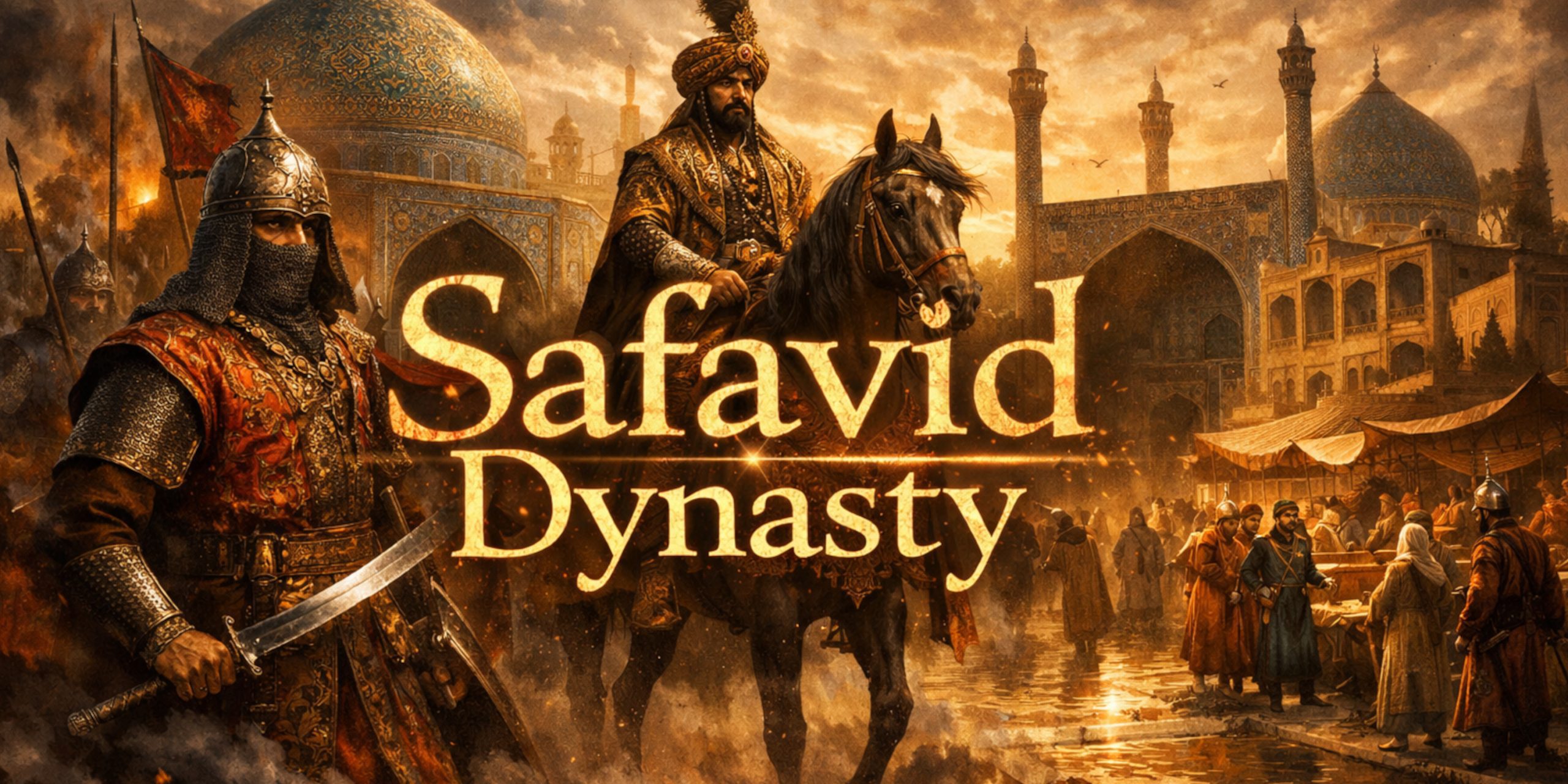
The Safavid dynasty ruled Persia from 1501 to 1736 and, in many ways, created the Iran that still exists today. Before the Safavids, Persia was fragmented, fought over by rival dynasties, tribal confederations and rather too many ambitious men with horses and opinions. By the time the dynasty collapsed, Persia had become a centralised state with a distinct identity, a flourishing artistic culture and a powerful religious foundation.
The Safavids are often remembered for silk, turquoise domes and beautifully painted manuscripts. All very lovely, of course. Yet they were also fierce empire-builders who spent much of their existence fighting the Ottomans, the Uzbeks and occasionally one another. The dynasty produced rulers of remarkable energy and intelligence, along with a few who appear to have regarded government as an unfortunate interruption to wine, hunting and palace intrigue.
The Origins of the Safavid Dynasty
The dynasty began with the Safavid order, a Sufi religious brotherhood founded in the fourteenth century in Ardabil, in north-western Persia. Its founder, Safi al-Din of Ardabil, was not a king, a conqueror or even particularly interested in creating an empire. He was a mystic whose followers gradually transformed his religious order into a political and military movement.
Over time, the Safavid family became increasingly influential. By the late fifteenth century, the order had attracted large numbers of Turkic tribal followers known as the Qizilbash. They were fiercely loyal, highly militant and wore distinctive red headgear with twelve folds to symbolise the Twelve Imams of Shi’a Islam. Their enemies could generally identify them from quite a distance away, which was helpful if one wished to flee in the opposite direction.
The crucial figure was Ismail, later Shah Ismail I. Born in 1487, he inherited both the spiritual leadership of the Safavid order and the ambitions of his ancestors. At just fourteen years old, he marched into Persia at the head of the Qizilbash. In 1501 he captured Tabriz and declared himself shah.
With that, the Safavid dynasty began.
Shah Ismail I and the Creation of the Empire
Shah Ismail I ruled from 1501 to 1524. He was charismatic, ruthless and astonishingly successful in his early years. He united much of Persia under his authority and established Twelver Shi’ism as the official religion of the state.
This decision changed Persian history permanently.
Before Ismail, most Persians were Sunni Muslims. By enforcing Shi’a Islam across the kingdom, Ismail gave Persia a distinct identity that separated it from its great rival, the Ottoman Empire, which was staunchly Sunni. The change was often brutal. Sunni scholars were removed, mosques were altered and Shi’a clerics were brought in from regions such as Lebanon and Iraq.
The religious transformation was neither quick nor gentle. Yet it succeeded. Persia became the centre of Shi’a Islam, and Iran remains predominantly Shi’a to this day.
Ismail’s military success, however, eventually met its limit. In 1514 he fought the Ottomans under Sultan Selim I at the Battle of Chaldiran.
The Battle of Chaldiran
The Battle of Chaldiran was one of the defining moments of Safavid history. Shah Ismail’s forces, brave and highly mobile though they were, relied heavily on cavalry and traditional warfare. The Ottomans brought artillery and firearms.
It was not a fair contest.
The Safavids were defeated decisively. Ottoman cannon shattered repeated Qizilbash charges, and the battle exposed the dangers of relying on courage alone when the enemy has gunpowder and several large cannons pointed directly at you.
The defeat had profound consequences:
- The Safavids lost territory in eastern Anatolia and Mesopotamia.
- Shah Ismail’s aura of invincibility was broken.
- The dynasty began to modernise its army.
- The long Safavid-Ottoman rivalry became a permanent feature of Middle Eastern politics.
After Chaldiran, Ismail withdrew from active government and seems to have become increasingly melancholy. One can hardly blame him. It is difficult to maintain the image of a divinely favoured conqueror after being thoroughly outgunned.
The Safavid State and Government
The Safavid Empire was ruled by the shah, who held almost absolute authority. In theory, the shah was both a political ruler and a divinely favoured leader. In practice, the quality of government depended heavily on whether the reigning shah was competent.
The empire was divided into provinces governed by officials appointed by the crown. These governors collected taxes, kept order and ensured that the shah’s authority extended across the kingdom.
The Safavid administration combined Persian bureaucratic traditions with Turkic military structures. Persian officials often managed finance and government, while the Qizilbash dominated the military.
This arrangement worked reasonably well, although it also created tension. The Qizilbash tribal leaders expected influence and rewards, while the shahs increasingly wanted to centralise power.
Later rulers attempted to weaken the Qizilbash by creating a new class of royal servants and soldiers called the ghulams. These were often enslaved or captured youths from the Caucasus, especially Georgians, Armenians and Circassians, who were trained to serve the shah directly.
The system resembled the Ottoman Janissaries, though with a distinctly Persian flavour.
Shah Abbas I: The Greatest Safavid Ruler
If one Safavid ruler deserves the title of great, it is Shah Abbas I, who ruled from 1588 to 1629.
When Abbas came to power, the empire was in serious trouble. The Ottomans had seized territory in the west, the Uzbeks threatened the east and the Qizilbash were behaving rather too much like independent warlords.
Abbas changed everything.
He reformed the army, strengthened central government and built one of the most impressive capitals in the Islamic world. He created a standing army equipped with muskets and artillery, recruited more ghulams and reduced the power of the Qizilbash.
Militarily, Abbas was highly successful. He defeated the Uzbeks, recaptured territory from the Ottomans and took Baghdad for a time. He also expelled the Portuguese from the island of Hormuz in 1622 with the help of the English East India Company. Few episodes illustrate the strange alliances of early modern politics better than an English trading company helping a Persian shah remove the Portuguese from the Persian Gulf.
Isfahan: The Jewel of the Safavid Empire
Shah Abbas moved the capital to Isfahan in 1598, and the city became the great showpiece of the dynasty.
There is an old Persian saying: “Isfahan is half the world.” After visiting the city in its Safavid heyday, one begins to suspect that the people of Isfahan considered themselves the better half.
Under Abbas, Isfahan was transformed into a magnificent capital filled with:
- Vast squares and avenues
- Mosques with turquoise domes and intricate tilework
- Palaces and gardens
- Bridges over the Zayandeh River
- Markets and caravanserais
The centrepiece was Naqsh-e Jahan Square, one of the largest public squares in the world. Around it stood the Shah Mosque, the Sheikh Lotfollah Mosque, the Ali Qapu Palace and the great bazaar.
The architecture of the Safavid period is among the most beautiful ever produced in Persia. The tilework glows with deep blue and gold. The calligraphy flows across walls with extraordinary elegance. Even the ceilings seem to have been designed by someone determined to prove that gravity was merely a suggestion.
Religion and Shi’a Identity
The Safavids made Shi’a Islam the heart of the state. Religious scholars gained great influence, and the dynasty sponsored shrines, mosques and schools.
The shahs portrayed themselves as defenders of the faith, though some were more convincing than others. Shah Ismail was revered almost as a messianic figure. Shah Abbas presented himself as a pious ruler while also maintaining an energetic interest in politics, warfare and the occasional ruthless execution.
The Safavid period saw the development of major Shi’a institutions and traditions. Pilgrimage to shrines became increasingly important, particularly to places such as Mashhad.
This religious policy also deepened hostility with the Ottoman Empire. The rivalry between the two states was political, territorial and theological all at once.
Society and Daily Life
Safavid Persia was a diverse and complicated society.
The population included Persians, Azeris, Kurds, Armenians, Georgians, Arabs and many others. Cities such as Isfahan, Tabriz and Shiraz were thriving centres of trade and culture.
Most people, however, lived in villages and worked on the land. Farmers grew wheat, barley, rice, fruit and cotton. Life for ordinary people could be difficult. Taxes were heavy, harvests uncertain and warfare had an unfortunate tendency to arrive without warning.
Women in Safavid Persia occupied a more varied position than is sometimes assumed. Elite women at court could wield considerable influence behind the scenes. Some owned property, sponsored religious buildings or took part in politics.
Yet public life remained dominated by men. The chroniclers, almost all male, are rather frustratingly inclined to write several pages about a courtier’s horse and then only a sentence or two about an intelligent and politically important woman.
Trade, Silk and the Persian Economy
The Safavid Empire occupied a strategic position between Europe, India and Central Asia. Trade became one of the foundations of its wealth.
Silk was the empire’s most valuable export. Persian silk was sold across Europe and Asia, and Shah Abbas worked hard to control and profit from the trade.
The Safavids also traded:
- Carpets
- Ceramics
- Spices
- Horses
- Precious metals
- Textiles
European merchants arrived in increasing numbers, including the English, Dutch and Portuguese. Armenian merchants, particularly those settled in New Julfa near Isfahan, became extremely important in international trade.
The famous Persian carpets of the Safavid era remain some of the finest ever made. Their patterns are intricate, elegant and remarkably sophisticated. Looking at one is rather like being politely informed that your own decorating efforts are hopelessly inadequate.
Art and Culture
The Safavid period was a golden age of Persian art.
Painting, calligraphy, architecture, poetry and craftsmanship all flourished. The royal workshops produced illuminated manuscripts of extraordinary beauty.
Safavid miniature painting reached its height under artists such as Reza Abbasi. These paintings are delicate, colourful and full of detail. They capture scenes from court life, literature and everyday existence.
Persian literature also thrived. Poets continued to draw on the traditions of Ferdowsi, Hafez and Saadi. Court patronage supported writers, scholars and artists.
Music and gardens were central parts of elite life. The Persian garden, with its geometric design and flowing water, became an expression of order and paradise.
The Safavids had a particular talent for creating beauty in the middle of political chaos. One moment the empire was at war with half its neighbours. The next, someone was calmly producing a carpet of breathtaking elegance.
The Safavid Military
The Safavid army evolved significantly over time.
Early Safavid power depended on the Qizilbash cavalry. They were brave, mobile and fiercely loyal, but they were also tribal and difficult to control.
After the disaster at Chaldiran, later shahs, especially Abbas I, modernised the army. The new military included:
- Qizilbash cavalry
- Ghulam troops
- Musketeers
- Artillery units
The Safavid army became more disciplined and more capable of fighting the Ottomans on equal terms.
Arms and Armour
Safavid soldiers and nobles were equipped with some of the finest weapons in the Islamic world.
Common weapons included:
- Curved shamshir swords, famous for their elegant blades and excellent cutting ability
- Straight swords and older Persian forms in the early period
- Spears and lances
- Composite bows
- Maces and axes
- Matchlock muskets
Armour often included:
- Mail coats
- Lamellar armour
- Steel helmets with nasal guards
- Shields made from hide or steel
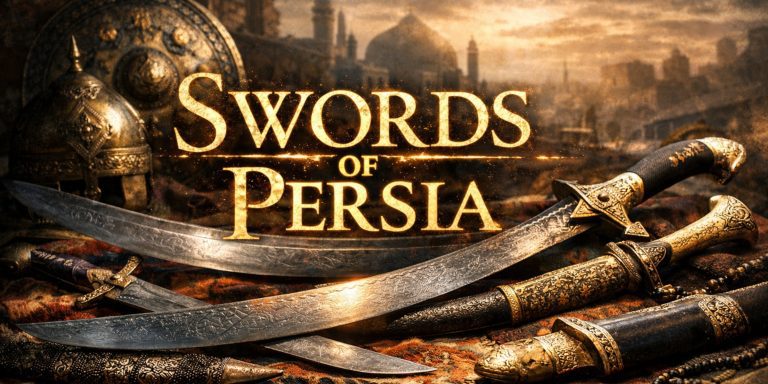
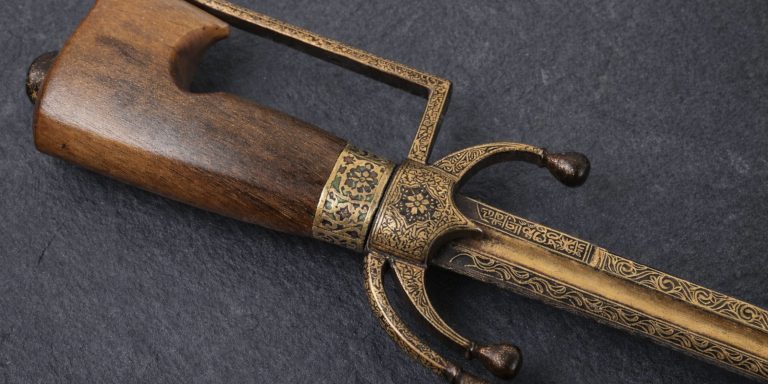
The shamshir became the iconic Safavid weapon. Its deeply curved blade was superb for mounted combat. Many surviving examples are richly decorated with gold inlay and inscriptions.
entity[“product”,”Shamshir”] became not only a weapon but also a symbol of Persian identity and craftsmanship.
Relations with Europe
The Safavids maintained extensive contact with Europe.
European travellers visited Persia and left fascinating accounts. Many were astonished by the splendour of Isfahan and the sophistication of Persian culture.
The shahs also sought alliances with European powers against the Ottomans. There were diplomatic exchanges with England, Spain, Venice and other states.
These relationships were often awkward and occasionally rather hopeful. European rulers liked the idea of Persia attacking the Ottomans from the east. Persia liked the idea of European powers attacking the Ottomans from the west. Unfortunately, both sides often waited for the other to do the difficult part.
Decline of the Safavid Dynasty
After the death of Shah Abbas I, the dynasty gradually weakened.
Later shahs were often less capable and increasingly dependent on court favourites, eunuchs and palace intrigue. The government became less effective, the army deteriorated and corruption spread.
The empire also faced economic difficulties. Trade routes shifted, silk revenues declined and warfare drained resources.
By the early eighteenth century, the Safavid state was dangerously fragile.
In 1722, Afghan forces led by Mahmud Hotak invaded Persia and captured Isfahan. The last effective Safavid ruler was overthrown.
Although members of the dynasty briefly returned to the throne, real power soon passed to Nader Shah, who formally ended the Safavid dynasty in 1736.
The end was rather sad for a dynasty that had once seemed so powerful. Yet many great empires collapse not with a dramatic final battle, but with a long, weary slide into incompetence.
Legacy of the Safavid Dynasty
The Safavids left a lasting mark on Persian and Middle Eastern history.
Their greatest achievements include:
- Uniting Persia as a coherent state
- Establishing Shi’a Islam as the dominant religion
- Creating a strong Persian identity
- Producing extraordinary art and architecture
- Making Isfahan one of the great cities of the early modern world
Modern Iran owes much to the Safavid period. The country’s religious identity, political boundaries and cultural traditions were all shaped by the dynasty.
As a historian, I find the Safavids endlessly fascinating because they contain so many contradictions. They were deeply religious but often ruthlessly pragmatic. They created some of the world’s finest art while spending much of their history fighting wars. They built exquisite gardens and mosques, then filled their court with plots, rivalries and enough intrigue to keep several playwrights employed for decades.