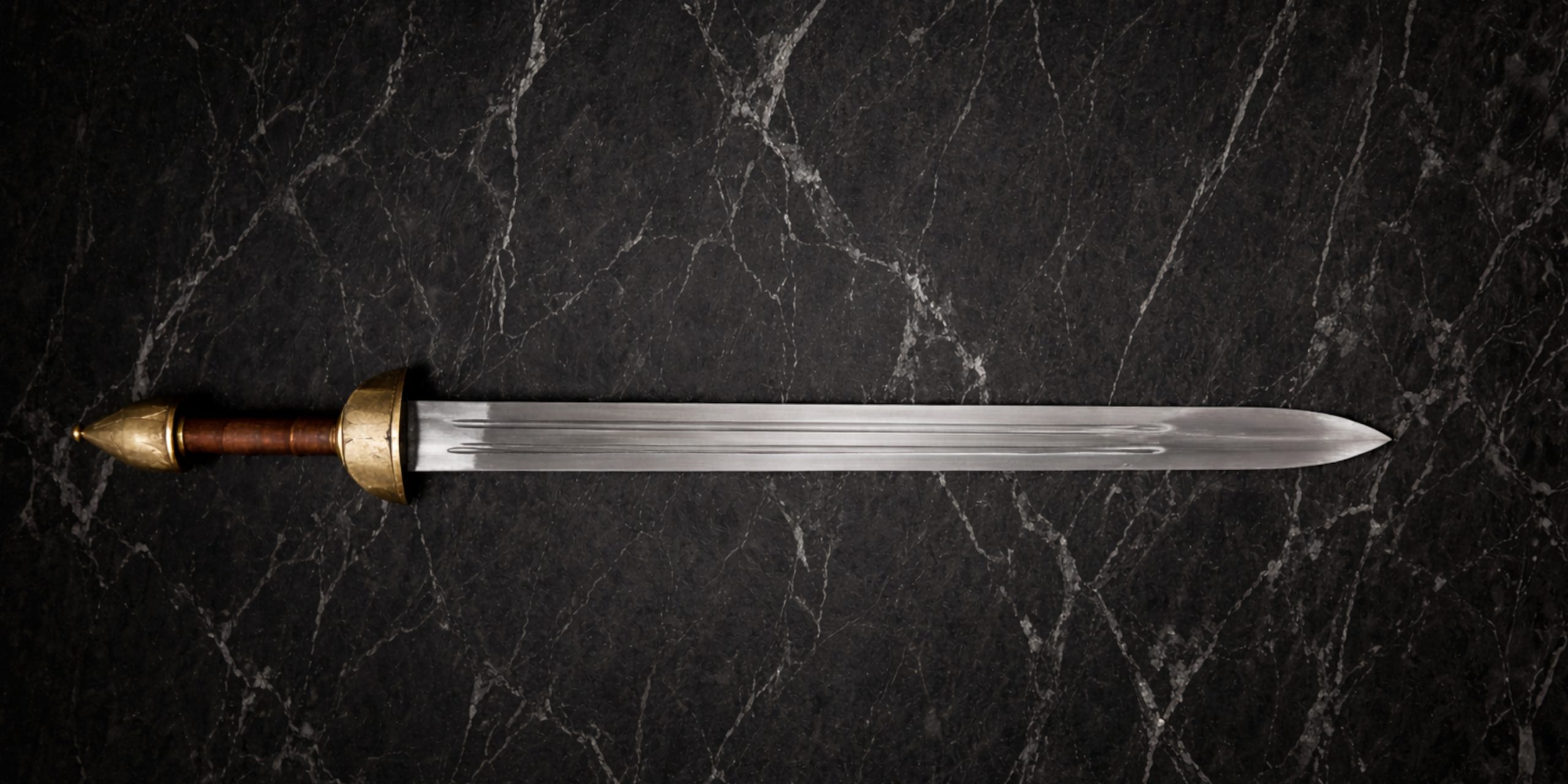
The Roman spatha marks a clear turning point in Roman military equipment. Longer than the gladius and better suited to a changing battlefield, it reflects a shift away from rigid close order combat toward more mobile and flexible fighting.
When described as a Hispanic variant, the term does not refer to a single official pattern. Instead, it covers spathae found in Roman Spain or associated with Hispania through garrisons, workshops, or later museum collections. These swords fit comfortably within wider imperial standards while showing how Spain remained tightly connected to Roman military supply and culture.
Specifications
Roman spathae vary by date and role, but the following ranges reflect commonly recorded examples.
Typical dimensions
| Feature | Common range |
|---|---|
| Blade length | 60 to 75 cm |
| Overall length | 75 to 100 cm |
| Blade width | 4 to 6 cm |
| Weight | 700 g to 1.2 kg |
| Edges | Double edged |
| Profile | Straight blade with moderate taper |
| Point | Acute, suited for thrusting |
Construction notes
- Iron blades, sometimes pattern welded in later periods
- Organic grips of wood or bone, rarely surviving intact
- Tang construction rather than full metal hilts
- Scabbards typically of wood with leather covering and metal fittings
History and evolution
Origins
The spatha entered Roman service during the early Imperial period, influenced by longer bladed Celtic swords already familiar to auxiliary troops. Initially associated with cavalry, its reach proved valuable from horseback and against longer enemy weapons.
Transition to standard issue
By the 3rd century AD, the spatha increasingly replaced the gladius among infantry. Roman warfare had become more fluid, especially along frontier zones, and the longer blade offered practical advantages in looser formations.
Hispania in context
In Roman Spain, spathae recovered or preserved in collections align closely with recognised imperial forms. Rather than representing a unique Spanish design, Hispania illustrates how Roman military equipment circulated efficiently across provinces, even far from Rome itself.
Advantages and disadvantages
Advantages
- Greater reach than the gladius
- Effective for both cutting and thrusting
- Well suited to cavalry and mixed troop roles
- Generally balanced despite increased length
Disadvantages
- Less convenient in dense shield wall fighting
- Longer blade can be awkward in confined spaces
- Surviving examples often heavily corroded
- Provenance issues common in older collections
Comparison with similar weapons
| Weapon | Blade length | Strengths | Limitations |
|---|---|---|---|
| Gladius | 45 to 52 cm | Excellent thrusting in close order | Limited reach |
| Spatha | 60 to 75 cm | Versatile, longer reach | Slightly slower in tight combat |
| Late Roman and early medieval swords | 70 cm and above | Builds on spatha design | Typology becomes less clear |
Legacy
The spatha forms the backbone of later European sword development. Its proportions and handling directly influence post Roman and early medieval swords, making it one of the most important transitional weapons in Western military history.
In Hispania, the spatha sits within a long continuum of Roman material culture that continues to shape Iberian arms into late antiquity and beyond.
Where to see examples
Roman spathae associated with Hispania can be found in several Spanish municipal and regional museums, including:
- Archaeological museums in Córdoba province
- Local historical museums in Andalusia
- Regional archaeological collections in eastern Spain
Most examples are displayed as part of broader Roman military or provincial exhibits rather than dedicated sword galleries.
Collector’s guide
Authenticity checks
- Expect heavy corrosion and mineralisation
- Organic hilts are usually fragmentary or reconstructed
- Blade profiles should match known Roman proportions
- Be cautious of overly clean or symmetrical examples
Provenance considerations
- Documentation is critical
- Older collections often lack excavation context
- Export and ownership paperwork should be clear and complete
Legal and ethical notes
- Cultural property laws vary by country
- Spanish and EU export regulations can apply
- Buyers are responsible for ensuring legal ownership
Auction prices and market value
Typical price ranges
| Condition and provenance | Expected price range |
|---|---|
| Poor condition, weak documentation | £2,000 to £4,000 |
| Average condition, reputable sale | £4,000 to £8,000 |
| Strong provenance, high profile auction | £8,000 to £15,000+ |
Prices fluctuate based on condition, completeness, documentation, and auction venue. High end results usually reflect confidence in authenticity rather than visual appeal alone.
Summary
The Roman spatha associated with Hispania is not a regional curiosity but a provincial reflection of a wider imperial shift in warfare. Longer, more adaptable, and influential well beyond the fall of Rome, it remains one of the most important swords for understanding how Roman arms evolved and why medieval European swords look the way they do.