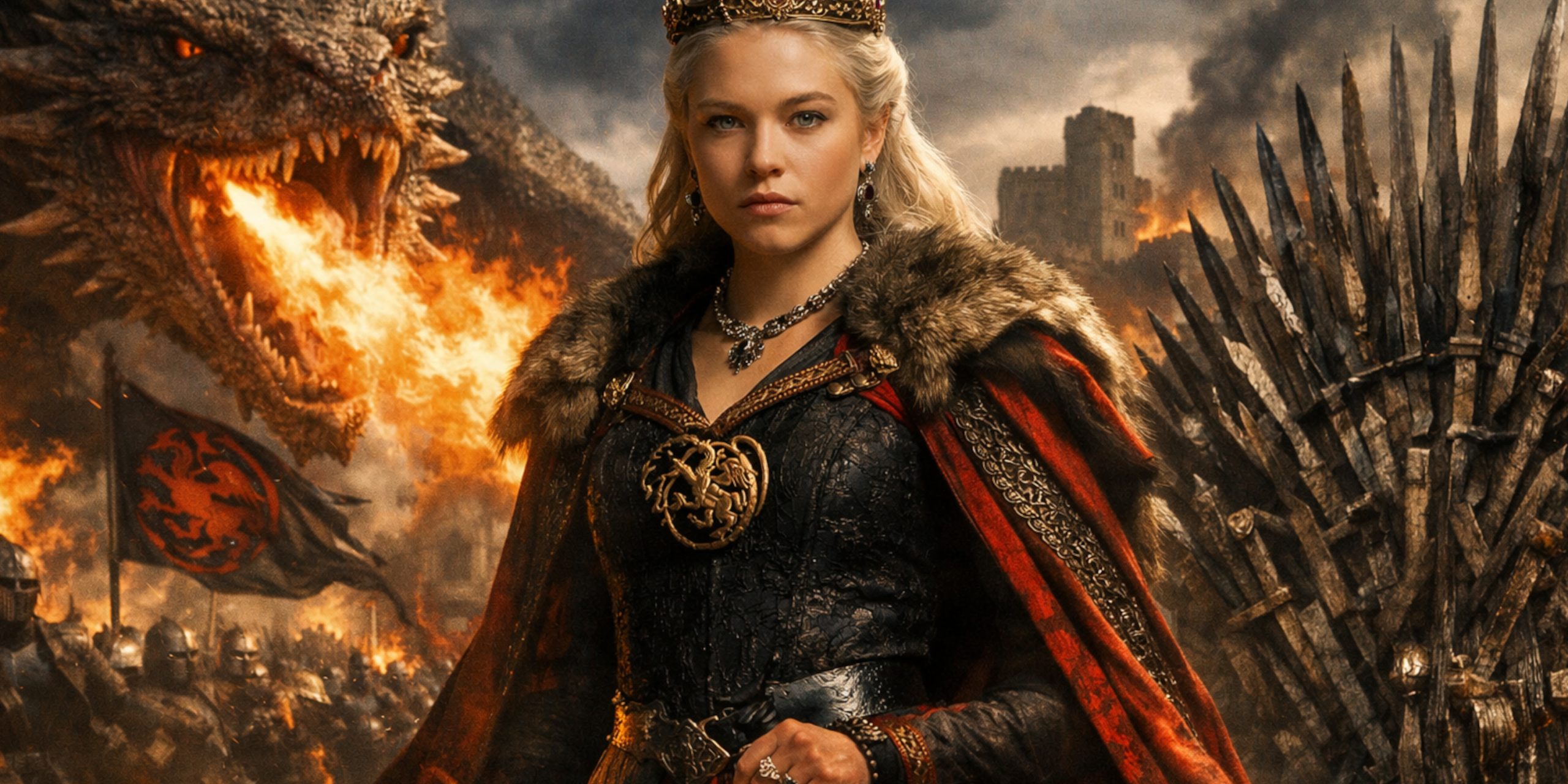
Rhaenyra Targaryen is one of those characters who feels inevitable and impossible at the same time. Named heir, dragonrider, political lightning rod. She grows up believing the crown is hers because her father says so. Westeros spends the rest of her life testing that assumption. Watching her story unfold in House of the Dragon feels less like fantasy escapism and more like a case study in power, memory, and how quickly legitimacy can curdle.
Who Rhaenyra Is on the Page and on Screen
Rhaenyra begins as the Realm’s Delight and ends up something closer to its warning label. She is clever, proud, affectionate, and stubborn in exactly the wrong moments. Her arc is not about becoming ruthless so much as learning how little room the system gives her to remain anything else.
Focus points
- Named heir by Viserys I, publicly and repeatedly
- Dragonrider of Syrax, a symbol of inherited authority
- A mother whose children become political weapons
- A ruler forced to govern while fighting for the right to exist
She is not written as flawless. That is the point. Every misstep is amplified because she is a woman claiming a space designed to eject her.
Power, Perception, and the Gender Trap
Rhaenyra’s greatest enemy is not a rival claimant. It is the story people tell about her. Men who act decisively are strong. Women who do the same are cruel. Men who produce heirs are virile. Women who do are suspect.
You see this tension everywhere
- Her romantic choices are framed as moral failures rather than political risks
- Her anger is treated as proof of unfitness
- Her restraint is read as weakness
The show leans into this without turning her into a saint. She can be petty. She can be harsh. She can also be right. That mix is what makes her compelling and, frankly, uncomfortable.
The Dance of the Dragons as a Character Pressure Cooker
Civil war strips away ceremony. Rhaenyra’s claim survives on paper but collapses in practice once violence begins. Dragons equal power until they equal destruction. Loyalty becomes transactional. Memory becomes propaganda.
Key pressures shaping her rule
- Loss of trusted allies and family members
- Constant doubt over legitimacy, even while crowned
- Governing a capital that never wanted her
By the time she takes the Iron Throne, it feels less like a victory and more like arriving late to a house already on fire.
Historical Inspiration, Empress Matilda and The Anarchy
George R. R. Martin has never hidden the medieval roots of his conflicts. Rhaenyra’s closest historical echo is Empress Matilda, daughter of Henry I of England and central figure in the civil war known as The Anarchy.
The parallels are hard to miss
- Both were named heirs by reigning kings
- Both saw their claims challenged by male relatives
- Both ruled briefly or partially, never securely
- Both were undermined by perception as much as armies
Matilda was never crowned queen, despite effectively ruling at points. History remembered her rival more cleanly. That lingering unfairness sits right at the heart of Rhaenyra’s story.
Dragons as Inheritance, Not Advantage
It is tempting to treat dragons as a cheat code. Rhaenyra’s arc quietly argues the opposite. Dragons escalate conflict faster than they resolve it. They harden opposition. They erase middle ground.
What dragons give her
- Spectacle and fear
- Symbolic legitimacy
What they take away
- Negotiation
- Mercy
- Any illusion that this ends cleanly
Syrax is not just a mount. She is a reminder that inherited power comes with inherited consequences.
Seven Swords Takeaway
Rhaenyra endures because her struggle feels modern. Being first sounds glamorous until you realise you are also the test case. She is judged not only on outcomes but on tone, posture, and palatability. The tragedy is not just that she loses. It is that even winning would never have been enough.
If Westeros had accepted her quietly, she might have been unremarkable. Instead, she becomes unforgettable.