Owain, King of Strathclyde, is one of those rulers who sits in the half-light of early medieval Britain. He appears suddenly in the record, fights in some of the most important conflicts of his age, and then slips back into obscurity. Historians are left picking through chronicles, Welsh poetry and a handful of hard archaeological clues in the hope of finding the man beneath the mist.
He ruled the Kingdom of Strathclyde during the early tenth century, probably from the great fortress of Dumbarton Rock or perhaps from Govan on the River Clyde. This was an age when Britain was fractured into competing kingdoms. Vikings raided and settled, the kings of Alba pushed south, Northumbria lurched between collapse and revival, and the old Brittonic kingdom of Strathclyde stubbornly endured.
Owain’s reign came at a moment when survival itself was an achievement. That Strathclyde remained standing at all says much about the man who ruled it.
Who Was Owain?
Owain, often identified as Owain ap Dyfnwal, was probably king of Strathclyde from around 925 until the mid tenth century. He was the son of Dyfnwal, another ruler of the kingdom. The kingdom itself stretched across what is now south-west Scotland and parts of northern England, centred on the Clyde valley.
Strathclyde was not Scottish in the modern sense. Its ruling elite spoke Cumbric, a Brittonic language closely related to Old Welsh. Its kings looked as much towards Wales and the old British kingdoms as they did towards Alba or Northumbria.
Owain is first securely mentioned in the sources during the reign of the English king Athelstan. In 927, Athelstan summoned the rulers of Britain to acknowledge his overlordship. Among those present was Owain of Strathclyde.
The surviving sources describe him as one of several kings who submitted to Athelstan at Eamont Bridge. It was a humiliating but probably necessary moment. Athelstan was at the height of his power and had recently seized York. Refusing him would have been a quick route to losing both a kingdom and perhaps one’s head.
Still, one suspects Owain agreed through gritted teeth.
The Kingdom He Ruled
Strathclyde was a tougher and more formidable kingdom than its modern reputation suggests. The Clyde basin was rich in farmland and trade. The kingdom controlled routes between the Irish Sea, the western Highlands and northern England.
Its main centres included:
- Dumbarton Rock, the ancient fortress known as Alt Clut
- Govan, which may have become the political centre after Viking attacks on Dumbarton
- Partick and the Clyde crossing points
- The lands around modern Glasgow
- Territory extending south towards Cumbria
By Owain’s day, the kingdom had already survived centuries of pressure from Picts, Angles, Scots and Norse raiders. It had become remarkably adept at making alliances when useful and fighting when necessary.
That skill would be tested repeatedly during Owain’s reign.
Owain and Athelstan
The submission at Eamont Bridge in 927 is the clearest early glimpse of Owain. He appears alongside Constantine II of Alba and other rulers of Britain.
Athelstan demanded that these kings cease alliances with Viking rulers and recognise his supremacy. For a while, Owain appears to have complied. Yet the arrangement did not last.
By the 930s, a coalition had formed against Athelstan. Constantine of Alba, Owain of Strathclyde and the Viking ruler Olaf Guthfrithson joined forces. It was an alliance born of necessity rather than affection. Medieval kings often loathed one another almost as much as they loathed their enemies, but common danger has a way of making even awkward dining companions tolerable.
The Battle of Brunanburh
No discussion of Owain is possible without Brunanburh.
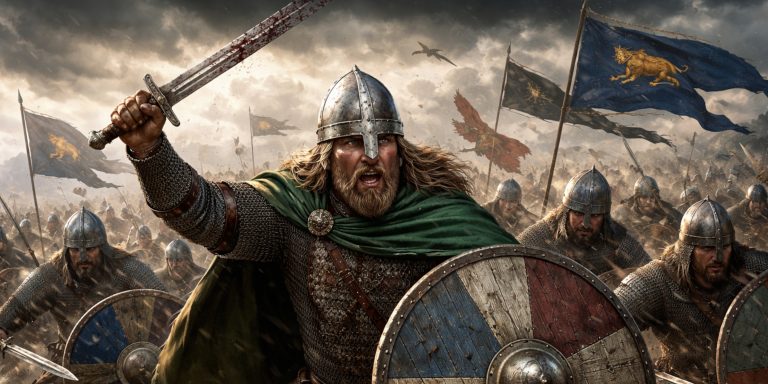
In 937, Owain joined the grand alliance against Athelstan and his brother Edmund. The resulting battle, fought somewhere in northern England, became one of the most decisive engagements in British history.
The coalition included:
- Owain and the men of Strathclyde
- Constantine II and the Scots
- Olaf Guthfrithson and the Norse of Dublin
Against them stood Athelstan and the English army.
The battle was catastrophic for the allies. The Anglo-Saxon Chronicle describes a terrible slaughter. Constantine lost a son. The Norse fled. Owain disappears from the sources soon afterwards, which has led some historians to wonder whether he was killed in the fighting.
Others believe he survived and continued to rule for several years.
What is clear is that Owain was not a passive or secondary figure. He committed the full weight of Strathclyde to the struggle. He gambled everything on breaking English dominance.
He lost.
As a historian, I find Brunanburh endlessly fascinating because it feels like the last great stand of several older Brittonic and northern kingdoms. Owain was fighting not merely for territory but for the continued independence of Strathclyde itself. One can almost imagine him looking across the battlefield and realising, perhaps too late, that the world of his fathers was slipping away.
Battles and Military Acumen
Owain’s reputation rests largely on diplomacy and coalition warfare. He understood that Strathclyde could not survive alone against larger neighbours. His instinct was to build alliances, even unlikely ones.
This was not weakness. It was intelligent statecraft.
Military Strengths
Owain appears to have been:
- A capable political strategist
- Skilled at balancing between England, Alba and Norse powers
- Willing to commit decisively when war came
- Able to draw together different forces under a common cause
The alliance of 937 was ambitious and, for a moment, genuinely dangerous to Athelstan. Had Brunanburh gone differently, the map of Britain might have looked very different.
Owain also inherited a kingdom with strong defensive traditions. Strathclyde’s rulers relied on fortified centres, hillforts and control of rivers and passes. Rather than seeking reckless open battle, they often fought from strong positions.
The great weakness of Owain’s strategy was that he depended on allies whose interests did not always align. Viking rulers wanted plunder and territory. Constantine wanted to protect Alba. Owain wanted to preserve Strathclyde. These aims overlapped only briefly.
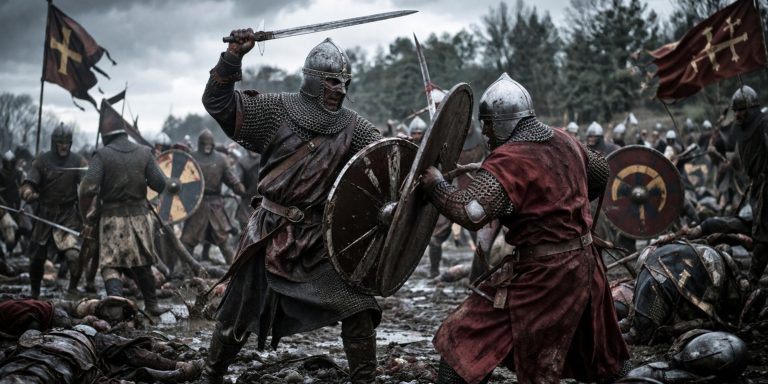
In battle, Strathclyde’s troops were probably experienced infantry supported by a small mounted elite. They were used to rough terrain and fast movement across hills and river valleys. They would have fought with grim determination. Early medieval warfare in Britain was rarely elegant. It was close, brutal and deeply personal.
Arms and Armour
The warriors of Strathclyde in Owain’s reign would have looked broadly similar to other British and Norse forces of the tenth century, though with their own local character.
Weapons
Typical weapons used by Owain’s warriors likely included:
| Weapon | Description |
|---|---|
| Spears | The most common weapon. Cheap, versatile and deadly in formation. |
| Swords | Used by nobles and elite warriors. Likely pattern-welded blades or imported Norse and Anglo-Saxon swords. |
| Seaxes | Long knives or short swords, useful in close fighting. |
| Axes | Increasingly common, especially under Norse influence. |
| Bows | Used for skirmishing and harassment before battle. |
The sword of a Strathclyde noble may have resembled an Anglo-Saxon or Viking blade, with a broad double-edged form and a decorated hilt. Surviving examples from the region suggest high-status warriors valued imported or finely crafted weapons.
Among the likely sword types were:
- Petersen Type H and Type K Viking swords
- Anglo-Saxon style broad-bladed swords
- Locally mounted blades with decorated hilts
A king such as Owain would almost certainly have carried a richly ornamented sword as both weapon and symbol of authority. In early medieval Britain, a king without a sword would have looked rather like a modern politician turning up to Parliament in a dressing gown.
Armour
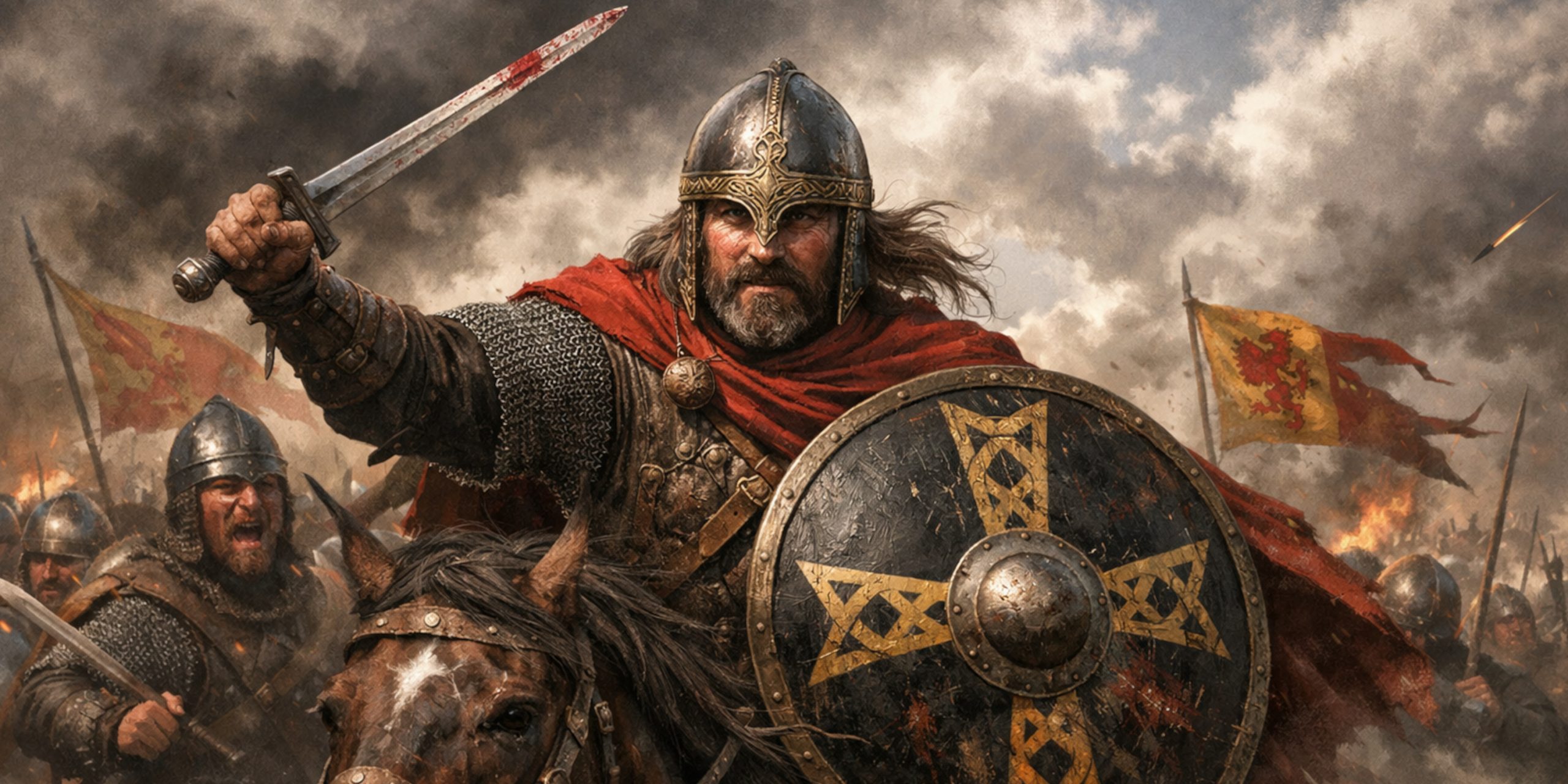
Most warriors probably wore little armour beyond a shield and perhaps a padded tunic. Elite retainers, however, could have possessed:
- Mail shirts
- Iron helmets with nasal guards
- Round wooden shields with iron bosses
- Leather or quilted protective garments
Helmet finds from Britain and Scandinavia suggest that tenth-century helmets were often practical rather than ornate. A wealthy king might own an impressive helm decorated with bronze or silver, though probably nothing as extravagant as later medieval crowns.
The shield remained the essential piece of equipment. Strathclyde warriors almost certainly fought in shield wall formations. Battles were often decided by whichever side could keep its line from collapsing first.
Where to See Artefacts from Owain’s Reign
No object can be securely identified as belonging personally to Owain, which is frustrating but not surprising. Tenth-century kings of Strathclyde left few inscriptions and fewer possessions.
Yet there are several places where artefacts from his world survive.
Govan Stones, Glasgow
The carved stones at Govan are among the most important remains of the Kingdom of Strathclyde.
These include:
- Massive hogback tombs
- Carved cross slabs
- Warrior imagery and interlace designs
- The so-called Govan Sarcophagus
The Govan Stones suggest that Govan was an important royal and ecclesiastical centre during Owain’s lifetime.
The sarcophagus may even have been associated with the royal dynasty of Strathclyde, though historians continue to debate precisely whom it commemorated.
Glasgow Museums Resource Centre
The Glasgow Museums collections hold artefacts from early medieval Strathclyde, including:
- Carved stone fragments
- Weapons from the Clyde region
- Jewellery and decorative metalwork
- Finds from Govan and Dumbarton
These collections help reconstruct the appearance of the kingdom during Owain’s reign.
Dumbarton Rock
Dumbarton Rock itself remains perhaps the most evocative surviving site linked to the kings of Strathclyde.
Although much altered, the fortress still dominates the Clyde. Archaeological finds from the site include:
- Pottery
- Weapon fragments
- Evidence of timber halls
- Imported goods from Ireland and the Continent
Standing atop the rock, one quickly understands why the kings of Strathclyde clung to it for centuries. It is one of those places where geography does half the work of politics.
National Museum of Scotland
The National Museum of Scotland in Edinburgh contains several artefacts from early medieval Scotland and Strathclyde, including weapons, carved stones and jewellery from the tenth century.
Visitors interested in Owain’s world should look especially for:
- Viking and Brittonic swords
- Mail fragments and shield bosses
- Decorative metalwork from western Scotland
- Stone carvings connected with the kingdom of Strathclyde
Latest Archaeological Findings
Recent archaeology has transformed our understanding of Strathclyde.
For much of the twentieth century, historians treated the kingdom as a fading remnant. Excavations now suggest something rather different: a wealthy, organised and resilient state.
Govan as a Royal Centre
Recent work at Govan has strengthened the idea that it became the chief centre of Strathclyde after the Viking sack of Dumbarton in 870.
Archaeologists have found evidence for:
- High-status burials
- Monumental stone sculpture
- Links with Ireland, Scandinavia and Anglo-Saxon England
- A concentration of elite activity in the tenth century
This fits remarkably well with Owain’s reign.
Excavations at Dumbarton Rock
Excavations at Dumbarton have uncovered traces of imported pottery, Mediterranean wine vessels and high-status occupation. These finds suggest that Strathclyde’s rulers were not isolated provincial chiefs but participants in long-distance trade.
One of the more surprising aspects of the evidence is just how cosmopolitan the kingdom appears. A ruler like Owain may have encountered merchants from Ireland, Norse settlers, churchmen from England and perhaps even traders with links stretching back towards the Continent.
New Research on Brunanburh
Archaeological work and fresh study of the sources continue to reshape debate over the location of Brunanburh.
While the battle site remains uncertain, recent scholarship increasingly points towards north-west England, possibly in the Wirral region.
If that is correct, Owain’s forces travelled a considerable distance to join the alliance. This underlines the scale of the conflict and the seriousness of his commitment.
The latest interpretations increasingly view Owain not as a minor ally tagging along behind stronger kings, but as one of the principal architects of the anti-English coalition.
That feels right to me. Strathclyde had too much at stake for its king to be merely an observer.
The End of Owain and His Legacy
After Brunanburh, the sources grow silent. Owain may have died soon after the battle, perhaps even on the field itself. Alternatively, he may have survived into the 940s and been succeeded by another ruler of his line.
Whatever the truth, his reign marks the last great moment when Strathclyde stood as an independent power in Britain.
Within a century, the kingdom would be absorbed into the expanding kingdom of Scotland.
Yet Owain should not be remembered simply as the loser at Brunanburh. He was the ruler of a stubborn and remarkably durable kingdom. He understood the politics of his age, forged dangerous alliances and fought for the independence of his people.
There is something quietly admirable about him. He knew the odds were poor. He fought anyway.
Perhaps that is why he lingers in the imagination long after so many better-documented kings have faded into footnotes.
Further Reading
- The Anglo-Saxon Chronicle
- Annals of Ulster
- Annals of Clonmacnoise
- Alex Woolf, From Pictland to Alba
- Tim Clarkson, Strathclyde and the Anglo-Saxons in the Viking Age
- Leslie Alcock, Kings and Warriors, Craftsmen and Priests in Northern Britain
- Stephen Driscoll, research on Govan and the Kingdom of Strathclyde