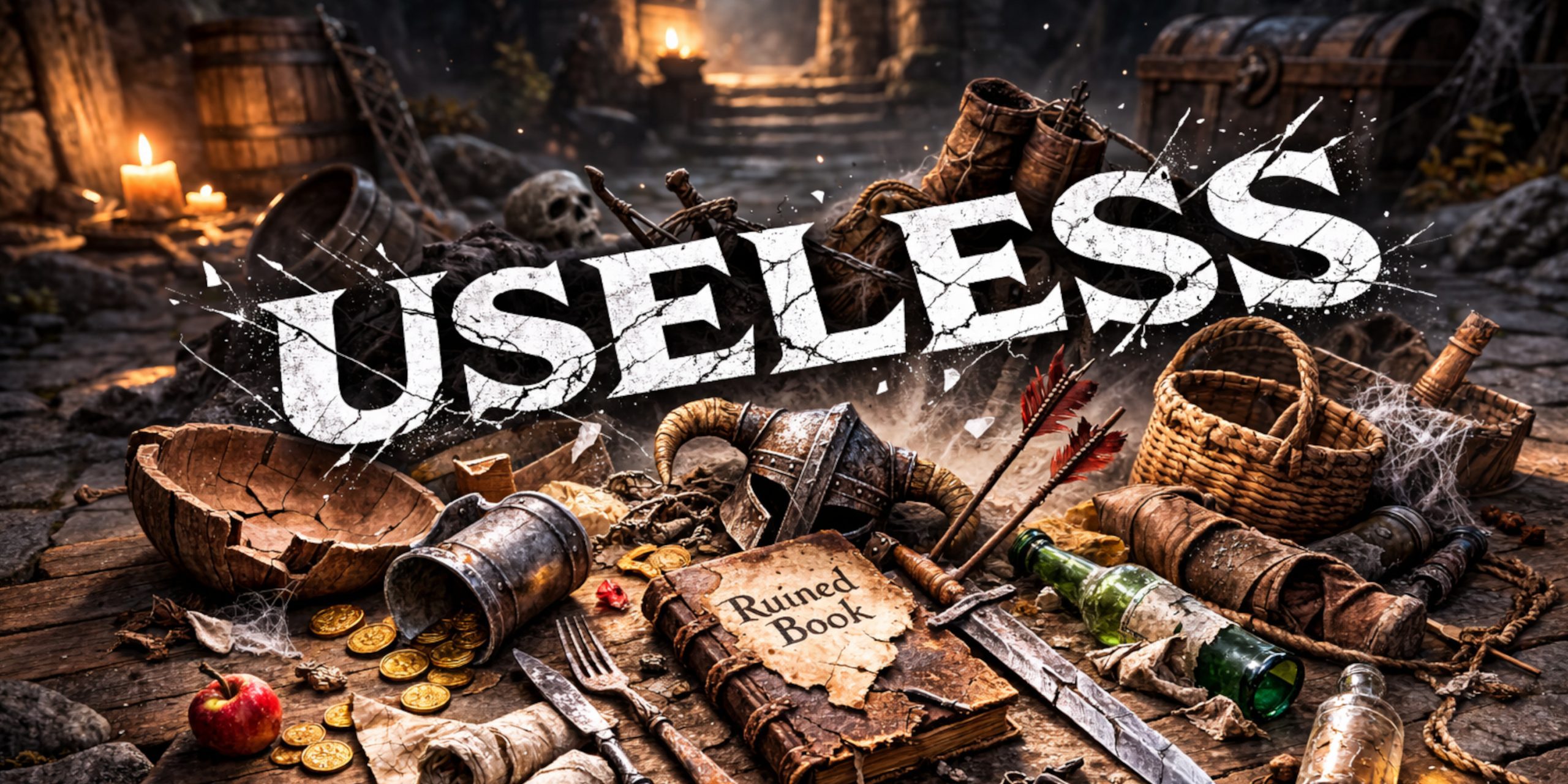
You start a new playthrough of The Elder Scrolls V: Skyrim with good intentions. This time, you say, you will not hoard junk. This time, you will not carry 400 weight units of nonsense into a dungeon.
Then you leave Helgen with three tankards, a wooden bowl, two torches, and something called a “Ruined Book” that you absolutely do not need.
Skyrim is brilliant at making everything look important. Some items are genuinely useful. Others are decorative. And then there are the objects that serve no meaningful purpose beyond cluttering your carry weight and mocking your sense of self control.
Here are the worst offenders.
Ruined Books
They look old. They look mysterious. They feel like they might unlock some hidden quest.
They do not.
Ruined Books cannot be read, cannot be turned into skill books, and cannot meaningfully contribute to crafting. They sell for next to nothing and exist largely to fill shelves in Nordic ruins. The first few times you see them, you think they must matter.
They never do.
If you are roleplaying a scholar, fine. Otherwise, leave them where they belong. On the dusty floor of Bleak Falls Barrow.
Wooden Plates and Bowls
There is something strangely compelling about picking up plates in Skyrim. Maybe it is the physics. Maybe it is the faint hope that you will need them later.
You will not.
Plates, bowls, tankards, and goblets have minimal value and no crafting utility. They add weight, clutter your inventory, and exist mostly for environmental immersion. Yes, you can glitch through walls with them if you are that kind of Dragonborn, but in normal play they are dead weight.
They are set dressing. Treat them that way.
Torches
In theory, torches help you see in dark caves.
In reality, your character can see suspiciously well in total darkness, and most players either crank up brightness or rely on spells like Candlelight. Torches occupy a hand, deal laughable damage, and rarely justify their presence.
By level five, they are obsolete.
You will still pick them up though. Because what if this cave is different.
Baskets and Buckets
If Skyrim had an award for most aggressively pointless item category, baskets would win.
They have almost no value, no crafting role, and no quest relevance. They are not even particularly interesting to look at. They exist purely to make rooms feel lived in.
And yet, early game players grab them. Just in case.
The Worn Imperial Armour from Helgen
You escape execution, loot a corpse, and feel unstoppable in your Worn Imperial gear. It feels earned. It feels dramatic.
Then you realise it cannot be improved.
Worn variants of armour are inferior to their standard counterparts and are largely there to reflect the chaos of Helgen. Once you reach Riverwood, they become vendor trash.
Sentimental value only lasts so long.
Iron Daggers After Level Ten
This one hurts a little.
Iron Daggers are iconic. For many players, they were once the backbone of levelling Smithing. Craft a hundred of them, sell them, repeat.
But after early game, they are almost useless in combat and barely worth the crafting materials. If you are still carrying one at level twenty, ask yourself why.
There are better blades waiting for you in Whiterun.
The Fork and Knife “Weapons”
Yes, you can technically fight with a fork.
No, you should not.
These novelty weapons do negligible damage and exist mostly as a joke. They are funny for about thirty seconds. After that, they are clutter.
Unless you are roleplaying the most committed tavern brawler in Tamriel, leave them on the table.
The Broken Iron Sword
You find one early. It looks tragic. It feels symbolic.
It is also useless.
Broken Iron Swords cannot be repaired into something meaningful and have very limited value. They are environmental storytelling pieces. That is it.
Skyrim is full of implied history. Not every relic needs to live in your backpack.
Linen Wrap
You will see it everywhere in Nordic tombs. It feels like it must be a crafting component.
It is not.
Linen Wrap has no practical crafting use in the base game. It sells for a tiny amount of gold and exists to dress up ancient burial sites.
It is atmospheric. It is not functional.
Empty Skooma Bottles
Skooma itself has a clear effect. The empty bottle, however, is pure clutter.
There is no recycling system, no alchemy bonus, no secret mechanic tied to hoarding empty containers. They just sit there in your inventory if you forget to drop them.
You are not starting a side hustle in bottle returns. Let it go.
Calipers and Tongs
They look like crafting tools. They should matter. They feel like they belong in a forge.
They do not contribute to smithing in any meaningful way. You cannot use them as tools. They are decorative items placed near workstations for immersion.
Skyrim excels at environmental detail. That detail sometimes tricks you into carrying rubbish.
Why Skyrim Makes Useless Items Feel Important
Part of the magic of Skyrim is density. Every room feels inhabited. Every ruin feels layered with history. That means objects exist for atmosphere, not utility.
The world is not built around the player alone. It is built to feel real.
And real places contain junk.
The trick is learning to separate immersion from inventory management. Early on, everything feels like it might unlock a hidden mechanic. After a few playthroughs, you realise most of it is simply there to make Tamriel believable.
Takeaway
Skyrim’s useless items are not design failures. They are world building tools. The frustration comes from us assuming everything must serve a gameplay function.
It does not.
If you are starting a fresh run, try this experiment. Ignore every decorative object. Pick up only what directly benefits your build. Watch how much lighter your character feels.
You will still accidentally grab a wooden bowl. That is part of the experience.
And somehow, despite knowing better, you will still check one Ruined Book. Just in case this time it is different.