The Obsidian Sword That Terrified the Conquistadors
The macuahuitl is one of those weapons that sounds exaggerated until you realise the sources were not trying to be dramatic. This was a wooden sword edged with volcanic glass, capable of slicing muscle, shattering bone, and in some cases decapitating a horse. It sat somewhere between sword, club, and ritual object, and it defined Mesoamerican warfare in a way steel never quite replaced.
What follows is a clearer, deeper look at how the macuahuitl worked, how it was used, and why it still matters.
What Is a Macuahuitl?
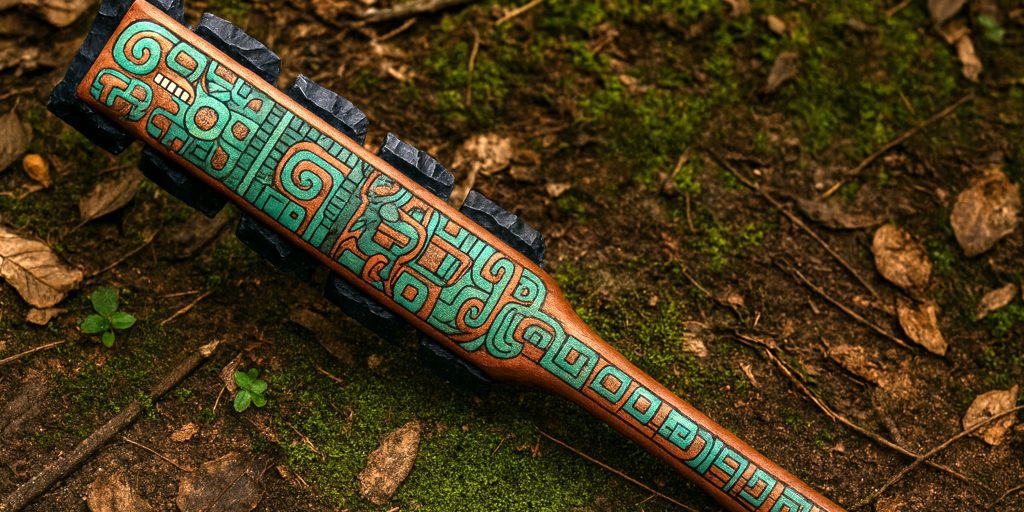
At its core, the macuahuitl was a hardwood blade fitted with razor sharp obsidian blades along one or both edges. Obsidian fractures at a molecular level, creating edges far sharper than steel, though far more brittle.
Rather than stabbing, the macuahuitl was built for cutting and disabling. Its purpose was not always to kill outright but to wound, capture, and dominate the battlefield.
The weapon was used widely across central Mexico, particularly by the Mexica and their allies, and was already mature in design by the time the Spanish arrived.
Construction and Materials

The design was deceptively simple and brutally effective.
The body was usually carved from dense local woods, shaped into a flat paddle or elongated club. Grooves were cut along the edges to seat obsidian blades, which were then fixed in place using natural adhesives such as plant resin or bitumen.
Each obsidian blade was individually knapped and set slightly apart, creating a serrated cutting edge that maximised damage. When a blade shattered, which they often did, it could be replaced rather than requiring a whole new weapon.
This modular approach was clever, practical, and well suited to the resources of the region.
Obsidian and Shark Tooth Variants
Obsidian-Edged Macuahuitl
This was the most common and iconic form. Obsidian blades were incredibly sharp, capable of deep slicing wounds with minimal effort. Spanish chroniclers described limbs nearly severed in a single blow.
The downside was fragility. Against metal armour, obsidian could shatter, reducing effectiveness in prolonged combat.
Shark Tooth Macuahuitl
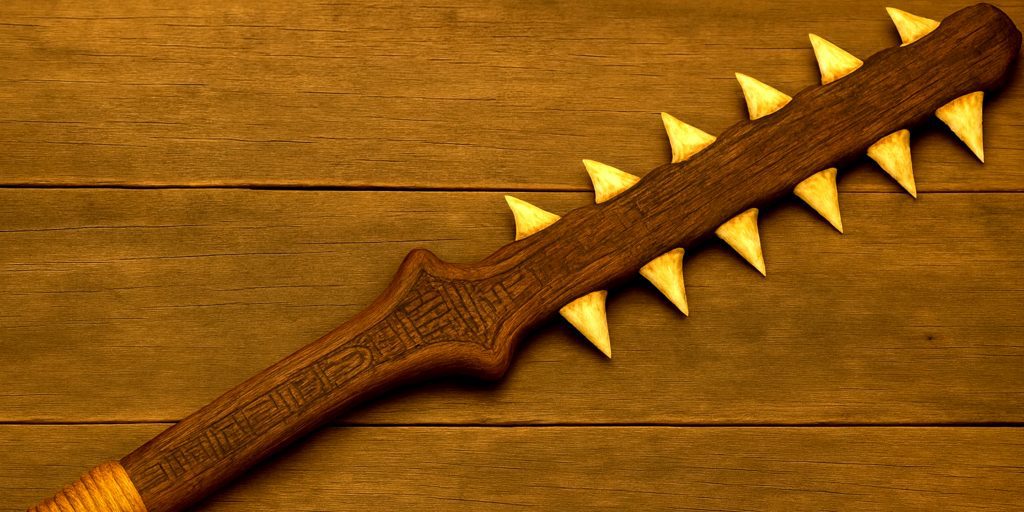
In coastal regions and earlier traditions, shark teeth were sometimes used in place of obsidian. These versions were less sharp but far tougher and better suited to repeated impacts.
Shark tooth macuahuitl likely predate widespread obsidian use and may have remained in ritual or regional contexts where obsidian was scarce.
One-Handed and Two-Handed Macuahuitl
One-Handed Macuahuitl
Shorter and lighter, these were typically used alongside a shield. They offered speed, control, and flexibility in close formations.
One-handed versions were popular among younger warriors or those focused on capturing enemies rather than outright killing.
Two-Handed Macuahuitl
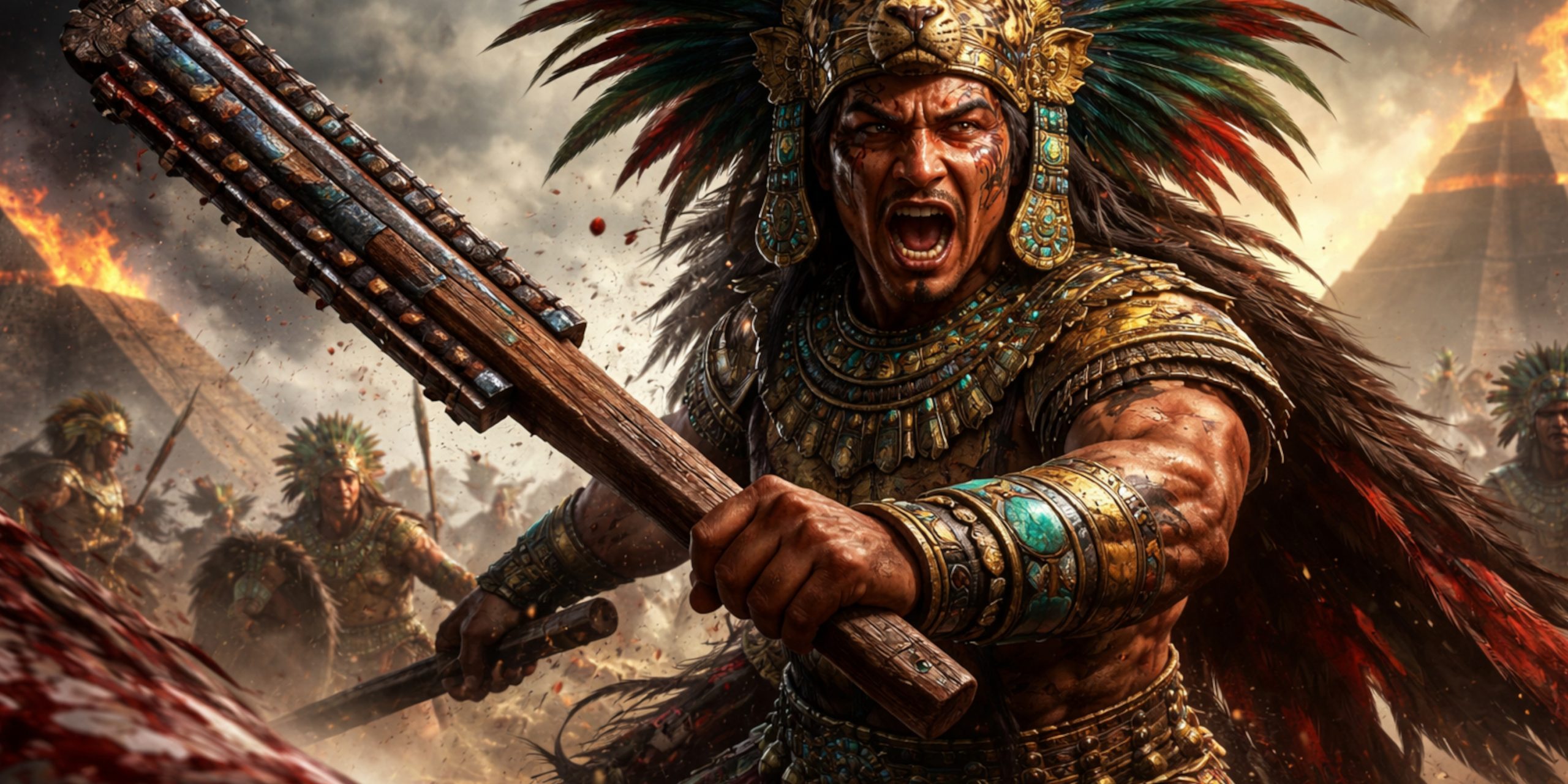
These were the monsters that terrified the Spanish. Longer, heavier, and swung with both hands, they delivered devastating cuts capable of disabling even armoured opponents.
Two-handed macuahuitl required space and strength but dominated open combat and shock assaults.
Specifications
| Feature | Detail |
|---|---|
| Material | Wooden body with obsidian blades |
| Length | Typically 90 to 120 cm |
| Width | Around 6 to 8 cm |
| Weight | Approximately 1.5 to 2.5 kg |
| Blade Material | Obsidian (volcanic glass) |
| Blade Configuration | Single- or double-edged (rarely full edge) |
| Handle | Often wrapped in cloth or fibres for grip |
The blades were glued into carved grooves using plant-based adhesives and could be replaced or resharpened after combat.
History and Evolution
The macuahuitl likely developed from earlier wooden clubs used by the Olmecs and Maya. It reached its most iconic form in Aztec society, where it was used by warriors of all ranks, from commoners to elite jaguar and eagle warriors.
It was not a battlefield anomaly but a refined weapon designed for a particular type of warfare: capturing enemies alive. While it could kill, its purpose often aligned with ritual combat and human sacrifice, favouring incapacitation over death.
Spanish conquistadors described it with astonishment. Bernal Díaz del Castillo recorded how it could decapitate a horse in a single blow, a testimony to its cutting power when wielded with precision.
Advantages and Disadvantages
Advantages:
- Lethal Cutting Power: Obsidian blades are sharper than steel scalpels, enabling deep lacerations.
- Replaceable Blades: Modular design allowed easy repair or upgrading.
- Lightweight: Easier to wield in prolonged engagements than full metal swords.
- Dual Purpose: Served ritual and combat roles, especially in capturing prisoners.
Disadvantages:
- Fragile Edges: Obsidian is brittle and can shatter on hard impact.
- Limited Penetration: Poor against metal armour or shields.
- Weather Sensitive: Wood could warp or degrade in extreme humidity or rain.
- Close-Combat Only: Limited thrusting capability, requiring proximity to the enemy.
How the Macuahuitl Was Used in Battle
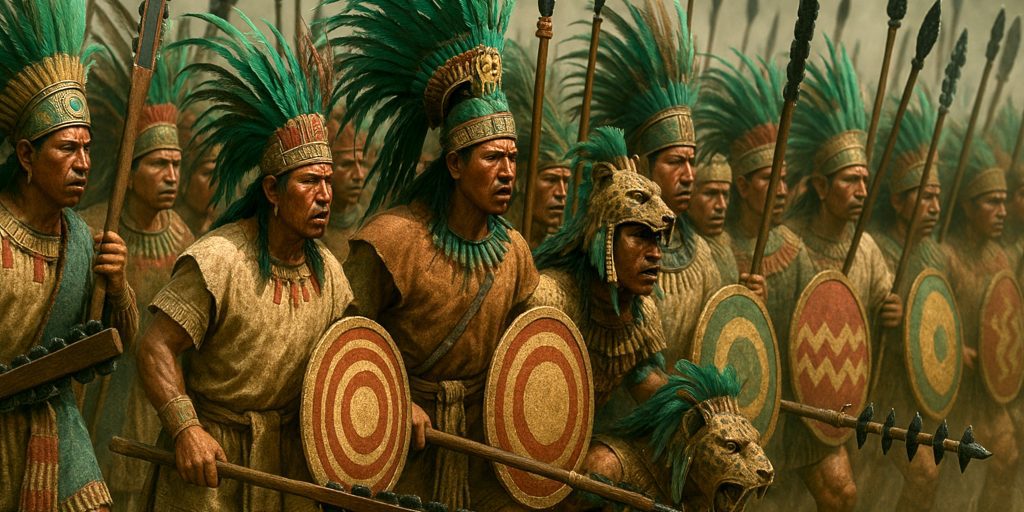
Mesoamerican warfare had different priorities from European warfare. Capturing enemies for ritual sacrifice was often more valuable than killing them outright.
The macuahuitl was perfect for this. Its cutting power could disable arms or legs without immediately killing, allowing warriors to subdue opponents for capture.
Training focused on controlled strikes, footwork, and timing rather than brute force. A skilled warrior knew exactly how much damage to do and when to stop.
Psychological Impact and Spanish Accounts
Spanish chroniclers were clearly shaken by the macuahuitl. Several accounts describe horses being brought down with a single strike, something Europeans did not believe possible without steel.
Bernal Díaz del Castillo famously described wounds so clean they looked surgically cut. To men used to steel blades, obsidian seemed unnatural and frightening.
The weapon also carried enormous psychological weight. Its appearance, sound, and reputation were all part of its power.
Comparison with Similar Weapons
| Weapon | Region | Material | Cutting Edge | Penetration Power | Durability |
|---|---|---|---|---|---|
| Macuahuitl | Mesoamerica | Wood + obsidian | Exceptional | Poor | Moderate |
| Khopesh | Egypt | Bronze | Moderate | Moderate | Good |
| Gladius | Rome | Steel | Good | Excellent | Excellent |
| Chinese Dao | China | Steel | Excellent | Good | Excellent |
| Viking Sword | Scandinavia | Iron/Steel | Good | Excellent | Excellent |
While formidable in its own context, the macuahuitl was highly specialised. It excelled in a ritual-combat environment but would not have fared well against fully armoured foes in Europe or Asia.
Legacy
The macuahuitl has become an enduring symbol of Aztec military culture. It represents the ingenuity of indigenous weapon design and the adaptation of available materials to warfare.
Its image appears in codices, murals, and even modern representations of pre-Columbian history. Though many original examples have decayed, reconstructions based on Spanish accounts and surviving fragments have revived understanding of its construction and use.
Where to See
Authentic or reconstructed macuahuitls can be seen at:
- Museo Nacional de Antropología, Mexico City – Home to some of the most detailed reconstructions.
- British Museum, London – Displays obsidian weapons and Mesoamerican warfare artefacts.
- American Museum of Natural History, New York – Holds Aztec exhibits including weapon replicas.
- Templo Mayor Museum, Mexico City – Displays Aztec war gear in ritual and combat contexts.
Collector’s Guide
Authenticity Note: Very few original macuahuitls have survived due to their organic materials. Most collector items are reconstructions or ceremonial replicas.
Recent Auction Prices (for replicas or ceremonial versions):
- Mid-range ceremonial macuahuitl: £300 to £800
- Museum-grade replica: £1,200 to £2,500
- Artistic reconstructions with rare obsidian: £3,000+
Buying Tips:
- Ensure the obsidian is real and not resin-based imitation.
- Check for traditional adhesives and carving styles if purchasing a replica claiming historical accuracy.
- Look for certified provenance if any claim is made of authenticity.
The macuahuitl is a striking example of how material constraints and cultural priorities shape weapon design. It may not have been forged in fire, but it was crafted with purpose, precision, and power.