A Border War that Became a Test of the New Kingdom
Late in the thirteenth century BC Egypt faced a serious threat from the west. A confederation of Libyan tribes, reinforced by wandering groups from the Mediterranean world, pushed into the Nile Delta with the intention of settling Egyptian land.
The crisis unfolded during the reign of Pharaoh Merneptah, son of the famous Ramesses II. Egypt had endured decades of heavy campaigning in Syria and Canaan. The western frontier, usually quiet, suddenly became the most dangerous border in the kingdom.
The resulting conflict is often called the Libyan Invasion of Egypt. It was less a single battle than a campaign that culminated in a major engagement somewhere in the western Delta. Egyptian inscriptions claim a decisive victory. Whether one believes every number carved in stone is another matter. Pharaohs had a habit of rounding figures in their favour.
Still, the evidence suggests a genuine and significant clash that reshaped Egypt’s relationship with its western neighbours.
Historical Background
By the late New Kingdom period, pressure was building across the Mediterranean. Population movements, drought, trade disruption and political instability pushed many groups to migrate.
The Libyan tribes known to Egyptian records as the Libu and Meshwesh began to organise larger raids into the Delta. These were not merely raiding parties seeking cattle and grain. They travelled with families and possessions, suggesting they intended to settle.
The Libyan leader Meryey assembled a coalition force. Egyptian records claim that foreign warriors from the Aegean and Anatolia joined the army. These groups would later appear again during the famous Sea Peoples crises a few decades later.
Merneptah responded quickly. The Egyptian army mobilised and moved west toward the Delta frontier to confront the invasion before it could spread deeper into the Nile heartland.
Forces
Precise numbers are uncertain. Egyptian inscriptions tend to exaggerate the enemy and understate their own losses. Still, surviving records provide useful estimates.
| Side | Estimated Strength | Composition |
|---|---|---|
| Egyptian New Kingdom Army | 20,000 to 25,000 | Infantry, archers, chariots |
| Libyan Confederation | 10,000 to 15,000 | Tribal infantry, mercenaries, allied Mediterranean warriors |
Egypt possessed a disciplined standing army supported by chariot units and professional archers. The Libyan coalition relied more on mobile tribal warriors supported by foreign fighters equipped with unfamiliar weapons.
The clash therefore represented two different military systems colliding on Egyptian soil.
Leaders
Egyptian Command
| Leader | Role | Notes |
|---|---|---|
| Merneptah | Pharaoh and supreme commander | Directed strategy and propaganda after the victory |
| Egyptian military commanders | Senior officers of the New Kingdom army | Names rarely preserved in surviving inscriptions |
Libyan Confederation
| Leader | Role | Notes |
|---|---|---|
| Meryey | Libyan coalition leader | Organised the invasion force and alliances |
| Various tribal chiefs | Sub-commanders | Represented Libu and Meshwesh tribes |
Egyptian inscriptions describe Meryey as the central figure of the invasion. After the battle he reportedly fled the field, abandoning his camp and family. Egyptian scribes enjoyed recording such details.
Arms and Armour
Egyptian reliefs and texts provide valuable evidence of the weapons used in the conflict.
Egyptian Equipment
Egyptian soldiers in the New Kingdom were well equipped and professionally organised.
Typical arms
- Khopesh sword, curved bronze blade used for slashing
- Straight bronze daggers for close combat
- Composite bows capable of powerful long range fire
- Spears used by infantry formations
Defensive equipment
- Leather or bronze scale armour for elite troops
- Large shields made of wood and leather
- Helmets or padded headgear
Libyan and Allied Equipment
Libyan warriors were lighter and more mobile.
Typical arms
- Straight swords or daggers
- Throwing spears and javelins
- Bows of simpler construction
- Clubs and axes
Foreign warriors from the Mediterranean reportedly carried distinctive equipment including round shields and long swords, unfamiliar to Egyptian soldiers at the time.
Weapon Comparison
| Weapon Type | Egyptian Army | Libyan Coalition |
|---|---|---|
| Primary sword | Khopesh | Straight sword or dagger |
| Missile weapon | Composite bow | Simple bow or javelin |
| Shield style | Rectangular or oval | Round shields |
| Armour | Scale armour for elites | Mostly light protection |
In short, Egypt brought organisation and disciplined archery. The Libyans brought speed and aggressive tribal fighting.
The Battle
The exact location of the main battle remains debated. Most scholars place it somewhere in the western Nile Delta, near the frontier approaches from Libya.
Egyptian inscriptions describe a sudden Egyptian counterattack that caught the invaders while they were establishing camp.
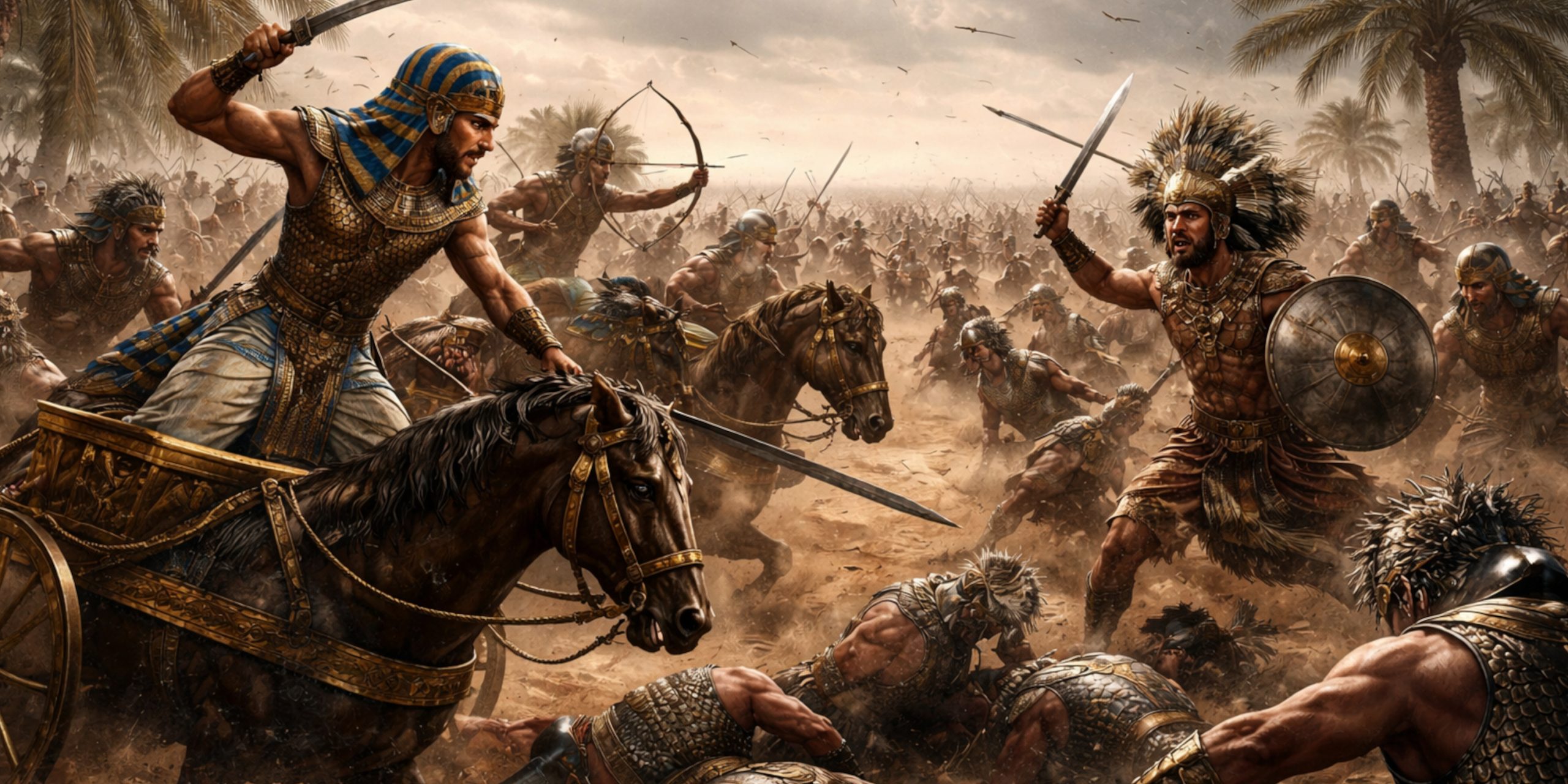
The Libyan coalition appears to have relied heavily on infantry formations supported by allied warriors. Egyptian chariots and archers likely played a decisive role by breaking up the enemy lines before infantry closed in.
Once the Libyan army began to collapse, the Egyptian army pursued and slaughtered the retreating forces. Egyptian records claim thousands were killed and many more captured.
Whether those figures are exaggerated is beside the point. The invasion clearly failed.
Battle Timeline
| Phase | Event |
|---|---|
| Early campaign | Libyan coalition under Meryey crosses into western Delta territory |
| Egyptian mobilisation | Merneptah gathers army and marches west |
| Contact | Egyptian scouts locate the Libyan encampment |
| Main battle | Egyptian chariots and archers disrupt Libyan formations |
| Collapse | Libyan forces retreat after heavy casualties |
| Aftermath | Egyptian troops capture prisoners and equipment |
Egyptian sources claim the Libyans lost over 9,000 men. Ancient rulers had a fondness for impressive statistics, so historians treat this cautiously.
Archaeology
Evidence for the invasion comes primarily from Egyptian monuments.
Karnak Reliefs
Temple inscriptions at Karnak describe the campaign in dramatic detail. These reliefs show Libyan warriors with distinctive hairstyles and feathered decorations.
The imagery also depicts foreign allies, some wearing helmets and carrying round shields. This supports the theory that Mediterranean mercenaries joined the Libyan coalition.
Merneptah Stele
Perhaps the most famous source is the Merneptah Stele, a victory inscription erected by the pharaoh.
It records the defeat of the Libyans and lists the peoples who fought alongside them.
The stele is also famous for another reason. It contains the earliest known written reference to Israel, though only briefly.
Battlefield Evidence
Unlike many later conflicts, archaeologists have not identified a confirmed battlefield site. The Delta landscape has shifted dramatically over the centuries, burying or erasing many ancient locations.
Even so, inscriptions provide a surprisingly detailed picture of the campaign.
Contemporary Quotes
Egyptian inscriptions present the victory in typical royal style.
From the Merneptah inscriptions at Karnak
The wretched chief of Libya has fled in the dead of night, alone and barefoot.
Another inscription celebrates the destruction of the invading army.
Their chiefs lie prostrate, saying peace. None lifts his head among the Nine Bows.
Such statements reflect Egyptian propaganda, but they also reveal how seriously the invasion was taken.
Aftermath and Legacy
Merneptah’s victory temporarily secured Egypt’s western frontier. The Libyan tribes were driven back and many prisoners were taken.
Yet the problem did not disappear. Over the following centuries Libyan groups gradually settled within Egyptian territory. Eventually they would even produce dynasties of pharaohs.
History has a sense of humour. The people Egypt defeated in battle later ruled the country.
The invasion also foreshadowed the wider turmoil of the Late Bronze Age collapse. Migrations and raids from the Mediterranean world would soon intensify, culminating in the famous Sea Peoples wars during the reign of Ramesses III.
From that perspective the Libyan invasion looks like an early warning shot.
A Historian’s Takeaway
The Libyan invasion is easy to overlook beside grander campaigns in Syria or the later Sea Peoples crisis. Yet it reveals something important about Egypt’s world at the end of the Bronze Age.
Borders that had seemed stable for centuries were beginning to shift. Tribes moved, alliances formed, and whole populations began searching for land.
Merneptah’s victory bought Egypt time. Not permanent security, just time. In the ancient world that was often the best outcome anyone could hope for.
And if the Egyptian scribes exaggerated the numbers a little, one can hardly blame them. After all, if you are carving your victory into stone for eternity, you might as well make it sound impressive.