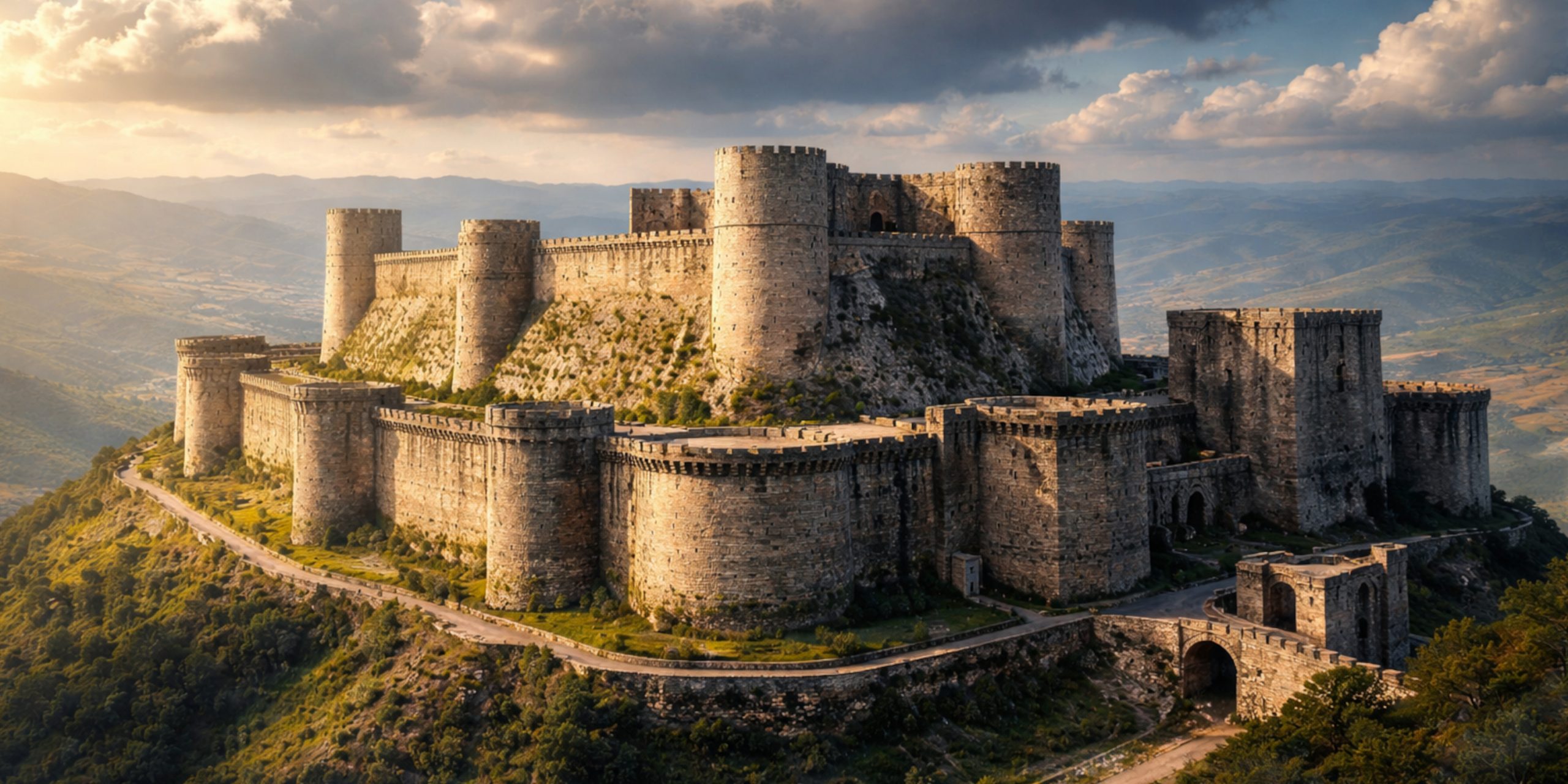
Few castles command the landscape quite like Krak des Chevaliers. Perched on a ridge overlooking the Homs Gap in western Syria, it dominates the route between the coast and the interior. As a historian, I find it hard not to admire the sheer audacity of it. This was not simply a fortress. It was a statement in stone.
Today it stands as one of the most complete and imposing Crusader castles in the world, a monument to medieval military engineering and the shifting tides of the eastern Mediterranean.
Location and Strategic Importance
Krak des Chevaliers sits near the modern town of Al-Husn, west of Homs. The site overlooks the Homs Gap, a natural corridor linking the Mediterranean coast with inland Syria. Whoever controlled this ridge could monitor, tax and if necessary choke off movement between key cities.
This strategic position explains everything about the castle’s history. It was never decorative. It was built to control, to intimidate and to endure.
Early History
The site was first fortified by Kurdish troops in the service of the Seljuks in the early eleventh century. In 1099, during the First Crusade, it was briefly occupied by Crusader forces but not yet transformed.
Its true chapter began in 1142 when Raymond II, Count of Tripoli, granted the fortress to the Knights Hospitaller, formally known as the Order of the Hospital of Saint John of Jerusalem. Under their stewardship, the site evolved from a stronghold into one of the most formidable castles in the Levant.
The Hospitallers rebuilt and expanded the structure after a devastating earthquake in 1170, creating the concentric design that defines it today.
Architecture and Design
Krak des Chevaliers is often described as the textbook example of a concentric castle. The design features:
- An outer curtain wall with massive towers
- A steep glacis that forces attackers uphill
- A powerful inner ward protected by its own walls and towers
- A vaulted Gothic hall within the inner enclosure
- Extensive storage, stables and water cisterns
The genius of the design lies in depth. If an enemy breached the outer wall, they faced a second defensive ring, higher and stronger. Every approach was exposed to missile fire. Every gate was angled to prevent a direct rush.
Walking through its passageways, one senses the calculation behind every stone. It feels less like architecture and more like a carefully laid trap.
Sieges of Krak des Chevaliers
Despite its reputation, Krak des Chevaliers was not invincible. It simply made conquest painfully expensive.
Siege of 1188
In 1188, the great Ayyubid ruler Saladin advanced through the region after his victory at Hattin. He captured many Crusader strongholds but did not take Krak. Its defences were too formidable, and he chose not to commit to a prolonged siege.
That decision alone tells us something about the castle’s strength.
Siege of 1271
The decisive moment came in 1271, when the Mamluk Sultan Baibars laid siege to the fortress.
Baibars employed siege engines and sustained bombardment. The outer ward eventually fell. The defenders withdrew into the inner fortress. According to Arabic sources, Baibars then used a forged letter, supposedly from the Hospitaller Grand Master, urging surrender.
Whether deception or exhaustion proved decisive, the garrison capitulated. After nearly 130 years under the Hospitallers, the castle passed into Mamluk hands.
Contemporary chronicler Ibn Shaddad wrote admiringly of Baibars’ campaigns, describing the capture of strongholds with method and resolve. From the Latin side, William of Tyre earlier reflected on the formidable nature of Crusader fortifications, noting that such castles were designed “to strike terror into the enemy and security into our own men.”
Occupants Timeline
Seljuk and Kurdish garrison
Early eleventh century, fortified by local Muslim forces controlling the region.
Crusader occupation
1099, briefly held during the First Crusade.
Knights Hospitaller
1142 to 1271, major expansion and transformation into a concentric fortress.
Mamluk control
1271 onward, modifications including additional towers and adjustments to the defences.
Ottoman period
Integrated into regional administration, with gradual decline in military importance.
Modern era
Under French Mandate in the twentieth century, restoration efforts began. It is now a UNESCO World Heritage Site.
Life Inside the Castle
At its height, Krak des Chevaliers could house perhaps two thousand people, including knights, sergeants, servants and local dependants. It was effectively a fortified community.
There were chapels, granaries, storerooms and vast cisterns to sustain long sieges. The great hall, with its ribbed vaulting, reflects Gothic influences imported from Europe and adapted to Levantine realities.
One imagines the daily rhythm of prayer, patrol and preparation. It was a religious house, a military base and a regional power centre rolled into one.
Archaeology and Modern Study
Archaeological work began in earnest during the French Mandate period in the 1920s and 1930s. French scholars cleared accumulated debris, stabilised walls and documented architectural phases.
Excavations revealed:
- Storage facilities indicating long term provisioning
- Water systems designed for extended resistance
- Masonry techniques blending European and local traditions
- Evidence of Mamluk modifications after 1271
Damage during the Syrian conflict in the early twenty first century raised global concern. Subsequent assessments showed structural harm but not catastrophic collapse. Restoration efforts have aimed to preserve the integrity of the monument while respecting its layered history.
As historians, we rely not only on chronicles but on mortar, tool marks and collapsed vaults. Stone often speaks more honestly than propaganda.
Cultural and Historical Legacy
Krak des Chevaliers has become emblematic of the Crusader presence in the Levant. It features in military history textbooks as a prime example of medieval defensive theory realised in stone.
Yet it also represents something more complex. It was a frontier institution, built by a European religious order on Syrian soil, later adapted by Muslim rulers, and now part of Syrian heritage.
Its identity has shifted across centuries. The stones have not moved. The meaning attached to them has.
Takeaway
Krak des Chevaliers endures because it was built with ruthless clarity of purpose. It controlled a vital corridor, embodied military innovation and served as a symbol of Hospitaller power.
Standing on its ramparts, you can see why men fought for it. The landscape stretches wide and open. The wind carries the weight of centuries.
For a historian, it is difficult not to feel a certain respect for the engineers who conceived it and the soldiers who trusted their lives to it. It is, quite simply, one of the greatest fortresses ever built.