Few figures of the fifteenth century embodied the collision of East and West quite like John Hunyadi. Born into the shifting frontier of Hungary’s noble class, Hunyadi rose from relative obscurity to become the kingdom’s most formidable soldier, diplomat, and statesman. He was both the defender of Christendom and the nightmare of the Ottomans. To his contemporaries he was “the White Knight of Wallachia,” and to his enemies, a man whose presence alone could decide a siege.
From the 1430s until his death in 1456, Hunyadi was the backbone of Hungary’s defence and one of the few commanders to consistently hold the line against Ottoman expansion. His victories, particularly at Belgrade, would echo through Europe as symbols of defiance against seemingly unstoppable power.
Arms and Armour
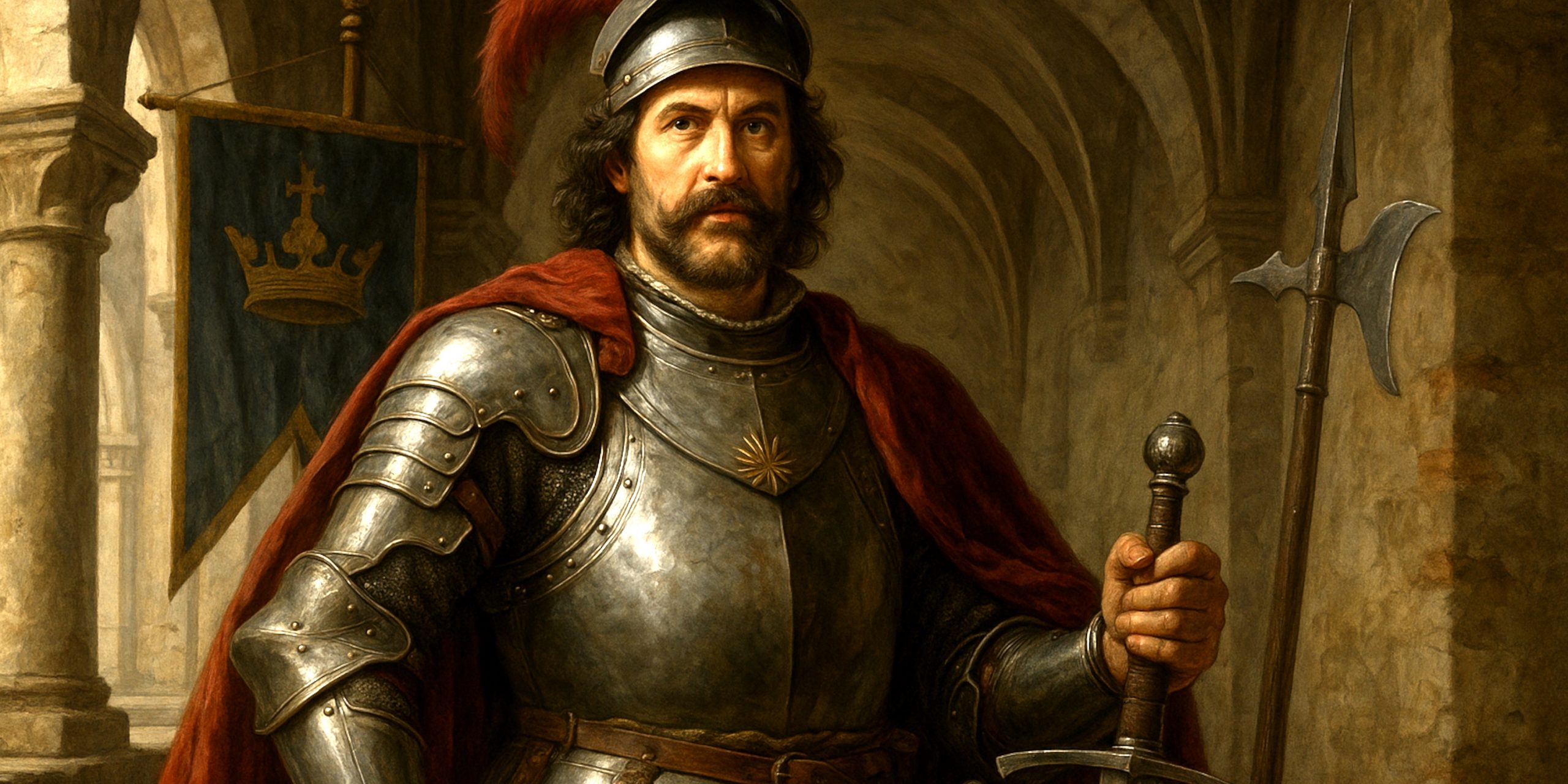
John Hunyadi’s equipment reflected both his station and his frontier environment. He stood at the crossroads of Western chivalric and Eastern martial traditions.
Armour:
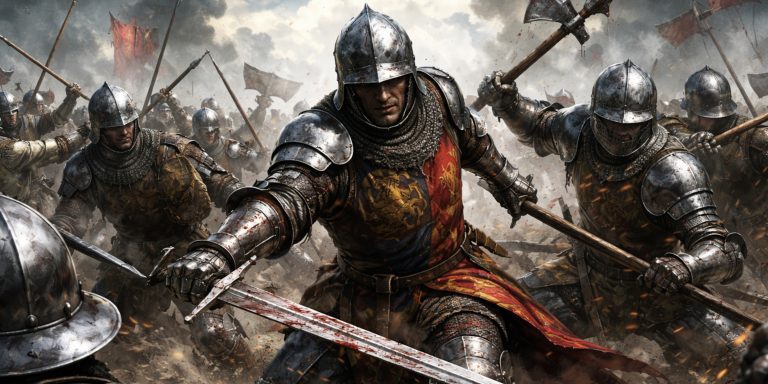
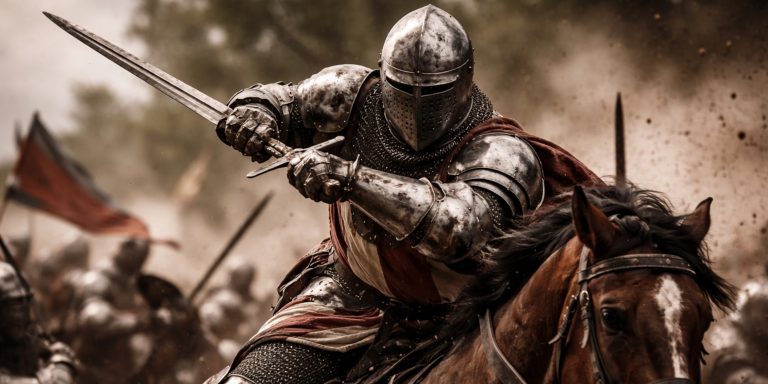
- Plate armour became the dominant form of protection in Central Europe during Hunyadi’s lifetime, and his suits likely followed the Gothic Hungarian style. These featured fluted breastplates, pointed sabatons, and ridged gauntlets designed to deflect blows.
- Contemporary accounts and illustrations suggest Hunyadi often wore a mix of Western plate and lighter Balkan mail, adapting to campaign conditions.
- His helms would have included both the armet and sallet, the latter offering superior visibility during mounted engagements.
Weapons:
- Sword: Hunyadi’s preferred sidearm would have been a Hungarian longsword, broad-bladed and slightly curved toward the tip, suitable for both cut and thrust.
- Polearms: As a commander in siege and field engagements, he made effective use of halberds and bardiches among his infantry, weapons ideal for countering Ottoman cavalry.
- Firearms and Artillery: Hunyadi embraced gunpowder weapons earlier than many of his peers. At Belgrade in 1456, Hungarian bombards and handheld guns were decisive in breaking Ottoman formations.
If anything, his approach to arms was pragmatic rather than symbolic. He wore splendour when diplomacy required it, but on campaign his kit reflected a man who expected to be in the thick of it.
Battles and Campaigns
Hunyadi’s military career is a catalogue of defensive brilliance and occasional overreach. Yet even his defeats often strengthened Hungary’s strategic position.
Key Engagements:
| Year | Battle | Outcome | Notes |
|---|---|---|---|
| 1441 | Battle of Semendria | Victory | Defeated Ottoman forces near the Danube, solidifying Hungarian control of southern fortresses. |
| 1442 | Battle of Hermannstadt | Victory | Crushed Ottoman troops under Mezid Bey in Transylvania, restoring regional morale. |
| 1443–44 | Long Campaign | Partial Success | A deep incursion into the Balkans reaching Sofia. Forced Ottoman retreat but stretched Hungarian logistics. |
| 1444 | Battle of Varna | Defeat | A disastrous Crusader defeat following Władysław III’s death. Hunyadi fought bravely but was forced to retreat. |
| 1448 | Second Battle of Kosovo | Defeat | A failed attempt to break Ottoman power in the Balkans. Hunyadi’s army was outnumbered and betrayed by regional allies. |
| 1456 | Siege of Belgrade | Victory | Hunyadi’s crowning triumph. His forces, reinforced by peasants and crusaders led by Giovanni da Capistrano, repelled Sultan Mehmed II’s siege. |
At Belgrade, the sight of Hunyadi’s banner inspired what might be called medieval morale engineering. As cannon smoke rose over the Danube, he launched a counterattack that caught the Ottomans mid-redeployment. It was one of the rare instances where an Ottoman field army under Mehmed the Conqueror was completely broken.
Hunyadi died soon after the victory, likely of plague, but his final campaign cemented him as one of Europe’s great captains.
Military Acumen
Hunyadi combined Western discipline with frontier adaptability. He understood that warfare on the Hungarian plain required mobility, flexible command, and intelligence gathering. His genius lay not only in battle tactics but in logistics and morale.
- Tactical Innovation: He favoured combined arms tactics, integrating heavy cavalry charges with disciplined infantry and artillery.
- Defensive Engineering: His reinforcement of fortifications along the southern Danube frontier created what was, in essence, a buffer zone for Christian Europe.
- Psychological Warfare: Hunyadi cultivated an image of invincibility, riding at the front of his troops, his armour gleaming, his banners visible to friend and foe alike.
- Coalition Building: He managed, through sheer force of will, to unite fractious Hungarian nobles and foreign volunteers under a single banner, at least for the duration of his campaigns.
A Venetian diplomat once wrote that “Hunyadi commands not with words, but with example.” It is a rare compliment from a republic that preferred cunning to courage.
Artefacts and Archaeology
The tangible remains of Hunyadi’s world are scattered across Central and Eastern Europe.
- Corvin Castle (Hunedoara, Romania): Often called Hunyadi Castle, this Gothic-Renaissance fortress was his residence. The structure, restored multiple times, still houses arms and decorative fragments from his era.
- Matthias Corvinus’s Treasury: Though most artefacts from Hunyadi’s family were dispersed or looted, a few ceremonial swords and armour pieces attributed to his lineage survive in the Hungarian National Museum.
- Belgrade Fortress: Archaeological surveys have uncovered fragments of cannonballs and siegeworks associated with the 1456 siege. The walls still bear repair traces dated to Hunyadi’s defence.
- Sibiu and Alba Iulia Sites: Excavations in Transylvania continue to reveal armour fragments and coin hoards from his campaigns. Some show evidence of Ottoman minting, captured as spoils of war.
The most evocative discovery, however, is intangible: the tolling of church bells at noon, a custom introduced by Pope Callixtus III to commemorate Hunyadi’s victory at Belgrade. It persists, quietly linking the modern world to the hour the Turks were turned back.
Legacy
John Hunyadi’s legacy straddles myth and history. To Hungarians, he is a national hero. To Romanians, a symbol of Transylvanian resilience. To European historians, he is the hinge upon which the late medieval frontier turned. His son, Matthias Corvinus, would go on to become one of Hungary’s most enlightened monarchs, building on the foundation his father laid in war.
In military terms, Hunyadi’s campaigns slowed Ottoman advance for half a century, buying time for Europe to adapt to the new gunpowder age. His command style bridged the chivalric past and the emerging age of disciplined infantry and artillery warfare.
As a historian, one cannot help but admire his contradictions. A crusader who understood pragmatism better than dogma. A nobleman who fought beside peasants. A general who died not on the field, but from the pestilence that followed victory. He remains, in every sense, the frontier personified.
Where to See Hunyadi’s World Today
- Corvin Castle (Hunedoara, Romania): Walk the halls where he planned campaigns.
- Hungarian National Museum (Budapest): Displays medieval armour and ceremonial weapons attributed to the Hunyadi family.
- Belgrade Fortress (Serbia): Offers reconstructed siege exhibits and archaeological displays from 1456.
- Museum of Transylvanian History (Cluj-Napoca): Features coinage, banners, and heraldic items from the Hunyadi period.
Latest Archaeological Findings
In recent years, ground-penetrating radar and metallurgical surveys near Hunedoara have revealed substructures beneath Corvin Castle’s courtyard, possibly linked to Hunyadi’s original fortifications. Meanwhile, digs at Belgrade have identified Ottoman cannon fragments consistent with Mehmed II’s siege ordnance. These findings underscore the scale of Hunyadi’s last victory and the technological transition of mid-fifteenth century warfare.
Watch the documentary: