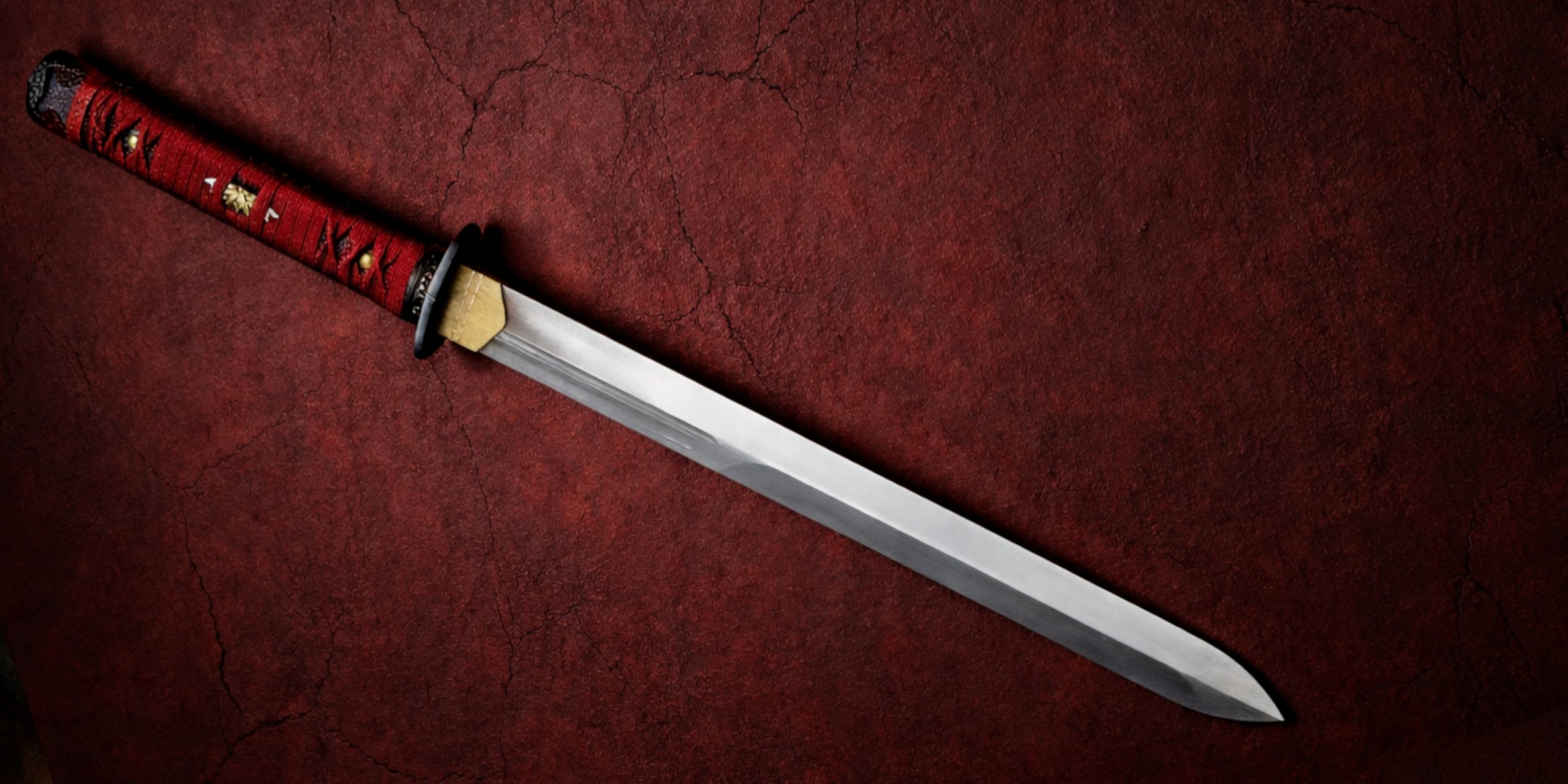
The Japanese ken is one of the oldest sword forms associated with Japan, and also one of the most misunderstood. Straight bladed, double edged, and visually closer to early continental swords than later katana, the ken occupies an unusual space between weapon, ritual object, and symbol. While it could be used in combat, its deeper importance lies in religion, court culture, and early state formation. To understand the ken is to look at Japan before the samurai ideal fully formed.
Specifications
The ken varies considerably by period and purpose, but most examples follow a recognisable pattern.
Typical characteristics
- Blade: straight, double edged
- Length: 30 to 70 cm, ceremonial examples may be longer
- Cross section: diamond or flattened diamond
- Tang: narrow, often with early rivet fixing
- Guard: minimal or absent on early examples
- Point: symmetrical, sharply tapered
| Feature | Typical Range |
|---|---|
| Overall length | 40 to 80 cm |
| Blade profile | Straight |
| Edge count | Double edged |
| Construction | Forged steel or iron |
| Primary use | Ritual, ceremonial, limited combat |
History and Evolution
The ken entered Japan during the Kofun period, heavily influenced by Chinese and Korean straight swords. Early Japanese states imported weapons directly, then began local production as metallurgy improved.
By the Asuka and Nara periods, the ken had taken on a clear religious role. It appears in Buddhist iconography, temple offerings, and court ritual. Many surviving examples were never meant for battle and were produced as votive objects.
As curved single edged swords developed, first the chokuto and later tachi forms, the ken faded from military relevance. By the Heian period it was largely symbolic, preserved through religion rather than warfare.
Advantages and Disadvantages
The ken reflects an earlier philosophy of sword use and carries both strengths and limitations.
Advantages
- Effective thrusting capability due to straight profile
- Double edges allow versatile cutting angles
- Strong symbolic authority in ritual contexts
- Easier edge alignment for formalised movements
Disadvantages
- Less efficient cutting than curved blades
- Inferior draw cuts compared to tachi or katana
- Reduced battlefield relevance as armour evolved
- Lacked hand protection on early forms
Comparison With Similar Weapons
The ken belongs to a wider family of early straight swords found across East Asia and beyond.
| Weapon | Origin | Key Difference |
|---|---|---|
| Chinese jian | China | More refined guards and grips |
| Korean geom | Korea | Transitional designs with ritual use |
| Japanese chokuto | Japan | Single edged evolution from ken |
| Roman spatha | Roman Empire | Longer, military focused blade |
The Japanese ken stands out for how completely it shifted from weapon to sacred object, a path not shared by most of its continental counterparts.
Legacy and Cultural Meaning
Today the ken survives primarily through religion and symbolism. It is closely associated with Buddhist guardian deities, especially Fudo Myoo, and appears in temple statuary and ritual art. In Shinto contexts it represents purity, authority, and divine protection.
Rather than being remembered as a battlefield weapon, the ken became a bridge between imported technology and Japan’s emerging spiritual identity. In many ways it is Japan’s first sword, but not its most martial one.
Where to See Authentic Ken Swords
Notable examples are preserved in major museum and religious collections.
- Tokyo National Museum, early iron and steel ken from burial contexts
- Kyoto National Museum, Buddhist ritual swords
- Temple treasuries across Nara and Kyoto, often not publicly displayed
- University collections specialising in Kofun and Asuka archaeology
Viewing a ken in person highlights how different it feels from later Japanese swords, lighter, narrower, and more formal in presence.
Collector’s Guide and Auction Prices
Original ken swords are rare and usually tied to archaeological or religious provenance.
What collectors look for
- Clear early forging characteristics
- Provenance from temple or excavation records
- Minimal later modification
- Documented age and context
Typical market values
| Condition | Estimated Price |
|---|---|
| Fragmentary archaeological examples | £3,000 to £8,000 |
| Complete early ken with documentation | £12,000 to £30,000 |
| Temple provenance ceremonial ken | £40,000+ |
Most private collectors encounter ken through museum loans or academic study rather than ownership. Replicas, however, are increasingly popular for educational collections and martial history displays.